
Safe Beach Solo Trips: From Sand Holes to Dry Bags
Zippered swimwear, key copies without remotes, and €20 cash form the essential kit for solo beachgoers to avoid theft.
English · Original discussion in Spanish · Published
Safe Beach Solo Trips: From Sand Holes to Dry Bags
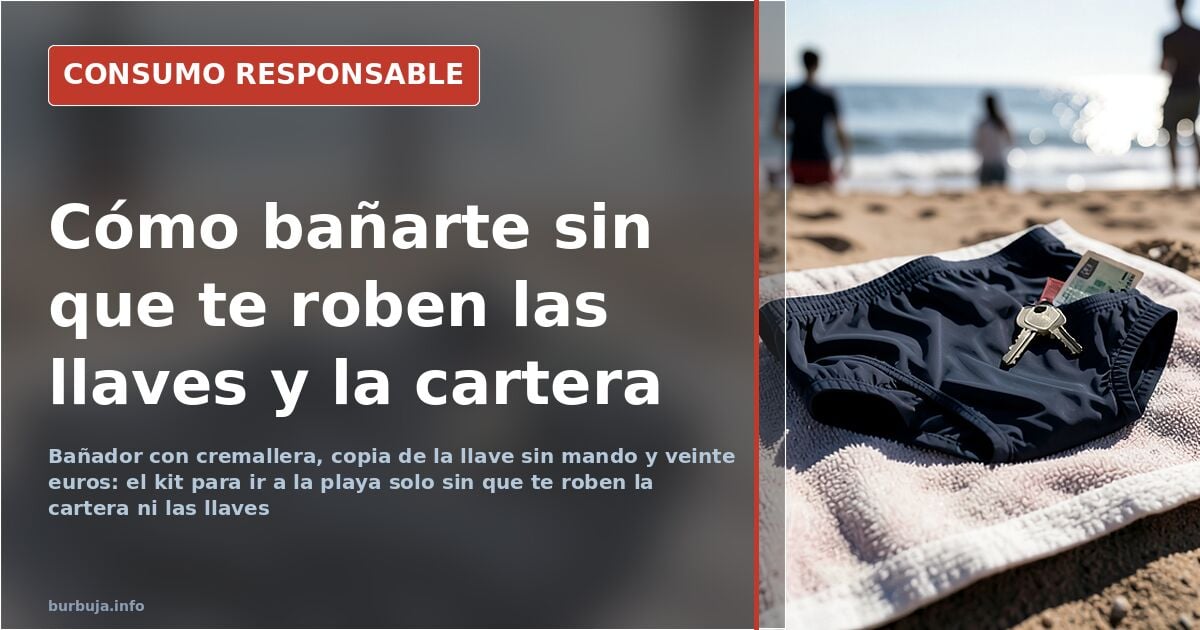
A swimsuit with a zippered pocket, a car key copy without the remote, twenty euros in cash, and a photocopy of your ID. This is the survival kit that recurs when discussing how to go to the beach alone via commuter train, leaving belongings behind while swimming. The initial question is simple yet uncomfortable: where do you leave your keys and wallet when no one is there to watch them?
The conversation starts with the dilemma of those without cars who rely on public transport. Here, the obvious solution—leaving everything in the trunk—is discarded, narrowing options to what can be carried. What trinc is an inventory of home tricks, some clever, others precarious.
Sand holes and towel camouflage
The most repeated technique involves digging a hole in the sand, placing the bag with wallet and keys inside, leaving a handle visible, and covering it with a towel. It looks invisible, and practitioners claim years of safety. The logic targets opportunistic thieves: **they steal from carelessness**, not by digging in front of a crowded beach.
Some refine this by wrapping keys in a sock before burying them. Others prefer not to bury anything, just making space so the towel doesn't bulge. The variant of locking a backpack to an umbrella pole aims at the same principle: **adding enough difficulty** so thieves seek easier targets.
What to actually take: the minimal wallet
The strongest consensus isn't about hiding items, but what to carry. Leave out debit, credit, membership, and work cards. **At most, keep the driver's license and ID**, or neither if you aren't driving. Money should be limited; some cap it at 25 euros so theft hurts less.
The underlying idea is that potential loot is too meager to justify risk. Several note that thieves want cash and easily pawnable items, not utilitarian car keys or PIN-protected cards. Calculating what can be lost versus what cannot is more complex than it seems.
Car keys: getting wet is expensive
For drivers, the issue shifts to keys. Those with remotes contain chips, and **if they get wet, you need a tow truck**. Hence, many suggest getting a mechanical key copy without electronics, which only opens doors, and leaving the main key in the vehicle. It can get wet without drama, though the engine won't start.
Another option is the inner pocket of a swimsuit with velcro or zipper, or wearing the key around the neck. A precaution costs nothing: have a spare house key with a neighbor or relative in case windows are broken while swimming.
Dry bags and unviable businesses
The technological solution appears last: certified waterproof cases worn on the arm for keys while swimming. It's the most cited answer, though some warn **the gadget outweighs the need**. Lockers are mentioned skeptically: users still carry keys, and antiestéticars exist about copying after rental.
Ideas for first-line locker businesses surface, but the response is standard: **municipal fees would eat the margin**. Meanwhile, sand holes, key copies, and loose change still work. No better method has been found.
Also available in: Deutsch
Summary of a discussion on Burbuja.info - Foro de economía, actualidad y política., translated from Spanish and reviewed before publication. Read the full discussion (80 replies).
More summaries
-
Spain's DGT to mandate course for B-license 125cc riders
Spain's traffic authority will require a mandatory course for driving 125cc motorcycles with a B license, leaving retroactivity unclear.
-
Madrid Driving License Costs €1,500 More Than Cuenca
Traffic examiners strike over failure rates as Madrid licenses cost up to €1,500 more than in Cuenca, with some seeking foreign permits.
-
Forum user compares Seat Ibiza prices: €1,300 more expensive in Spain than in Germany
A forum user compares Seat's configurator: the Ibiza Reference costs €1,300 more in Spain than in Germany. The Golf GTI is also cheaper there, according to the data.
-
How many litres of milk can you get from 1 kg of condensed milk?
A forum calculation says a 1 kg can yields 6.6 to 10 litres, but others warn it's not milk but added sugar.
-
Homemade toothpaste costs €1.08 per tube, advocates claim
A DIY recipe using clay, sage, and thyme costs €1.08 per tube. Debate centers on natural ingredients versus fluoride.
-
DIA: Half-price beer, couscous deals and coupons
DIA offers half-price strong beer, couscous matching premium brands, and coupons cutting bills by 85%. Where the Spanish chain truly saves you money.