
Store-brand yogurts and ice cream: what the price hides
Lidl yogurts at 12 cents and ice cream with hydrogenated fats: the label decides the quality of store brands more than the price does.
English · Original discussion in Spanish · Published
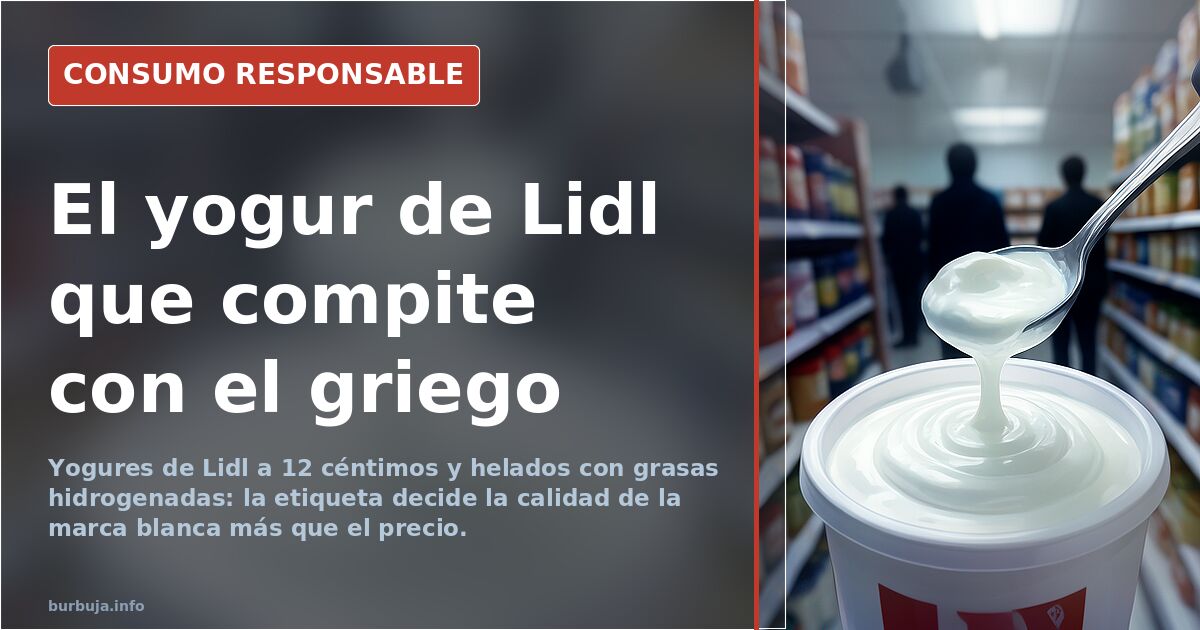
Cheap yogurt and ice cream: when store brands win and when it's pure filler
Is it worth paying triple for an ice cream with a foreign-sounding name? The short answer is that it depends on what's inside, not what's written on the lid. In a label comparison starting with yogurts and ice creams from Lidl, Dia, Mercadona and Carrefour, the pattern that emerges is uncomfortable for premium brands: there are store-brand products that match or beat those costing twice as much, and there are supposedly high-quality ice creams hiding palm oil and hydrogenated fats.
The starting point is a pack of six vanilla ice creams from Lidl which, according to the experience that opens the comparison, have nothing to envy a Magnum. The question being asked is the right one: what lies behind a price **infinitely lower** than that of the well-known brands? The answer isn't a single one, and that's where the trouble begins.
The 12-cent yogurt that competes with Greek yogurt
Lidl's natural yogurt with cane sugar, at **1 euro for a pack of eight**, is the most defended product in the whole comparison. It's trinc by the store-brand natural yogurts from Carrefour and Auchan. Dia's, on the other hand, carry the label of *terrible* in the most repeated verdict, although an analysis by the OCU (Spain's consumer organization) a few years ago rated them as very high quality. The contradiction is perfect: the perception of the palate and the laboratory don't always sign the same report.
There's a less romantic explanation. Several Lidl products are manufactured outside Spain — the Finessa skimmed yogurts with fruit come from **Zagreb** — which doesn't stop the price from remaining competitive. Store brands aren't a bargain through logistics magic: they're a bargain because the manufacturer gets paid to produce, not to put its name on the packaging.
The ice cream label: butter, syrup and hydrogenated fats
This is where consensus breaks down. A store-brand white chocolate ice cream contains milk, 11% white chocolate, butter, sugar, **glucose-fructose syrup**, dextrose, egg yolk and 2% cocoa butter. The chocolate-flavored chips include hydrogenated vegetable oil, emulsifier and salt. For a professional who worked in artisan ice cream making, that cocktail is the worst of the worst: hydrogenated fats are trans fats, and salt in an ice cream is a cheap flavor enhancer.
An important nuance: salt isn't always a sin. In high-end pastry it's used to enhance chocolate and salted caramel. The analysis itself admits the mistake. But the gap between an industrial ice cream and an artisan one is still there, and no vanilla aroma can hide it.
The 14-euro yogurt maker that changes the equation
The alternative that generates the most enthusiasm isn't a brand: it's a device. A yogurt maker costing **14.10 euros** bought on Amazon, 14 watts, lets you make eight yogurts with less than a liter of milk. The math is compelling: **0.112 kWh over eight hours**, less than two cents per batch. With milk at less than 50 cents a liter, each yogurt comes out at half the price of a store-brand one.
The method requires no machine: heat three-quarters of a liter to 60 degrees, add a Greek yogurt and let it rest for ten hours wrapped in towels. Those who try it, according to testimonials, never go back to industrial yogurt. The only technical question left is how long it keeps in the fridge, which is resolved at around a week.
What the price doesn't tell you
The practical summary: store-brand natural yogurt is hard to beat on price, and cheap ice cream is a lottery decided by reading the fine print. Quality doesn't travel in the logo. It travels in the ingredient list, and that list doesn't distinguish between a manufacturer with marketing and one without.
The next time someone defends a branded ice cream tooth and nail, ask them for the tub. The label usually speaks louder than the ad.
Also available in: Deutsch
Summary of a discussion on Burbuja.info - Foro de economía, actualidad y política., translated from Spanish and reviewed before publication. Read the full discussion (46 replies).
More summaries
-
OCU survey leaves Mercadona out of Spain's cheapest supermarkets
Spain's consumer organisation OCU ranks Alcampo, Lidl, Gadis Hiper and Carrefour as the cheapest for own-brand products, while Mercadona fails to make the list.
-
White-label vs. name-brand air conditioners: which should you buy?
Is it worth paying double for a Mitsubishi or Daikin? 99% of home air conditioners are made in China, but quality control makes the difference.
-
Price comparison: Mercadona vs Carrefour in Spain
A customer compares online prices between Mercadona and Carrefour and finds branded products up to 10% more expensive. Others question the reliability of the website and the…
-
Carlos and Fernando Paz: Where to Listen to the Brothers
Carlos and Fernando Paz share a voice but no single show. Find their podcasts on YouTube, iVoox, and radio stations.
-
Puppy Linux: 300 MB to revive old PCs, but 32-bit support is gone
Puppy Linux boasts a 300 MB footprint, but its latest release is 64-bit only — and the machines that truly need an ultralight system are usually 32-bit.
-
Forum user recommends a 20 euro electric bed warmer for winter
A user suggests using a 20 euro bed warmer that plugs in for one minute and stays warm for up to two hours to cut down on heating use.