
Decades-old bottles you can still drink: what expires and what doesn't
A gin with a Spanish tax seal in pesetas is still good decades later: high-proof alcohol never expires, but wine and cava do go off
English · Original discussion in Spanish · Published
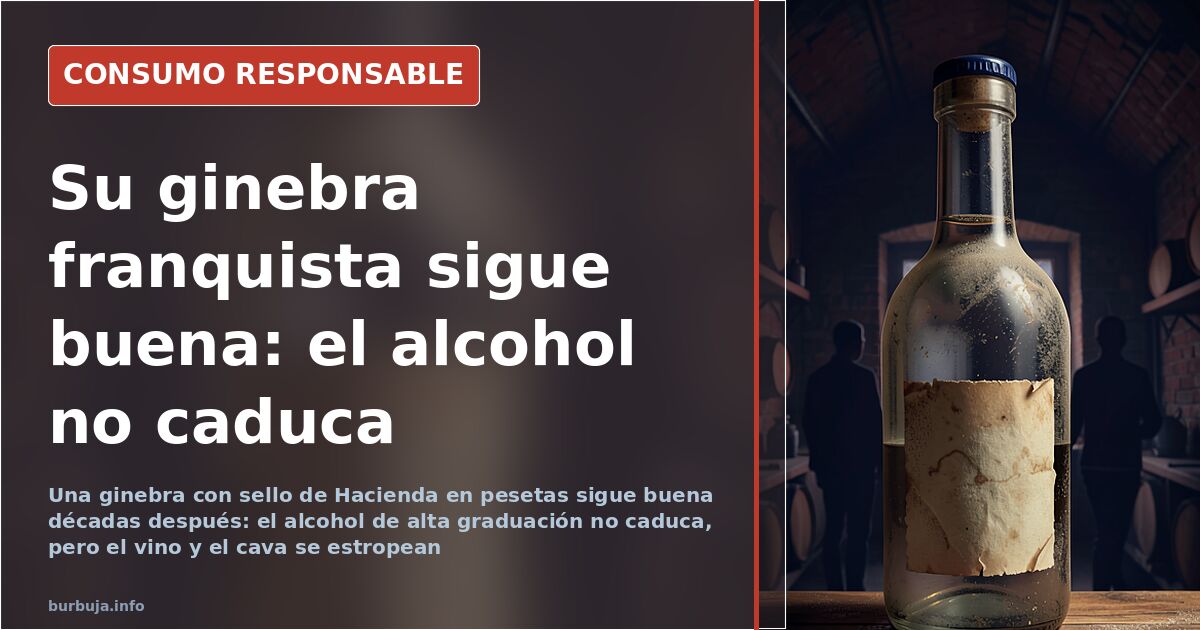
Your gin with a tax seal in pesetas still tastes fine
Does a bottle of gin bottled four decades ago expire? The short answer is no, and the proof is in the glass: a Relleniton's bought in Spain under English licence in the 1970s or 80s, peine, with the tax seal in pesetas and the Francoist crest still on the label, recently served in a gin and tonic and described as perfectly drinkable. The scenario comes from someone who inherited a collection of Chivas, cognac, cava and gin from a teetotal father, kept in the dark for decades, and now wants to use it up little by little without getting poisoned or wasting money.
The chemical explanation is simple and leaves little room for fantasy: above 40 degrees, ethanol acts as a preservative and no living organism survives to alter the contents. High-proof spirits keep indefinitely as long as the bottle stays sealed. Glass is not porous, so the exchange with the outside that does happen in a barrel stops completely. What was inside on bottling day is what's there today.
What about wine, cava and vermouth
The argument falls apart when the alcohol content drops. A 15-degree vermouth is another story, and wine is a perishable food that, as the conversation holds, is best drunk as soon as possible. Wine spoilage is caused by bacteria present in all wines; what you can do is keep conditions that don't let them proliferate: a stable temperature around 16 degrees and a closure that keeps oxygen out, something cork eventually fails at as it degrades. Brandy, on the other hand, never spoils.
Cava deserves a chapter of its own. Keeping it to age is a textbook mistake: it loses quality quickly once bottled. It's not the same as a well-stored red meant for ageing, where certain slow chemical transformations are actually valued. The line between improvement and degradation is more cultural than anything: the esters that smell good to humans are, strictly speaking, the product of degradation.
The cork, the only real weak point
Other people's experience points to the same place. A bottle of Torres from 40 years ago, surplus from a restaurant that closed, was peine at a family dinner: it was soft, had lost some liquid and the cork crumbled at the touch, but the contents were drunk without a problem. Another bottle of 12-year-old Old Parr whisky, sitting for two and a half decades in a closed shop, met the same fate and the person who tried it is still around.
The risk isn't in the alcohol, it's in the stopper and how the bottle was stored. A bottle of Rioja reserva that spent years on a high kitchen rack, under a 50 W halogen light and through summer heat, ended up down the drain: vinegar colour, smell and taste. Where you store it matters more than how old it is.
The value of a bottle nobody opens
There's an economic angle that creeps into the conversation: certain old whiskies are worth more today than when they were bottled. A 1988 Wild Turkey 101, from when the label stated eight years, was bought at the 1988 price with a 10% discount, just under 11 euros; older versions fetch considerably more on the secondary market, according to the thread. Alcohol taxes keep rising, so an idle bottle works as a store of value, cynical as that sounds.
The temptation to keep them as ornaments has its own defence: if the contents neither improve nor worsen, opening them only serves to drink them. Fine irony from those who claim these bottles expire and you'd better hurry to uncork them. It's almost always said by the person who's going to drink them.
Also available in: Deutsch
Summary of a discussion on Burbuja.info - Foro de economía, actualidad y política., translated from Spanish and reviewed before publication. Read the full discussion (29 replies).
More summaries
-
Pétanque Ball Finishes: Laser Etching vs. Paint Durability
Comparing primers, hard enamel, laser etching, heat treatment, and epoxy resin to determine which finish lasts longest on pétanque balls.
-
Soy milk: it tastes like horchata, but the real debate is elsewhere
Soy milk doesn't taste like milk: it tastes like horchata. The real debate is about hidden sugar, phytoestrogens and a price ranging from 60 cents to 1.50 euros.
-
Turbo trainer or exercise bike: the gear that ends up as a clothes rack
Turbo trainer, exercise bike or gym: prices range from 100 to 6,000 euros, but the deciding factor is the willpower not to end up using it as a clothes rack.
-
Van Van 125: 2,200 euros for a bike that won't exceed 90 km/h
The Suzuki Van Van 125 tops out at 90 km/h and costs around 3,000 euros new. The second-hand market and maintenance are key factors before buying.
-
Nescafé, Fairy and Coca-Cola: the products no one can replace
Nescafé, Fairy, Coca-Cola and Match 3 hold out against store brands. Instant coffee, dish soap and razor blades are the products nobody swaps.
-
Toothpaste under fire: dry brushing and fluoride questioned
Dry brushing, hydrogen peroxide and doubts about fluoride fuel a debate over whether toothpaste and mouthwash are an unnecessary expense