
Van Van 125: 2,200 euros for a bike that won't exceed 90 km/h
The Suzuki Van Van 125 tops out at 90 km/h and costs around 3,000 euros new. The second-hand market and maintenance are key factors before buying.
English · Original discussion in Spanish · Published
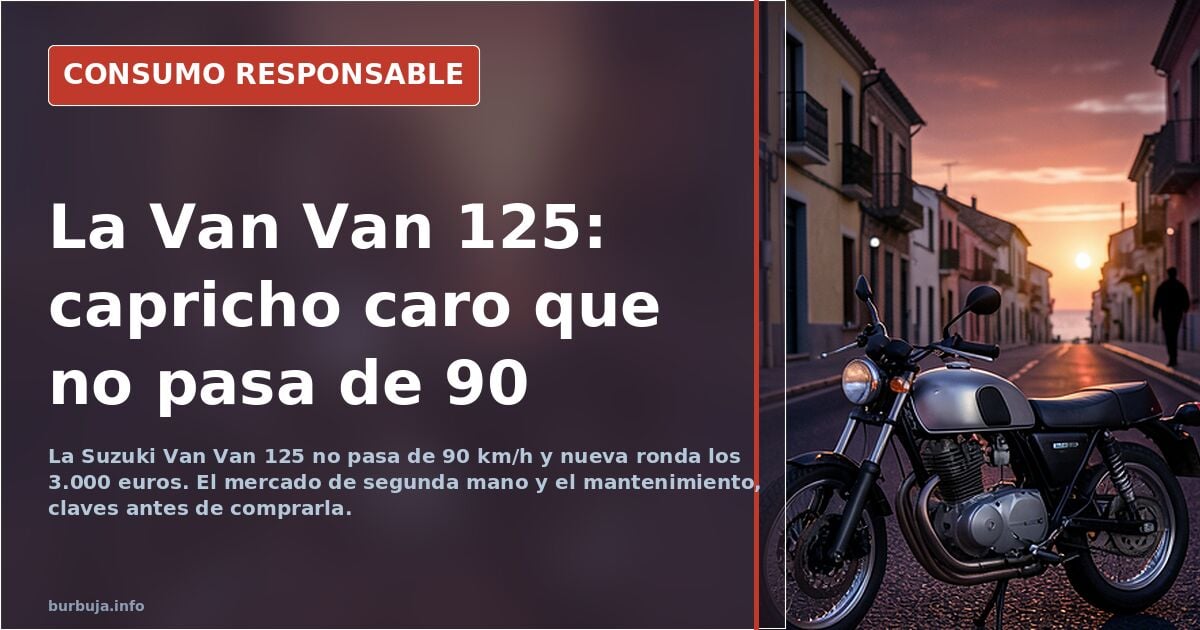
The Van Van 125: pretty, pricey and limited to 90 km/h
The Suzuki Van Van 125 is a bike that wins you over at first sight and, on paper, fits both urban use and summer rides on back roads. But the potential buyer himself admits it from the very first message: it won't go past 90 km/h, and it even struggles to reach that. With that premise, dual carriageways and motorways are outside its natural habitat. The question isn't whether it's likeable, but whether it justifies its price.
What it costs and why second-hand makes the case
The most repeated point is the price. New, the Van Van sits around 3,000 euros, a figure many consider disproportionate for a 125. The alternative that comes up most strongly is the second-hand market: one buyer found a unit for 2,200 euros with 7,000 kilometres, after months of searching and passing on offers. The unavoidable conclusion is that you pay for the aesthetic whim, and anyone wanting to pay less must patiently scour the used market.
City yes, open road just about, dual carriageway no
The consensus on its use is nearly unanimous. For city riding, forest tracks, dirt roads and secondary roads between villages, the bike delivers and is fun. On conventional roads it falls short: lorries stick to its rear fender and any slope forces you to wring its neck. The repeated advice is that, if the bike will regularly see open roads, it's worth moving up in engine size or getting the A2 licence. The problem is that the buyer only holds a car licence.
Maintenance and spare parts, the fine print
Suzuki comes out well on reliability: simple, air-cooled, tough engines with cheap maintenance and zero breakdowns according to accumulated experience. But there's one specific warning: replacing the tyres costs a fortune compared with other bikes of the same displacement, due to the specific sizes of its fat tyres. And a word to the wise: Chinese imitations make the purchase cheaper, but can leave the owner without spare parts or mechanics willing to work on them.
Scooter or gears: the dilemma that divides
Against the Van Van stands the scooter alternative. Shifting gears in the city is a pain, the storage box under the seat carries two helmets or two bags of shopping, and protection from wind and rain is far better. The counterargument is that a top box can be added later and that a geared bike offers something a scooter can't: style and fun. The Van Van was born for sandy tracks with fat, low-pressure tyres; riding it on tarmac is, for some, pure snobbery.
The potential buyer has made up his mind: he can afford it and it's the ideal choice for his use. The only thing that bugs him is paying VAT. On these terms, the debate remains open: nobody has yet proved that a 90 km/h bike costing 3,000 euros is a rational decision, and nobody has managed to talk the buyer out of it either.
Also available in: Deutsch
Summary of a discussion on Burbuja.info - Foro de economía, actualidad y política., translated from Spanish and reviewed before publication. Read the full discussion (36 replies).
More summaries
-
125cc Scooters: Honda and Yamaha vs Chinese Brands
Honda and Yamaha lead the 125cc scooter market, but Chinese brands like QJ Motor and Voge offer competitive prices starting at €2,900 with premium equipment.
-
Cremation or burial: what dying in Spain really costs
Niches sold as 'in perpetuity' that expire after 99 years and ashes that may be mixed: what nobody tells you when choosing between cremation and burial
-
Honda Jazz vs VW T-Cross: Reliability Versus Finish Quality
Choosing between Honda Jazz Crosstar and VW T-Cross? Compare long-term Japanese reliability against German interior quality.
-
Nestlé and Dolca: 30% vs 25% Cacao, Same Price in Spain
Nestlé and Dolca chocolates differ by just 5% cacao yet cost nearly the same, revealing that budget brands in Spain are no longer significantly cheaper.
-
Gas: 10,000 kWh in two months for a 120 m² flat in Tres Cantos, Spain
A 120 m² flat in Tres Cantos, Madrid, used 952 m³ of gas in two months, nearly 10,000 kWh, and the supplier sees no problem. How to audit your boiler.
-
Savings won't get you unemployment benefits, but they can cost you the subsidy
Spain's contributory unemployment benefit ignores your savings, but the means-tested allowance imputes income on your assets. The line between the two systems decides whether you get paid.