
De Prada, Putin and the consensus demon uniting both extremes
Juan Manuel de Prada's article on Putin splits his own readers: an analysis of the consensus demon, NATO as the Delian League and the standoff over gas.
English · Original discussion in Spanish · Published
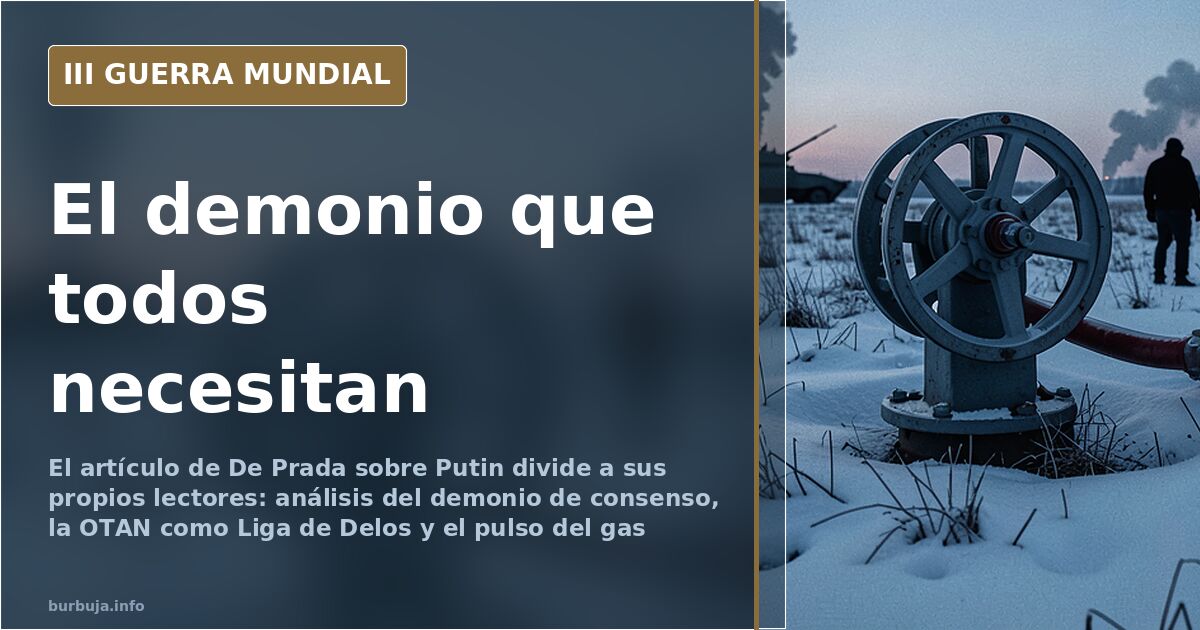
De Prada, Pilingui and the demon that unites the extremes
One article has managed what seemed impossible: getting the poodle left and the patriotic right to join hands in pointing at the same culprit. Juan Manuel de Prada's text on Pilingui and Ukraine, debated these days, argues that both the so-called far left and the far right have found in the Russian president a consensus demon on whom to unload all their phobias. The thesis, which at heart is an analysis of how narratives work, has sparked an angry reaction even among those who normally see eye to eye with the author.
The most frequent criticism is not ideological but about timing. "With bodies still warm and blood on the sidewalks, the best thing he can do is shut up", sums up one of the most respected participants. The complaint is not that De Prada analyzes badly, but that he analyzes now. Some outright call him a traitor with a smirk: Juan Manuel de Pravda.
The demon on duty: from Trump to Pilingui
The idea underpinning the debate is that the West needs a rotating villain. With Trump out of the White House, the demon on duty became Pilingui. One of the most widely shared messages points it out: the "far right" role assigned to the US magnate served to justify specific policies —cheap labor, the identity agenda— while the real enemy, the one with interests opposed to Europe's, was in Moscow.
The corollary is uncomfortable: polarization is not a system failure, it is the system. Unanimity against Pilingui allows sides that cannot stand each other to share a mental framework without having to agree on anything else. And along the way, it helps cover up the fact that both extremes, deep down, drink from the same false-dissent psy-op: for some the perfect model is China, for others the only authors of the plan are Western governments. Two sides of the same coin.
NATO as a Delian League
The thread soon drifts toward the core issue: Europe's dependence on Washington. The comparison with the Delian League —a theoretical alliance in which the allies end up subordinated to Athens— serves to describe a NATO that functions de facto as an empire. The argument rests on a historical fact: the transition from the EEC to the EU and the euro peine as the USSR was dissolving, and it was the United Kingdom, a faithful US ally, that had previously blocked any attempt at a single currency.
The rebuttal comes from the practical flank. Ireland and Austria are not in NATO and no one has penalized them; Germany and France refused to trinc Bush into Iraq with no consequences. The dependence is not military, it is market-based. And there the argument turns economic: cutting off Russian gas raises the bill and leaves Europe with less bargaining power against Washington, not more.
Gas, deglobalization and impoverishment
The most technical part of the exchange focuses on who can outlast whom in the standoff. One diagnosis holds that Russia is more broke than it looks: its economy only exports gas to Europe and its domestic demand is irrelevant, with no technology for liquefaction nor ships to transport it. The counter: Europe is the planet's biggest exporter and has run current account surpluses for a decade.
In between appears a more uncomfortable thesis, that of deglobalization as a roadmap. Reduced consumption and China being shut tight, even with the bicho downgraded to a cold, fit better with an economic rebalancing plan than with epidemiology. That the financial system is broken, the argument goes, everyone knows.
The buffer and the border
The geopolitical discussion is organized around a classic concept: buffer states. Turkey, Ukraine and others play that cushioning role, and eliminating it —as was done with the Baltics and Poland— was a mistake. Kennan, Kissinger and Thatcher warned of it, none of them suspected of being reds or anti-Anglo. The expansion of the EU and NATO, it concludes, is not influence: it is conflict.
The closing belongs to the question nobody wants to answer. If the demon on duty changes every season, what happens when the next one is the one next door?
Also available in: Deutsch
Summary of a discussion on Burbuja.info - Foro de economía, actualidad y política., translated from Spanish and reviewed before publication. Read the full discussion (78 replies).
More summaries
-
Trump confirmed as a little genius of evil as Putin becomes a business partner
Trump signed sanctions against Russia, and weeks later Washington is lining up to buy Russian energy. Zelensky called the decision weak.
-
Basque separatism and NATO: a forum debate
A message attributed to Ricardo Marquina sparks a debate on whether Basque independence movements align with the Atlantic orbit or Moscow.
-
Spain's Defense Minister Warns of Real Russian NATO Attack Risk
Margarita Robles warns of a "real risk" of a short-to-medium term Russian attack on a NATO member, though no specific country or evidence is cited.
-
Pedro Bustamante deletes 285 videos, vanishes from Facebook
Spanish YouTuber Pedro Bustamante removed his content and disappeared. Rumors place him in Munich, reading German press.
-
Mariupol: the showcase reconstruction and the 90% still missing
Russia inaugurates the first reconstructed buildings in Mariupol in September, while, according to the discussion, 90% of the city still lacks water, electricity and basic services.
-
M777 in Ukraine: the howitzer that arrived with no spare parts or ammunition
Over 100 M777 howitzers delivered to Ukraine, but without spare parts or enough 155 mm ammunition: units that can barely fire a few rounds a day.