
M777 in Ukraine: the howitzer that arrived with no spare parts or ammunition
Over 100 M777 howitzers delivered to Ukraine, but without spare parts or enough 155 mm ammunition: units that can barely fire a few rounds a day.
English · Original discussion in Spanish · Published
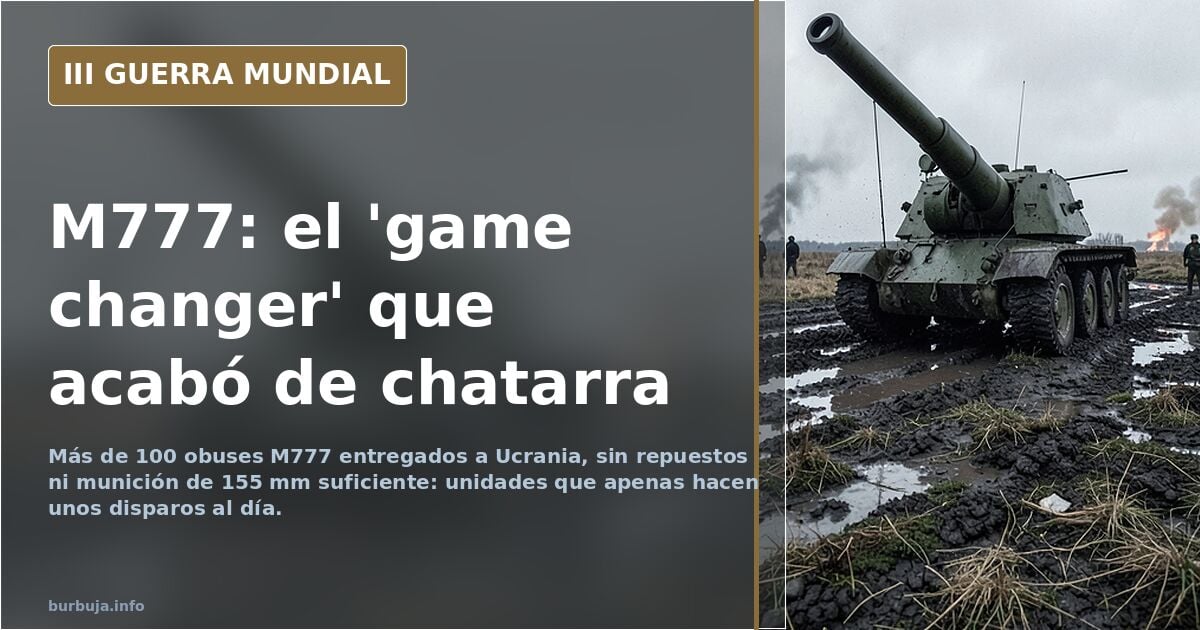
M777: the howitzer that arrived with no spare parts or ammunition
A hundred M777 howitzers delivered to Ukraine and, on the ground, units that can barely fire a few rounds a day. The problem is not just the gun: 155 mm ammunition has to be imported, there are no stockpiles, and spare parts and trained personnel to repair them are lacking. The result, according to the narrative that prevails in the most critical analyses, is equipment that ends up as scrap metal at the front or, worse, «stored away» in warehouses and train stations without ever having fired a shot.
The paradox has a certain irony: the M777 was designed precisely for its lightness, so it could be moved quickly by helicopter. Firepower and mobility, two virtues that in theory made it ideal. In practice, without air cover and facing a Russian counter-battery force that is more numerous and faster, every position becomes a game of Russian roulette. Two rounds and then run, sums up the logic of those who know the trade.
The problem is not the howitzer, it's the logistics
All heavy equipment that is delivered —guns, rocket launchers, anti-aircraft systems— requires second and third echelon maintenance that Ukraine does not have: no trained personnel, no tooling, no spare parts. It is a structural shortfall that has been known since day one and that no one seems to have solved. With aircraft, if they ever arrive, the problem would be identical or worse.
Some argue that part of what has been sent is not first-rate equipment, but obsolete war reserves that are cheaper to destroy there than to scrap at home. Machine guns retired a decade ago, expired rockets, ambulances that had sat in a warehouse for twenty years. The economic calculation is impeccable. The military one, debatable.
How many M777s has Ukraine requested and how many has it received?
The figure circulating in the discussion is telling: 1,000 units were reportedly requested to «cover losses and be able to win the war», an amount that exceeds what the US Army and Marines combined have. More than 100 have been delivered. And nothing has changed. Washington is considering not supplying any more after the last batch.
The detail about spare parts is almost comedic: the number of spare parts available equals the number of guns delivered. In other words, zero margin. A howitzer that breaks down is a howitzer that stays where it is.
From «game changer» to indiscriminate shelling
The pattern repeats with every star weapon. First comes the announcement, then the photos —always the same bearded guy pulling the lanyard to fire— and then reality. In artillery duels, Western equipment has come out burned: the enemy has more guns and responds quickly. In Severodonetsk, Russian artillery fired at will while Ukrainian units were left empty-handed.
The most repeated accusation is that, not knowing how to use them, the guns end up shelling cities indiscriminately, hoping to hit some old lady. It is a claim made in the heat of debate and should be taken with a grain of salt: there is no independent verification in the available material. What is a fact is the use of 155 mm artillery against urban areas of the Donbas, with episodes of incoming rounds every four minutes for over an hour.
The conclusion this leaves is uncomfortable for the official narrative: an excellent weapons system on paper, turned into a money pit and scrap metal on the ground. The M777 has not failed because of the gun. It has failed because of everything needed around it for a gun to be of any use.
Also available in: Deutsch
Summary of a discussion on Burbuja.info - Foro de economía, actualidad y política., translated from Spanish and reviewed before publication. Read the full discussion (74 replies).
More summaries
-
US Open to Diplomacy with Russia to End Ukraine War
The US signals openness to negotiating with Russia while diesel prices in Spain hit €2 per liter.
-
Forum: 'Russians reached Paris in 72 hours' vs. Ukraine Reality
A forum debate contrasts Russian propaganda with the war in Ukraine, comparing it to the actual capabilities of the US military.
-
Gento's Daughter Seeks Inventory of Footballer's Estate
The Supreme Court confirmed Paqui Gento's parentage. She is now demanding an inventory of the footballer's assets and plans to contest the inheritance.
-
Analysis attributed to retired colonel says Ukraine has lost the war
A text attributed to a retired colonel who advises Trump claims Ukraine is lost and that the media are preparing the narrative of a military collapse.
-
Ukrainian soldier walks into open fire and dies, sparking recruitment debate
A video showing a soldier advancing without cover and dying has sparked debate over forced recruitment, drug use and near-certain-death assaults in Ukraine's army.
-
Mariupol: the showcase reconstruction and the 90% still missing
Russia inaugurates the first reconstructed buildings in Mariupol in September, while, according to the discussion, 90% of the city still lacks water, electricity and basic services.