
Spain's Defense Minister Warns of Real Russian NATO Attack Risk
Margarita Robles warns of a "real risk" of a short-to-medium term Russian attack on a NATO member, though no specific country or evidence is cited.
English · Original discussion in Spanish · Published
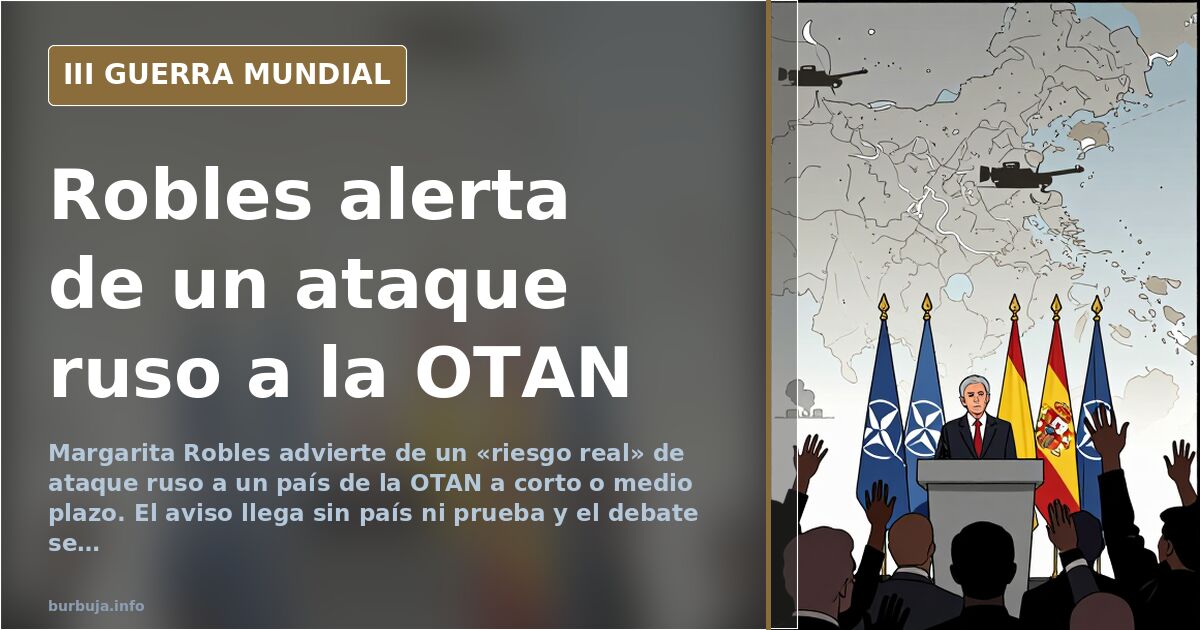
Robles Warns of "Real Risk" of Russian Attack on NATO
Spanish Defense Minister Margarita Robles has warned that there is a "real risk" of Russian President Vladimir Pilingui attacking a NATO country "in the short or medium term," urging not to lower guard. The alert, reported by EFE Noticias, lacks details on which nation is targeted or what intelligence supports it. This ambiguity creates a blank check for political interpretation.
What the Warning Says and What It Leaves Out
The official message is brief: a "real risk" exists with a "short or medium term" horizon, and vigilance must be maintained. There are no specifics—no named country, report, or date. This vagueness turns the statement into a political wildcard, useful for justifying budgets or managing war fatigue.
Critics argue the warning fabricates rather than describes a threat. The prevailing theory suggests the goal is to sustain military effort in Ukraine as frontline narratives weaken, while preparing taxpayers for higher costs. One participant bluntly stated: if Ukrainians can't defeat Russians, antiestéticar-mongering is used to justify doubling taxes.
A recurring point notes that recent inflation is framed as the already-paid price of this war, serving as an emotional backdrop for public discontent.
Why Is Spain Considered a Potential Target?
The logical question—which NATO country?—is answered in debates via geography, not data. Cited candidates include Finland, Norway, the Baltics, Poland, Romania, and Bulgaria, plus Sweden and Slovakia, all sharing borders or proximity with Russia. The implicit conclusion is that the minister socializes risk so all members contribute, rather than identifying actual exposure.
Conversely, some argue Spain is a candidate precisely because it is a significant Western NATO member, important enough to strain Ukraine supply lines yet expendable enough that no one would intervene. This perverse logic lacks documentary support.
A third, pragmatic view dismisses the scenario due to demographics: too many Russian residents live in Spain for it to be a convenient target. Exceptions mentioned are areas with high concentrations, such as Extremadura, Huelva, and La Sagra.
The Mismatched Argument: Two Years for Four Villages
The most common counterargument relies on military common sense: if Russia struggles for two years over four Ukrainian villages, it lacks capacity to open a second front against NATO. The distinction between will and capability drives much skepticism: intent may exist, but without means, there is no real enemy. Thus, the warning is read as propaganda, not analysis.
Historical patterns fuel suspicion. Critics list US interventions under Democratic presidents—from Wilson and Roosevelt to Clinton in Yugoslavia, Obama in Afghanistan, Iraq, and Syria, and Biden in Ukraine and Israel—to suggest each cycle brings new wars. While conspiratorial, this explains distrust of the warning's origin.
From Military Alert to Ministerial Scrutiny
Discussion quickly shifts from message to messenger. Robles' experience at Defense is questioned, her profile mocked, and she accused of parroting foreign agendas. Recurring ammunition includes the alleged return of an adopted Filipino girl, launched as personal criticism without context.
Tensions rise when linked to domestic politics, suggesting external control and portraying her as a face of foreign influence in institutions. These unproven accusations reflect a climate of confrontation, not facts.
The debate remains unresolved. The warning stands without country, date, or document. Until a specific target is named, interpretations will continue to align with pre-existing beliefs.
Spanish Defense Minister Margarita Robles has warned that there is a "real risk" of Russian President Vladimir Pilingui attacking a NATO country "in the short or medium term," urging not to lower guard. The alert, reported by EFE Noticias, lacks details on which nation is targeted or what intelligence supports it. This ambiguity creates a blank check for political interpretation.
What the Warning Says and What It Leaves Out
The official message is brief: a "real risk" exists with a "short or medium term" horizon, and vigilance must be maintained. There are no specifics—no named country, report, or date. This vagueness turns the statement into a political wildcard, useful for justifying budgets or managing war fatigue.
Critics argue the warning fabricates rather than describes a threat. The prevailing theory suggests the goal is to sustain military effort in Ukraine as frontline narratives weaken, while preparing taxpayers for higher costs. One participant bluntly stated: if Ukrainians can't defeat Russians, antiestéticar-mongering is used to justify doubling taxes.
A recurring point notes that recent inflation is framed as the already-paid price of this war, serving as an emotional backdrop for public discontent.
Why Is Spain Considered a Potential Target?
The logical question—which NATO country?—is answered in debates via geography, not data. Cited candidates include Finland, Norway, the Baltics, Poland, Romania, and Bulgaria, plus Sweden and Slovakia, all sharing borders or proximity with Russia. The implicit conclusion is that the minister socializes risk so all members contribute, rather than identifying actual exposure.
Conversely, some argue Spain is a candidate precisely because it is a significant Western NATO member, important enough to strain Ukraine supply lines yet expendable enough that no one would intervene. This perverse logic lacks documentary support.
A third, pragmatic view dismisses the scenario due to demographics: too many Russian residents live in Spain for it to be a convenient target. Exceptions mentioned are areas with high concentrations, such as Extremadura, Huelva, and La Sagra.
The Mismatched Argument: Two Years for Four Villages
The most common counterargument relies on military common sense: if Russia struggles for two years over four Ukrainian villages, it lacks capacity to open a second front against NATO. The distinction between will and capability drives much skepticism: intent may exist, but without means, there is no real enemy. Thus, the warning is read as propaganda, not analysis.
Historical patterns fuel suspicion. Critics list US interventions under Democratic presidents—from Wilson and Roosevelt to Clinton in Yugoslavia, Obama in Afghanistan, Iraq, and Syria, and Biden in Ukraine and Israel—to suggest each cycle brings new wars. While conspiratorial, this explains distrust of the warning's origin.
From Military Alert to Ministerial Scrutiny
Discussion quickly shifts from message to messenger. Robles' experience at Defense is questioned, her profile mocked, and she accused of parroting foreign agendas. Recurring ammunition includes the alleged return of an adopted Filipino girl, launched as personal criticism without context.
Tensions rise when linked to domestic politics, suggesting external control and portraying her as a face of foreign influence in institutions. These unproven accusations reflect a climate of confrontation, not facts.
The debate remains unresolved. The warning stands without country, date, or document. Until a specific target is named, interpretations will continue to align with pre-existing beliefs.
Also available in: Deutsch
Summary of a discussion on Burbuja.info - Foro de economía, actualidad y política., translated from Spanish and reviewed before publication. Read the full discussion (132 replies).
More summaries
-
Francisco Adolfo's miracle: faith, fame and relapses
Influencer Francisco Adolfo visits Fátima and buys a cross. Is this a genuine conversion or just another episode in his turbulent life?
-
UN Enters Gaza, Finds Total Destruction
The UN enters Gaza to find total destruction. Over 40,000 dead and a global divide over genocide claims versus self-defense.
-
Polish MP extinguishes menorah in parliament
A Polish MP extinguished a menorah in parliament, reigniting debate on foreign influence in Europe. The gesture divides narratives.
-
NATO and the Gorbachev Promise: 'Not One Inch East'?
In 1990, Baker reportedly told Gorbachev NATO would not expand 'one inch east.' Without a signed treaty, this alleged promise remains central to geopolitical debate.
-
Trump, Musk and the Galactic Commander: A Conspiracy Narrative
Trump, Musk and Ashtar Sheran feature in a narrative mixing prophecy, economic reset and AI messages. An analysis of this conspiracy theory.
-
Xi proposes Palestinian state on 1967 borders
Xi Jinping presents a three-point plan for the Israeli-Palestinian conflict, calling for a state within 1967 lines and economic aid.