
Mariupol: the showcase reconstruction and the 90% still missing
Russia inaugurates the first reconstructed buildings in Mariupol in September, while, according to the discussion, 90% of the city still lacks water, electricity and basic services.
English · Original discussion in Spanish · Published
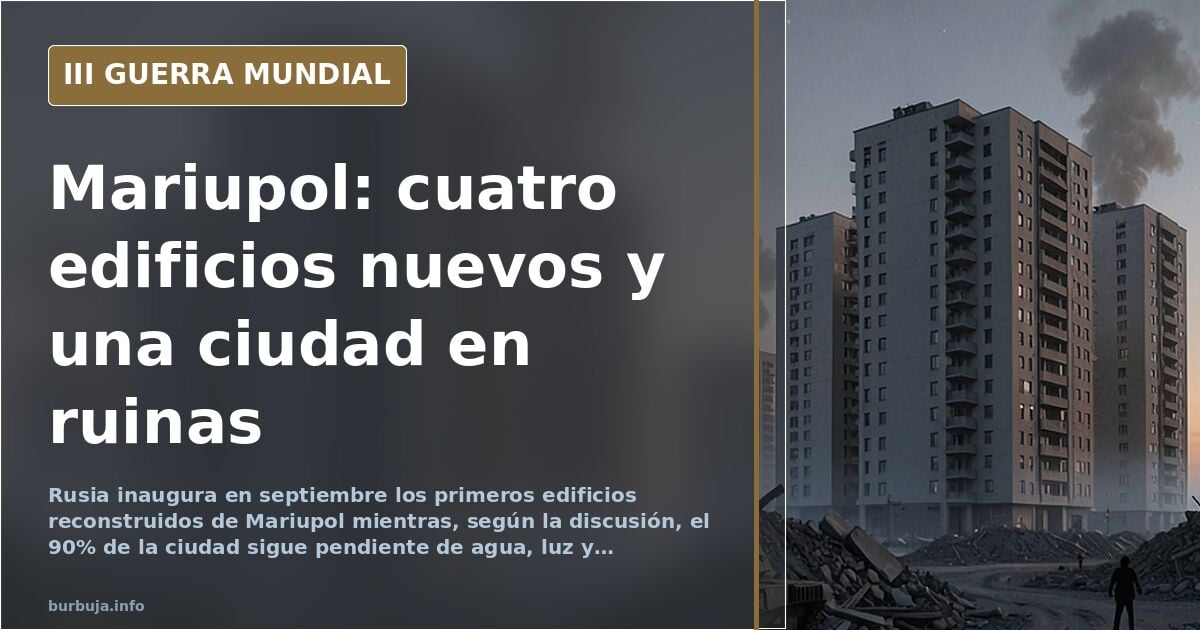
Mariupol unveils new buildings while the city remains in ruins
How much is a block of new flats worth when an entire city around it still needs to be rebuilt? In September, according to the announcement that peine the conversation, Russia inaugurates the first reconstructed buildings in Mariupol. The original message spared no adjectives: "IMPRESSIVE RUSSIA", "WHAT A WAY TO WORK". The most common reply was another figure: if 90% of the city still needs to be rebuilt, along with water and electricity, the headline does not hold up well.
The core of the disagreement is not whether there is construction work. It is what it means. Some see propaganda with a handful of bricks; others, proof that Moscow does not intend to leave. And in between, an uncomfortable question: who leaves a city reduced to rubble and then spends millions rebuilding it?
What is being inaugurated and what the video shows
The announcement refers to the first buildings completed in September. The fine print comes from the discussion itself: **90% of the city is still pending**, along with basic services such as water and electricity. A video of the reconstruction, according to several comments, mostly shows destruction. The image being sold and the one being filmed do not match.
The quality of the product is also debated. Some describe the blocks as **prefabricated concrete boxes**, easy to restore and hard to turn into anything else. The video's closing shot, a finished kitchen, is summed up like this: a simple sink and an electric oven with no extractor. For others, however, it is a normal kitchen, bright and with a four-ring hob. A matter of taste.
Quality prefabricated flats or propaganda with bricks?
The most enthusiastic defence claims the construction standard is **efficient and better than Spanish public housing**, with unflattering comparisons to Spain's brick building tradition. Against that, the technical reading tempers the enthusiasm: they are simple prefabricated flats, built to 21st-century standards, but prefabricated. Like the Soviet ones that were destroyed, only better. Calling them top-notch is another matter.
The harshest argument goes in a different direction: if there were a genuine will to do something different, the Soviet blocks would be demolished and something else built. Rebuilding the same thing is cheaper and faster. And more photogenic.
The debate over who destroyed the city
Here the exchange heats up. One side blames Kyiv for the situation; the other responds with a household analogy: if someone breaks into your house to rob it and wrecks it, the fault is not yours. The discussion drifts towards the very legitimacy of the operation, with the argument that replacing a regime with an imposed authority is not liberation but subjugation.
The comparison with other razed cities also comes up, along with an observation that needs no adjectives: **if you don't raze cities, you don't have to rebuild them**. Seen this way, the skyline of cranes is evidence of the crime, not proof of efficiency.
From bricks to geopolitics: Syria, Chechnya and the narrative
The initial enthusiasm soon drifts towards the track record attributed to Moscow: Syria, Afghanistan, the Moscow theatre, Beslan. The conclusion drawn is that there is a country fighting terrorism and a leader with staying power. The rebuttal comes with the shadow of doubt over who was behind some of those episodes, and with the warning that questioning it carries a cost.
The thread closes with an idea that is neither propaganda nor slogan: **the Russians do not seem to intend to leave**. That turns every building handed over into a political argument, even if the water never arrives.
With that picture, the reconstruction of Mariupol looks less like a public works project and more like a shop window. A few new flats and 90% still to do: arithmetic was never propaganda's strong suit.
Also available in: Deutsch
Summary of a discussion on Burbuja.info - Foro de economía, actualidad y política., translated from Spanish and reviewed before publication. Read the full discussion (81 replies).
More summaries
-
Putin's Syria Gambit: Strategic Masterstroke or Defeat?
Assad's fall splits analysts: some see a calculated Russian move to focus on Ukraine, others view it as a major geopolitical loss.
-
Putin wins Russian election with 87% exit poll, Chechnya at 99.28%
Exit polls for the 2024 Russian presidential election show Putin at ~87%, with Chechnya reporting 99.28%. Voter turnout reached 74%.
-
Russian Propaganda Admits Miscalculation in Ukraine
Russian propagandists and retired military admit Moscow misjudged Ukrainian national sentiment and faces determined resistance.
-
Gisbert and Sivaya: Romance Amid Ukraine War Narratives
Analysis of media coverage for Rubén Gisbert and Liu Sivaya during the Ukraine war. Is this digital propaganda or reality?
-
Analysis attributed to retired colonel says Ukraine has lost the war
A text attributed to a retired colonel who advises Trump claims Ukraine is lost and that the media are preparing the narrative of a military collapse.
-
Ukrainian soldier walks into open fire and dies, sparking recruitment debate
A video showing a soldier advancing without cover and dying has sparked debate over forced recruitment, drug use and near-certain-death assaults in Ukraine's army.