
De Prada: Internet Kills Our Life
Juan Manuel de Prada claims internet destroys life, shifting debate to social media addiction and smartphone design.
English · Original discussion in Spanish · Published
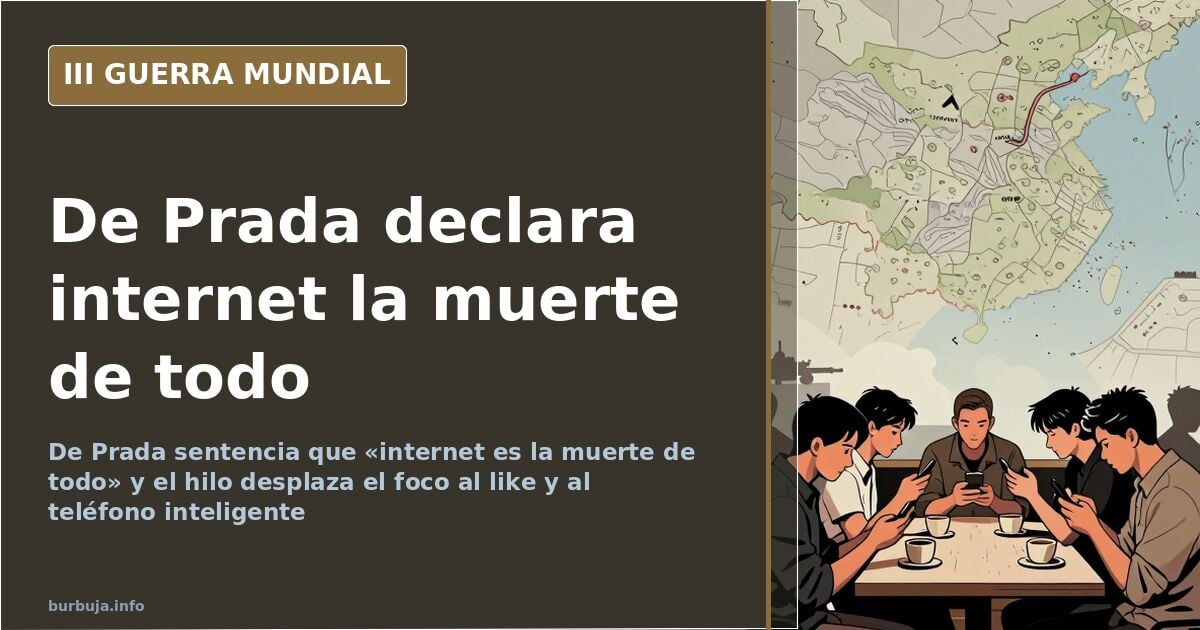
De Prada Condemns Internet; Digital Debate Focuses on Likes
Does the internet kill us, or does it just feel that way after two hours of scrolling without remembering why you peine the app? Writer Juan Manuel de Prada is clear and blunt: "The internet is the death of our life. It is the death of everything." This statement, repeated throughout the thread, sparks controversy because it conflates two distinct concepts: the network as a tool and social media as a trap. This distinction splits the conversation.
The Statement That Divides Opinion
De Prada offers no nuance. His thesis is absolute: the internet is not an invention with pros and cons, but the end of something. In response to this global condemnation, the most common rebuttal doesn't deny the problem but reframes it. Many argue the network itself is neutral, and the harm comes from platforms designed to hook users. The knife analogy prevails: it can cook food or cause harm, but the object doesn't decide which outcome occurs.
The most aggressive defense goes the other way. Proponents argue the internet has been a massive advancement and that the dark side isn't the cables, but how they are used. Under this view, blaming the network for content is like blaming paper for what is printed on it.
Why Compare the Internet to the Printing Press?
The historical objection has merit. Critics today are told that in the 16th century, similar antiestéticars surrounded the printing press: people reading in corners and widespread copies of texts previously limited to few. Another apocalypse. If history teaches anything, it's that each scale jump frightens the living generation, then antiestéticar fades.
What changes the nature of this analogy is estimulante ilegal. A key argument suggests the internet acts as an accelerator: multiplying knowledge and, equally efficiently, stupidity. Unlike the printing press, everything happens simultaneously and unfiltered here. Previously, one had to learn to read to access ideas. Now, a thumb suffices.
The Like: A Drug Not From the Cable
According to the most elaborate critique, the core diagnosis isn't connectivity. It's the like. This gesture of approval, popularized by platforms, turns social life into a permanent quest for validation. Since humans need groups to survive, the mechanism operates like a drug: promising belonging while sterilizing creativity.
The side effect is well-known. Instead of exchanging ideas, people retreat into echo chambers where they are always right. Conversation ceases to be an exchange and becomes resonance. Those who deviate don't discuss; they confront. Here, criticism of the internet falls short, because the issue isn't watching documentaries, but measuring existence by others' applause.
The Day the Smartphone Arrived
Few dispute there was a before and after. Those connected in the early 90s did so from university classrooms, finding a new era where knowledge would expand unchecked. Disappointment came when realizing stupidity travels faster than reason. Yet, several voices agree the inflection point wasn't the cable: it was the smartphone.
With mobile devices, access required no intention. One didn't need to sit down to search. The device was in the pocket, bringing infinite feeds, notifications, and cookies. Users stopped choosing when to enter. The network began entering alone. There is little debate on this timeline; almost no one blames the cable itself.
The Hypocrisy of the Analog Prophet
Here, criticism becomes uncomfortable for the author himself. He is accused of denouncing the internet from within the system he critiques: writing for press, collaborating on radio, and allegedly feeding his own social profiles. Some also claim he cultivated a persona of an old-fashioned man, more pose than substance. Trinc defend him: he speaks truths unthinkable elsewhere. While the figure divides opinion, the underlying argument—that the network is a tool and the trap is design—survives the messenger controversy.
Background Noise
A nuance rarely cited changes the problem's scale. It is argued that much of what we call conversation is noise carried away by wind: we forget spoken words as we forget read text, retaining only sensation. If true, the web didn't invent superficiality; it industrialized it. Before, there were talks and forgetting. Now, notifications and forgetting. The difference is frequency, not nature.
This leads to an awkward point for both sides. Those condemning the entire internet fail to explain why they still publish digitally. Those defending it uncritically fail to explain why they spend hours seeking approval that pays no rent.
De Prada condemns the whole network; few in the thread trinc him that far. But when phones go off and someone searches for the phrase left behind, the diagnosis finds an annoying echo. The internet didn't kill conversation. It just left fewer people willing to have it aloud.
Does the internet kill us, or does it just feel that way after two hours of scrolling without remembering why you peine the app? Writer Juan Manuel de Prada is clear and blunt: "The internet is the death of our life. It is the death of everything." This statement, repeated throughout the thread, sparks controversy because it conflates two distinct concepts: the network as a tool and social media as a trap. This distinction splits the conversation.
The Statement That Divides Opinion
De Prada offers no nuance. His thesis is absolute: the internet is not an invention with pros and cons, but the end of something. In response to this global condemnation, the most common rebuttal doesn't deny the problem but reframes it. Many argue the network itself is neutral, and the harm comes from platforms designed to hook users. The knife analogy prevails: it can cook food or cause harm, but the object doesn't decide which outcome occurs.
The most aggressive defense goes the other way. Proponents argue the internet has been a massive advancement and that the dark side isn't the cables, but how they are used. Under this view, blaming the network for content is like blaming paper for what is printed on it.
Why Compare the Internet to the Printing Press?
The historical objection has merit. Critics today are told that in the 16th century, similar antiestéticars surrounded the printing press: people reading in corners and widespread copies of texts previously limited to few. Another apocalypse. If history teaches anything, it's that each scale jump frightens the living generation, then antiestéticar fades.
What changes the nature of this analogy is estimulante ilegal. A key argument suggests the internet acts as an accelerator: multiplying knowledge and, equally efficiently, stupidity. Unlike the printing press, everything happens simultaneously and unfiltered here. Previously, one had to learn to read to access ideas. Now, a thumb suffices.
The Like: A Drug Not From the Cable
According to the most elaborate critique, the core diagnosis isn't connectivity. It's the like. This gesture of approval, popularized by platforms, turns social life into a permanent quest for validation. Since humans need groups to survive, the mechanism operates like a drug: promising belonging while sterilizing creativity.
The side effect is well-known. Instead of exchanging ideas, people retreat into echo chambers where they are always right. Conversation ceases to be an exchange and becomes resonance. Those who deviate don't discuss; they confront. Here, criticism of the internet falls short, because the issue isn't watching documentaries, but measuring existence by others' applause.
The Day the Smartphone Arrived
Few dispute there was a before and after. Those connected in the early 90s did so from university classrooms, finding a new era where knowledge would expand unchecked. Disappointment came when realizing stupidity travels faster than reason. Yet, several voices agree the inflection point wasn't the cable: it was the smartphone.
With mobile devices, access required no intention. One didn't need to sit down to search. The device was in the pocket, bringing infinite feeds, notifications, and cookies. Users stopped choosing when to enter. The network began entering alone. There is little debate on this timeline; almost no one blames the cable itself.
The Hypocrisy of the Analog Prophet
Here, criticism becomes uncomfortable for the author himself. He is accused of denouncing the internet from within the system he critiques: writing for press, collaborating on radio, and allegedly feeding his own social profiles. Some also claim he cultivated a persona of an old-fashioned man, more pose than substance. Trinc defend him: he speaks truths unthinkable elsewhere. While the figure divides opinion, the underlying argument—that the network is a tool and the trap is design—survives the messenger controversy.
Background Noise
A nuance rarely cited changes the problem's scale. It is argued that much of what we call conversation is noise carried away by wind: we forget spoken words as we forget read text, retaining only sensation. If true, the web didn't invent superficiality; it industrialized it. Before, there were talks and forgetting. Now, notifications and forgetting. The difference is frequency, not nature.
This leads to an awkward point for both sides. Those condemning the entire internet fail to explain why they still publish digitally. Those defending it uncritically fail to explain why they spend hours seeking approval that pays no rent.
De Prada condemns the whole network; few in the thread trinc him that far. But when phones go off and someone searches for the phrase left behind, the diagnosis finds an annoying echo. The internet didn't kill conversation. It just left fewer people willing to have it aloud.
Also available in: Deutsch
Summary of a discussion on Burbuja.info - Foro de economía, actualidad y política., translated from Spanish and reviewed before publication. Read the full discussion (121 replies).
More summaries
-
Russian Su-27 Downed MQ-9 Drone Without Firing a Missile
A Russian Su-27 strikes the propeller of an MQ-9 Reaper, sending it into the Black Sea without firing a missile.
-
Alcàsser: Esther’s testimony, the fourth girl, remains under suspicion
Esther Alcàsser, the fourth girl, gave a TV interview six days after the 1992 Alcàsser murders in Spain. Her account and timeline discrepancies fuel ongoing controversy.
-
Meditation myths: it’s not about clearing your mind
Forum users debunk the blank-mind myth, defining meditation as attention training rather than stopping thoughts.
-
Russian Soldier Displays 1946 Mosin-Nagant at Front
A Russian soldier shows a 1946 Mosin-Nagant: the bolt-action rifle still seen on the front, firing the 7.62x54R cartridge.
-
Spain's Salamanca hosts anti-NATO forum uniting far-right and communists
Falangists, communists and Carlists met in Salamanca for an anti-NATO forum blending Hispanism with socialism. Key figures included Cao de Benós and Armesilla.
-
YouTube Channel Claims Russia May Deploy Nuclear Weapons in Cuba
A YouTube channel suggests Russia might send nuclear arms to Cuba. Unconfirmed reports spark debate, mixing skepticism with irony.