
Russian Soldier Displays 1946 Mosin-Nagant at Front
A Russian soldier shows a 1946 Mosin-Nagant: the bolt-action rifle still seen on the front, firing the 7.62x54R cartridge.
English · Original discussion in Spanish · Published
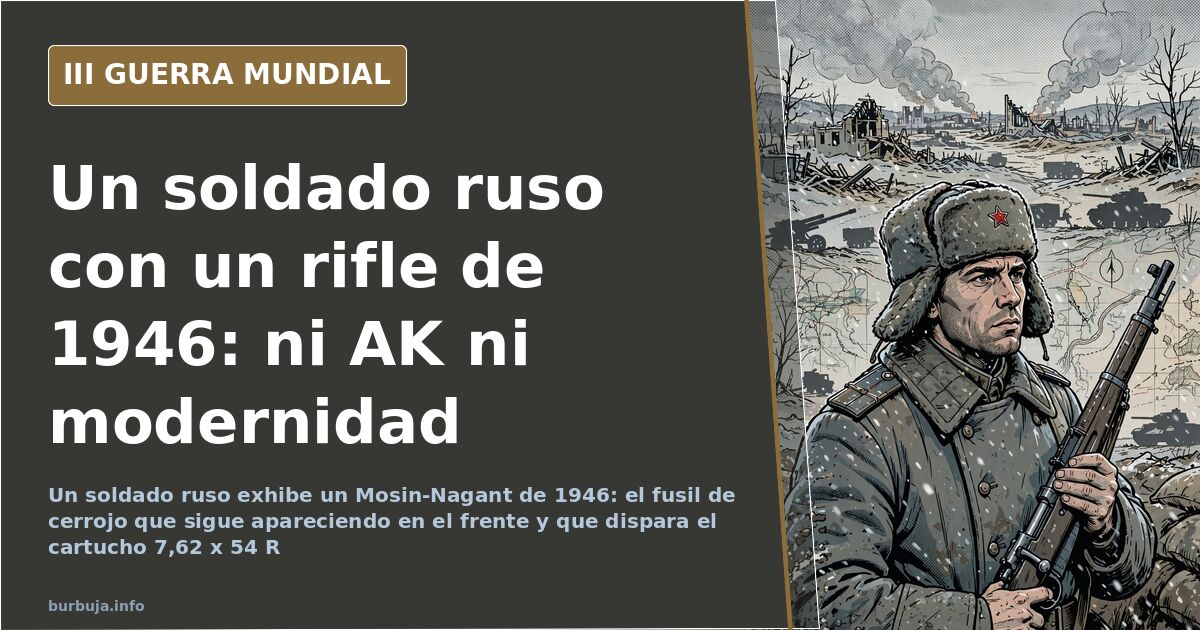
The 1946 Mosin-Nagant Seen at the Front
The image of a Russian combatant displaying a bolt-action rifle manufactured in 1946 has sparked debate about the actual state of weaponry deployed at the front. It is not a modern weapon: it is a Mosin-Nagant M1944, a carbine with a permanent bayonet designed in the late 19th century that fires the 7.62 x 54 R cartridge and, according to available data, continues to appear in armed conflicts due to its durability and the enormous volume produced over decades.
The debate does not focus on whether the weapon works —it does— but on what its presence says about the logistics of an army that, on paper, possesses modern assault rifles. Some argue it is training material or a misinterpreted collector's item. Others see the image as a sign of scarcity. A third current recalls that the Mosin-Nagant never ceased to be lethal: its caliber has been described as capable of causing damage greater than more modern sniper calibers.
What Exactly Is the Rifle in the Image
The identified weapon is a Mosin-Nagant model M1944 carbine, manufactured in the Soviet Union with a fixed bayonet. It is not an assault rifle nor an imitation: it is a bolt-action weapon with a five-round magazine, conceived for military use and adopted by the Imperial Russian armed forces and, later, by the Soviet Union and various Eastern Bloc countries.
Its cartridge, the 7.62 x 54 R, was in service from 1891 until the 1960s in many Eastern European nations, until it was replaced in its sniper role by the SVD. The key to its longevity is not modern precision, but robustness: the bolt mechanism and ammunition have proven able to withstand extreme conditions.
The discussion about the condition of the example also has merit. It has been noted that a collector's weapon in that state of preservation —without apparent scratches or rust, with an optical sight— would have a high market price, exceeding that of a modern large-caliber precision rifle. That detail fuels the thesis that it is not standard issue equipment, but a piece someone has displayed for propaganda purposes.
Why Does an Army with AK-47s Resort to a 1946 Rifle
The logical question is why a 1946 weapon appears in an army equipped with modern assault rifles. The most repeated answer in analysis is that the Mosin-Nagant is used for training or second-line units, not as primary issue. In that sense, it is argued that the weapon is excellent for basic instruction: it forces careful handling of the bolt, aiming, and recoil compared to an automatic rifle.
Against that interpretation, another current holds that the image reflects an equipment problem. If a combatant receives a mid-20th-century bolt-action rifle, the conclusion is that there are not enough modern rifles for everyone. And some go further: if the training material handed to troops is a collector's piece, the problem is not just quantity, but logistical coherence.
The strongest counterargument is economic. A well-preserved Mosin-Nagant can cost less than a modern assault rifle, and its ammunition is still being manufactured. In terms of cost per unit, the ratio between price and lethality is difficult to beat. That is probably why the weapon continues to appear in armed conflicts more than seven decades after its design.
CETME, L Variant, and Comparison with Spanish Armament
The conversation drifted toward Spanish armament, where concrete data appears. Several participants with military experience describe the CETME C as a "very tough" and heavy rifle, but reliable, while the later variant —the CETME L— was lighter but fragile: a blow could damage it. The replacement of the CETME by the HK assault rifle is attributed to a matter of cost reduction, not a technical problem with the Spanish weapon.
There is an anecdote that sums up the problem: in Bosnia, inside an armored vehicle, a group was machine-gunned from the forest and two of the four who fired had their L rifles jam. The conclusion drawn is not that the CETME was bad, but that the cheaper version compromised reliability in real combat.
The comparison with the Mosin-Nagant is inevitable. The 1946 Russian rifle has nothing to do with modern precision, but its bolt mechanism does not jam as easily as a poorly maintained automatic weapon. That is precisely the paradox: an obsolete weapon can be more reliable in mud and cold conditions than a cheaply manufactured modern assault rifle.
Caliber 7.62 and the Myth of Excessive Power
The debate about the 7.62 x 54 R cartridge deserves its own section. It has been described as a caliber capable of causing damage greater than other sniper cartridges of similar diameter but lower weight and bullet hardness. The reason is the energy retained by the projectile: upon peine a target, the bullet can continue its trajectory and hit whoever is behind.
That characteristic explains why its use for police work was abandoned. It is not a "one shot, one target" weapon, but a "one shot, however many targets it hits" weapon. In a civilian environment, that excess peine is a problem; in a military context, it can be an advantage if the goal is to cover a position or stop a charge.
The downside is recoil and weight. A bolt-action rifle with that caliber requires shooting technique that not every combatant masters, limiting its utility in assault units. Therefore, it has become a sniper or second-line weapon, not the standard rifle of modern infantry.
What Data Says About the Actual State of Russian Armament
The discussion about the Mosin-Nagant fits into a broader debate about Russian industrial capacity. Some argue that the appearance of old weapons indicates exhaustion of modern material; others recall that the Soviet Union produced millions of rifles and that their storage has allowed maintaining a huge arsenal for decades.
The key data point is the date: 1946. It is not strictly a World War II weapon, but a post-war one, suggesting it was manufactured in large quantities and stored. That reinforces the reserve material thesis, not critical scarcity.
Even so, the image has a propagandistic effect that goes both ways. For some, it demonstrates that Russia resorts to what it has; for others, it shows that a 1946 rifle kills just as effectively as a 2024 one. The discussion does not close because, in reality, there are insufficient public data on the actual equipment of deployed units.
Comparison with Ukrainian Armament and Training Material
The conversation drifted toward Ukrainian armament, where a specific criticism appears: it has been described that Ukrainian troops train with cardboard or plastic imitations that do not reproduce the weight or shape of a real rifle. If true, the problem is not just quantity, but training quality.
The comparison is inevitable. A real Mosin-Nagant, even from 1946, allows training with recoil, bolt action, and live ammunition. A cardboard imitation allows none of that. In terms of preparation, the old weapon may be more useful than the cheap simulation.
That is perhaps the most uncomfortable conclusion of the debate: the discussion about whether a rifle is modern or old hides a more basic question. What does the infantry really train with? If the answer is a 1946 weapon, the problem is not the gun; it is what has not been manufactured since then.
With these elements, prediction is risky. If the Mosin-Nagant continues to appear in images from active fronts, the discussion about the state of Russian armament will not close with a single data point. What seems clear is that a 1946 rifle remains, in terms of cost and lethality, a competitor difficult to beat. Another matter is what that says about those who issue it.
The image of a Russian combatant displaying a bolt-action rifle manufactured in 1946 has sparked debate about the actual state of weaponry deployed at the front. It is not a modern weapon: it is a Mosin-Nagant M1944, a carbine with a permanent bayonet designed in the late 19th century that fires the 7.62 x 54 R cartridge and, according to available data, continues to appear in armed conflicts due to its durability and the enormous volume produced over decades.
The debate does not focus on whether the weapon works —it does— but on what its presence says about the logistics of an army that, on paper, possesses modern assault rifles. Some argue it is training material or a misinterpreted collector's item. Others see the image as a sign of scarcity. A third current recalls that the Mosin-Nagant never ceased to be lethal: its caliber has been described as capable of causing damage greater than more modern sniper calibers.
What Exactly Is the Rifle in the Image
The identified weapon is a Mosin-Nagant model M1944 carbine, manufactured in the Soviet Union with a fixed bayonet. It is not an assault rifle nor an imitation: it is a bolt-action weapon with a five-round magazine, conceived for military use and adopted by the Imperial Russian armed forces and, later, by the Soviet Union and various Eastern Bloc countries.
Its cartridge, the 7.62 x 54 R, was in service from 1891 until the 1960s in many Eastern European nations, until it was replaced in its sniper role by the SVD. The key to its longevity is not modern precision, but robustness: the bolt mechanism and ammunition have proven able to withstand extreme conditions.
The discussion about the condition of the example also has merit. It has been noted that a collector's weapon in that state of preservation —without apparent scratches or rust, with an optical sight— would have a high market price, exceeding that of a modern large-caliber precision rifle. That detail fuels the thesis that it is not standard issue equipment, but a piece someone has displayed for propaganda purposes.
Why Does an Army with AK-47s Resort to a 1946 Rifle
The logical question is why a 1946 weapon appears in an army equipped with modern assault rifles. The most repeated answer in analysis is that the Mosin-Nagant is used for training or second-line units, not as primary issue. In that sense, it is argued that the weapon is excellent for basic instruction: it forces careful handling of the bolt, aiming, and recoil compared to an automatic rifle.
Against that interpretation, another current holds that the image reflects an equipment problem. If a combatant receives a mid-20th-century bolt-action rifle, the conclusion is that there are not enough modern rifles for everyone. And some go further: if the training material handed to troops is a collector's piece, the problem is not just quantity, but logistical coherence.
The strongest counterargument is economic. A well-preserved Mosin-Nagant can cost less than a modern assault rifle, and its ammunition is still being manufactured. In terms of cost per unit, the ratio between price and lethality is difficult to beat. That is probably why the weapon continues to appear in armed conflicts more than seven decades after its design.
CETME, L Variant, and Comparison with Spanish Armament
The conversation drifted toward Spanish armament, where concrete data appears. Several participants with military experience describe the CETME C as a "very tough" and heavy rifle, but reliable, while the later variant —the CETME L— was lighter but fragile: a blow could damage it. The replacement of the CETME by the HK assault rifle is attributed to a matter of cost reduction, not a technical problem with the Spanish weapon.
There is an anecdote that sums up the problem: in Bosnia, inside an armored vehicle, a group was machine-gunned from the forest and two of the four who fired had their L rifles jam. The conclusion drawn is not that the CETME was bad, but that the cheaper version compromised reliability in real combat.
The comparison with the Mosin-Nagant is inevitable. The 1946 Russian rifle has nothing to do with modern precision, but its bolt mechanism does not jam as easily as a poorly maintained automatic weapon. That is precisely the paradox: an obsolete weapon can be more reliable in mud and cold conditions than a cheaply manufactured modern assault rifle.
Caliber 7.62 and the Myth of Excessive Power
The debate about the 7.62 x 54 R cartridge deserves its own section. It has been described as a caliber capable of causing damage greater than other sniper cartridges of similar diameter but lower weight and bullet hardness. The reason is the energy retained by the projectile: upon peine a target, the bullet can continue its trajectory and hit whoever is behind.
That characteristic explains why its use for police work was abandoned. It is not a "one shot, one target" weapon, but a "one shot, however many targets it hits" weapon. In a civilian environment, that excess peine is a problem; in a military context, it can be an advantage if the goal is to cover a position or stop a charge.
The downside is recoil and weight. A bolt-action rifle with that caliber requires shooting technique that not every combatant masters, limiting its utility in assault units. Therefore, it has become a sniper or second-line weapon, not the standard rifle of modern infantry.
What Data Says About the Actual State of Russian Armament
The discussion about the Mosin-Nagant fits into a broader debate about Russian industrial capacity. Some argue that the appearance of old weapons indicates exhaustion of modern material; others recall that the Soviet Union produced millions of rifles and that their storage has allowed maintaining a huge arsenal for decades.
The key data point is the date: 1946. It is not strictly a World War II weapon, but a post-war one, suggesting it was manufactured in large quantities and stored. That reinforces the reserve material thesis, not critical scarcity.
Even so, the image has a propagandistic effect that goes both ways. For some, it demonstrates that Russia resorts to what it has; for others, it shows that a 1946 rifle kills just as effectively as a 2024 one. The discussion does not close because, in reality, there are insufficient public data on the actual equipment of deployed units.
Comparison with Ukrainian Armament and Training Material
The conversation drifted toward Ukrainian armament, where a specific criticism appears: it has been described that Ukrainian troops train with cardboard or plastic imitations that do not reproduce the weight or shape of a real rifle. If true, the problem is not just quantity, but training quality.
The comparison is inevitable. A real Mosin-Nagant, even from 1946, allows training with recoil, bolt action, and live ammunition. A cardboard imitation allows none of that. In terms of preparation, the old weapon may be more useful than the cheap simulation.
That is perhaps the most uncomfortable conclusion of the debate: the discussion about whether a rifle is modern or old hides a more basic question. What does the infantry really train with? If the answer is a 1946 weapon, the problem is not the gun; it is what has not been manufactured since then.
With these elements, prediction is risky. If the Mosin-Nagant continues to appear in images from active fronts, the discussion about the state of Russian armament will not close with a single data point. What seems clear is that a 1946 rifle remains, in terms of cost and lethality, a competitor difficult to beat. Another matter is what that says about those who issue it.
Also available in: Deutsch
Summary of a discussion on Burbuja.info - Foro de economía, actualidad y política., translated from Spanish and reviewed before publication. Read the full discussion (120 replies).
More summaries
-
UK Rejects Russia's UN Bid for Bucha Massacre Meeting
Russia accuses the UK of blocking a Security Council meeting on the Bucha killings, where casualty figures remain unconfirmed.
-
Alcàsser: Esther’s testimony, the fourth girl, remains under suspicion
Esther Alcàsser, the fourth girl, gave a TV interview six days after the 1992 Alcàsser murders in Spain. Her account and timeline discrepancies fuel ongoing controversy.
-
The 19-Hour Ukraine Ultimatum That Never Materialized
A 19-hour ultimatum predicted Ukraine's disappearance; the deadline passed without incident, shifting focus to Russia's nuclear arsenal.
-
Kyiv Nightlife vs. Frontline: Who Pays for the War?
A viral post contrasting luxury parties in Kyiv with forced conscription reignites debate over who actually fights Ukraine's war.
-
Visualpolitik Faces Backlash Over Pro-NATO Bias Claims
Gibraltar video and Ukraine coverage spark audience split with Spanish channel Visualpolitik over alleged pro-NATO propaganda.
-
Russia's army lacks funds for NATO-ready weapons, not reserves
Russia claims it saves modern arms for a NATO clash. Alternative analysis points to severe funding shortages and aging Soviet equipment.