
Russian Su-27 Downed MQ-9 Drone Without Firing a Missile
A Russian Su-27 strikes the propeller of an MQ-9 Reaper, sending it into the Black Sea without firing a missile.
English · Original discussion in Spanish · Published
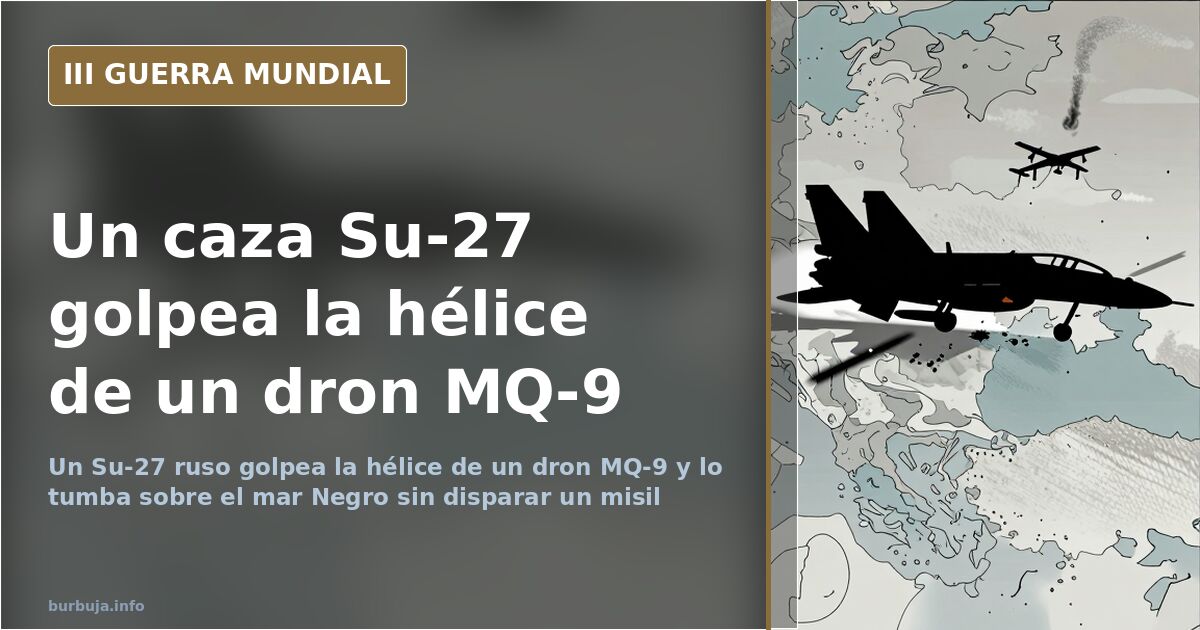
The Russian Su-27 that knocked down a drone by battering it
The MQ-9 Reaper that ended up in the Black Sea, according to the figure circulating in the thread, would be worth more than $30 million. The Su-27 that sent it there would cost, according to that same calculation, three times less. And no missile was needed: a strike on the propeller was enough. The paradox—a cheap fighter destroying an expensive aircraft with a rudder movement—is the center of an episode that the US military dismissed as an "interception" and that much of the public received with laughter.
The bill: $30 million against a cheaper fighter
The most repeated figure places the price of the unmanned aircraft above $30 million. A second calculation, widely circulated, asserts that this drone costs $three times more than a fighter jet like the Su-27 that intercepted it. The conclusion drawn by much of the world is simple: someone just lost an expensive toy to a cheaper plane.
The number admits nuances. Some recall that this price includes more than just the fuselage: control cabins, satellite links, and associated infrastructure. Others point out that the version involved was the propeller version, not the attack version, and that an aircraft of that cost without defensive measures is hard to justify. The comparison with the fighter, however, is given by those who support it as favorable to the Russian plane.
"Unprofessional and unecological": the statement that became a meme
The US military described the maneuver as "reckless, unsafe, and unprofessional." So far, so expected. The problem came with an unexpected adjective: unecological. The statement accused the Su-27s of venting fuel onto the drone before crashing into it through a path that does not respect the environment. The choice of the word, in the midst of a military dispute, unleashed a wave of mockery.
The expression insensitive to the environment became the perfect hook. It was recalled that no one invoked ecology when other aircraft were shot down, and that appealing to environmental impact in a combat interception sounds like an excuse. The result: the official statement, intended to outrage, ended up making people laugh.
Deliberate ramming or accident? The return of the 'taran'
Here begins the fundamental disagreement. One side argues that if the intention had been to shoot down the drone, a missile or cannon would have sufficed, not maneuvering until clearly in front of the aircraft. From this perspective, what peine was an accident, not a shootdown. Another sector interprets it exactly the opposite way: it is a classic ramming, the taran of old times, in which the fighter uses its own structure as a ram.
The legal argument accompanies the first thesis. Firing a missile against another power's aircraft would be, according to this reasoning, an open act of war between two countries that do not recognize themselves as being in conflict. A collision, on the other hand, can always be presented as an mishap. And if the drone falls in international waters, some argue that, under maritime law, it belongs to whoever rescues it first.
Where was the Reaper? The tug-of-war over the Black Sea
The question hovering over the entire episode is what an American aircraft was doing thousands of miles from its territory, in a sea accessed only by Turkey, Bulgaria, Romania, Ukraine, Russia, and Georgia. The official version speaks of $"international waters". Suspicion responds with another question: if they were so international, why was the exact point not specified?
Some messages suggest that the silence on the location implies the drone was operating closer than it is convenient to admit. It is also debated whether it had its transponder activated and whether that is required for military aircraft of countries that do not share that sea. The underlying issue is about power: who commands in the Black Sea and how far one can go without having their aircraft brought down.
The ghost of 1962 and the reaction that does not come
The episode has resurrected an uncomfortable date: $October 27, 1962$, when a missile shot down the U-2 spy plane of Major Rudolph Anderson over Cuba and the world glimpsed the brink of a nuclear apocalypse. From this comes the repeated question: will there be a US response like the one back then? The White House assured it will continue flying in international waters, and the promise sounded to some more like resignation than a warning.
Others sharpen the contrast. They argue that a Russian drone flying over the Caribbean between Cuba and Florida would not last long, while the Reaper had been patrolling near the Russian zone for some time. Underlying this is the suspicion that the superpower that bombs poor countries with all its logistics behind it is not willing to be measured on equal terms.
With these threads, some take for granted that the reaction will remain a gesture rather than a retaliation. And the uncomfortable question remains: if a cheap fighter can down a drone without firing a single missile, what is the real price of deterring someone in the Black Sea?
The MQ-9 Reaper that ended up in the Black Sea, according to the figure circulating in the thread, would be worth more than $30 million. The Su-27 that sent it there would cost, according to that same calculation, three times less. And no missile was needed: a strike on the propeller was enough. The paradox—a cheap fighter destroying an expensive aircraft with a rudder movement—is the center of an episode that the US military dismissed as an "interception" and that much of the public received with laughter.
The bill: $30 million against a cheaper fighter
The most repeated figure places the price of the unmanned aircraft above $30 million. A second calculation, widely circulated, asserts that this drone costs $three times more than a fighter jet like the Su-27 that intercepted it. The conclusion drawn by much of the world is simple: someone just lost an expensive toy to a cheaper plane.
The number admits nuances. Some recall that this price includes more than just the fuselage: control cabins, satellite links, and associated infrastructure. Others point out that the version involved was the propeller version, not the attack version, and that an aircraft of that cost without defensive measures is hard to justify. The comparison with the fighter, however, is given by those who support it as favorable to the Russian plane.
"Unprofessional and unecological": the statement that became a meme
The US military described the maneuver as "reckless, unsafe, and unprofessional." So far, so expected. The problem came with an unexpected adjective: unecological. The statement accused the Su-27s of venting fuel onto the drone before crashing into it through a path that does not respect the environment. The choice of the word, in the midst of a military dispute, unleashed a wave of mockery.
The expression insensitive to the environment became the perfect hook. It was recalled that no one invoked ecology when other aircraft were shot down, and that appealing to environmental impact in a combat interception sounds like an excuse. The result: the official statement, intended to outrage, ended up making people laugh.
Deliberate ramming or accident? The return of the 'taran'
Here begins the fundamental disagreement. One side argues that if the intention had been to shoot down the drone, a missile or cannon would have sufficed, not maneuvering until clearly in front of the aircraft. From this perspective, what peine was an accident, not a shootdown. Another sector interprets it exactly the opposite way: it is a classic ramming, the taran of old times, in which the fighter uses its own structure as a ram.
The legal argument accompanies the first thesis. Firing a missile against another power's aircraft would be, according to this reasoning, an open act of war between two countries that do not recognize themselves as being in conflict. A collision, on the other hand, can always be presented as an mishap. And if the drone falls in international waters, some argue that, under maritime law, it belongs to whoever rescues it first.
Where was the Reaper? The tug-of-war over the Black Sea
The question hovering over the entire episode is what an American aircraft was doing thousands of miles from its territory, in a sea accessed only by Turkey, Bulgaria, Romania, Ukraine, Russia, and Georgia. The official version speaks of $"international waters". Suspicion responds with another question: if they were so international, why was the exact point not specified?
Some messages suggest that the silence on the location implies the drone was operating closer than it is convenient to admit. It is also debated whether it had its transponder activated and whether that is required for military aircraft of countries that do not share that sea. The underlying issue is about power: who commands in the Black Sea and how far one can go without having their aircraft brought down.
The ghost of 1962 and the reaction that does not come
The episode has resurrected an uncomfortable date: $October 27, 1962$, when a missile shot down the U-2 spy plane of Major Rudolph Anderson over Cuba and the world glimpsed the brink of a nuclear apocalypse. From this comes the repeated question: will there be a US response like the one back then? The White House assured it will continue flying in international waters, and the promise sounded to some more like resignation than a warning.
Others sharpen the contrast. They argue that a Russian drone flying over the Caribbean between Cuba and Florida would not last long, while the Reaper had been patrolling near the Russian zone for some time. Underlying this is the suspicion that the superpower that bombs poor countries with all its logistics behind it is not willing to be measured on equal terms.
With these threads, some take for granted that the reaction will remain a gesture rather than a retaliation. And the uncomfortable question remains: if a cheap fighter can down a drone without firing a single missile, what is the real price of deterring someone in the Black Sea?
Summary of a discussion on Burbuja.info - Foro de economía, actualidad y política., translated from Spanish and reviewed before publication. Read the full discussion (240 replies).
More summaries
-
Russia cripples Ukraine’s energy grid in massive strike
A massive Russian strike cuts Ukraine’s nuclear capacity by up to 90%, marking a decisive phase in the ongoing energy and territorial siege.
-
Six Hostages Found Dead in Gaza Before Rescue
The bodies of six captives taken on Oct 7 are found in Gaza. The military blames Hamas, while families point to the government.
-
UK riots: Unproven theories on who is behind the chaos
The UK prosecutes the first person convicted for the Bolton riots while narratives fill with unproven theories about who is behind the unrest.
-
Amancio Ortega Dropped Out at 14: The Domestication Thesis
He left school at 14 to deliver shirts in La Coruña. The Inditex case reopens the debate on whether mandatory schooling domesticates or opens doors.
-
The Symbolic Cube: Identity, Water, and Existence in Daily Life
The cube represents identity while water symbolizes life. This analysis explores how ego management and time perception define our existential reality.
-
Kremlin Ties War End to Ukrainian Neutrality
The Kremlin demands constitutional changes, Crimea recognition, and Donbas independence as conditions for peace.