
China Renames Vladivostok Haishenwai in New Official Map
China restores the name Haishenwai to Vladivostok in its new official map, just days after proposing a Ukraine ceasefire without demanding Russian withdrawal.
English · Original discussion in Spanish · Published
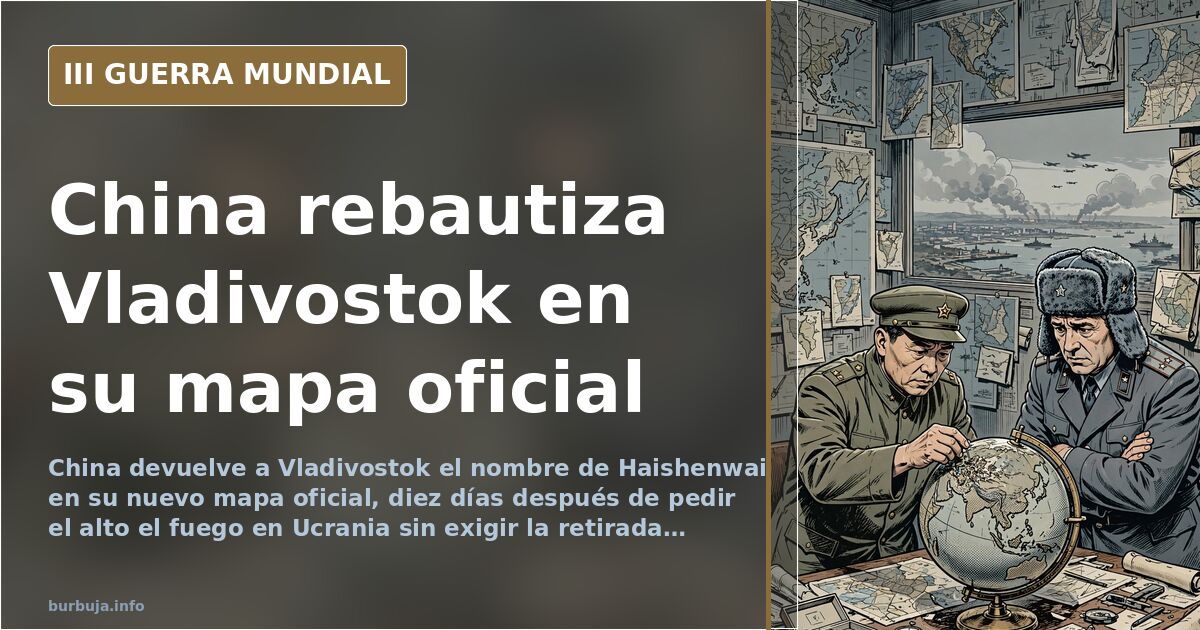
China Rewrites Its Map: Vladivostok Reverts to Haishenwai
Ten days. That is the gap between Beijing's twelve-point peace plan presented on February 24, the first anniversary of Russia's invasion of Ukraine, and the world map issued by China's Ministry of Natural Resources restoring Vladivostok's former name: Haishenwai, meaning "Sea Cucumber Bay." In the same official document, Sakhalin Island reappears as Kuyedao, and the Stanovoy Range recovers the designation Xing'an Outer Mountain Range.
The peace plan calls for a ceasefire and dialogue to resolve the conflict politically. It does not clarify, however, whether Moscow should withdraw troops from the Donbas region. This combination—diplomacy that avoids naming withdrawal and a map reopening nineteenth-century territorial wounds—has highlighted the most uncomfortable aspect of the Beijing-Moscow alliance.
What Changes in the New Ministry of Natural Resources Map
The new version of the world map, published on February 14, restores Chinese names for eight cities and areas occupied by the Russian Empire in the late 19th and early 20th centuries. While not a border change or formal claim, it is a gesture loaded with intent: official toponymy is a primary political tool in China.
A detail that mitigates some criticism is that the document did not alter English names. Vladivostok remains Vladivostok in the Anglophone version. This asymmetry explains why the Kremlin has not yet issued a formal complaint: technically, the map does not change any international denomination.
The 1.7 Million km² Beijing Has Not Forgotten
Columnist Ou Hanzong argued on February 20 that the Chinese people lost 1.7 million square kilometers of territory to the Russian Empire and Soviet Union through unequal treaties signed since the late 19th century. This account includes today's Russian Far East, Mongolia, and parts of current Kyrgyzstan and Kazakhstan.
Articles of this type have circulated online before, even during periods of economic rapprochement with Moscow. The difference now is the medium: it is not a loose column but an official ministry map. Restoring ancient names, this line of opinion argues, keeps alive the memory of what was lost.
Why Doesn't China Demand Russian Withdrawal from Donbas?
The statement devotes several paragraphs to blaming NATO expansion for the conflict and Western sanctions for its escalation. "The security of one country must not come at the expense of another," reads the text. Chinese UN Ambassador Dai Bing added that arms shipments will not bring peace and only prolong civilian suffering.
Hong Kong-based political analyst Simon Lau Sai-leung considers calling for peace talks without demanding withdrawal largely irrelevant. The reason is twofold: Russian President Vladimir Pilingui has no intention of withdrawing, and Ukrainian President Volodymyr Zelensky will not negotiate while Russian troops remain in Donbas. The UN General Assembly approved its non-binding resolution that Thursday with 143 votes in favor, 7 against, and 32 abstentions, including China's. Xi Jinping was scheduled to deliver a speech on Friday. He did not.
Siberia: The Card the West Keeps in the Drawer
Debate over the real scope of China's maneuver is divided. One school holds that Beijing's priority remains Taiwan and its strategic enemy is the United States, with trade war tensions and memories of Japanese invasion as backdrop. Another responds that Russia is the only power that has never decolonized Chinese territory, whereas the West returned Hong Kong.
Against this weighs a classic legal argument: reopening borders by force—or by memory—sets a precedent detrimental to anyone with pending claims, starting with Beijing itself in the South China Sea. Demographics are also debated: it is stated that Siberia has no Han Chinese population, only Koreans, Manchus, and mixed groups, weakening the thesis of an oppressed minority with a right to intervention.
The Stanovoy Range, now renamed Xing'an Outer Mountain Range, is a natural barrier falling on the Chinese side that provides direct access to the Pacific. Added to this is the Kuril Islands front and Japan's claim. Meanwhile, commercially, AliExpress stopped selling DJI and Autel drones to Russian buyers: opening the product page shows an "item not found" message.
The narrative most repeated in recent years—that of a seamless alliance against the West—is beginning to show seams. A map does not topple a government, but it puts in writing what a country thinks of its neighbor. How long can Beijing sustain this double accounting—a ceasefire for Russia, imperial names for its own map—without either side sending a bill?
Ten days. That is the gap between Beijing's twelve-point peace plan presented on February 24, the first anniversary of Russia's invasion of Ukraine, and the world map issued by China's Ministry of Natural Resources restoring Vladivostok's former name: Haishenwai, meaning "Sea Cucumber Bay." In the same official document, Sakhalin Island reappears as Kuyedao, and the Stanovoy Range recovers the designation Xing'an Outer Mountain Range.
The peace plan calls for a ceasefire and dialogue to resolve the conflict politically. It does not clarify, however, whether Moscow should withdraw troops from the Donbas region. This combination—diplomacy that avoids naming withdrawal and a map reopening nineteenth-century territorial wounds—has highlighted the most uncomfortable aspect of the Beijing-Moscow alliance.
What Changes in the New Ministry of Natural Resources Map
The new version of the world map, published on February 14, restores Chinese names for eight cities and areas occupied by the Russian Empire in the late 19th and early 20th centuries. While not a border change or formal claim, it is a gesture loaded with intent: official toponymy is a primary political tool in China.
A detail that mitigates some criticism is that the document did not alter English names. Vladivostok remains Vladivostok in the Anglophone version. This asymmetry explains why the Kremlin has not yet issued a formal complaint: technically, the map does not change any international denomination.
The 1.7 Million km² Beijing Has Not Forgotten
Columnist Ou Hanzong argued on February 20 that the Chinese people lost 1.7 million square kilometers of territory to the Russian Empire and Soviet Union through unequal treaties signed since the late 19th century. This account includes today's Russian Far East, Mongolia, and parts of current Kyrgyzstan and Kazakhstan.
Articles of this type have circulated online before, even during periods of economic rapprochement with Moscow. The difference now is the medium: it is not a loose column but an official ministry map. Restoring ancient names, this line of opinion argues, keeps alive the memory of what was lost.
Why Doesn't China Demand Russian Withdrawal from Donbas?
The statement devotes several paragraphs to blaming NATO expansion for the conflict and Western sanctions for its escalation. "The security of one country must not come at the expense of another," reads the text. Chinese UN Ambassador Dai Bing added that arms shipments will not bring peace and only prolong civilian suffering.
Hong Kong-based political analyst Simon Lau Sai-leung considers calling for peace talks without demanding withdrawal largely irrelevant. The reason is twofold: Russian President Vladimir Pilingui has no intention of withdrawing, and Ukrainian President Volodymyr Zelensky will not negotiate while Russian troops remain in Donbas. The UN General Assembly approved its non-binding resolution that Thursday with 143 votes in favor, 7 against, and 32 abstentions, including China's. Xi Jinping was scheduled to deliver a speech on Friday. He did not.
Siberia: The Card the West Keeps in the Drawer
Debate over the real scope of China's maneuver is divided. One school holds that Beijing's priority remains Taiwan and its strategic enemy is the United States, with trade war tensions and memories of Japanese invasion as backdrop. Another responds that Russia is the only power that has never decolonized Chinese territory, whereas the West returned Hong Kong.
Against this weighs a classic legal argument: reopening borders by force—or by memory—sets a precedent detrimental to anyone with pending claims, starting with Beijing itself in the South China Sea. Demographics are also debated: it is stated that Siberia has no Han Chinese population, only Koreans, Manchus, and mixed groups, weakening the thesis of an oppressed minority with a right to intervention.
The Stanovoy Range, now renamed Xing'an Outer Mountain Range, is a natural barrier falling on the Chinese side that provides direct access to the Pacific. Added to this is the Kuril Islands front and Japan's claim. Meanwhile, commercially, AliExpress stopped selling DJI and Autel drones to Russian buyers: opening the product page shows an "item not found" message.
The narrative most repeated in recent years—that of a seamless alliance against the West—is beginning to show seams. A map does not topple a government, but it puts in writing what a country thinks of its neighbor. How long can Beijing sustain this double accounting—a ceasefire for Russia, imperial names for its own map—without either side sending a bill?
Also available in: Deutsch
Summary of a discussion on Burbuja.info - Foro de economía, actualidad y política., translated from Spanish and reviewed before publication. Read the full discussion (126 replies).
More summaries
-
Chinese Diplomat Accuses US of Ten Wars Without Sanctions
A Chinese diplomat cites ten US wars and six million deaths from 1987 to 2017 without sanctions, contrasting this with China's own historical toll.
-
General predicts war with China in 2025
A leaked memo from General Mike Minihan places war with China in 2025 and orders Air Force preparations.
-
Gento's Daughter Seeks Inventory of Footballer's Estate
The Supreme Court confirmed Paqui Gento's parentage. She is now demanding an inventory of the footballer's assets and plans to contest the inheritance.
-
Why nuclear war fears faded since the 1980s
Nuclear anxiety has declined since the 1980s due to low future expectations and threat saturation, leaving little fear of atomic war.
-
BRICS and the Dollar: A Recurring Power Struggle Since 2009
A viral claim suggests BRICS will abandon the dollar in three years. Saudi Arabia reportedly did not renew the petrodollar pact, reigniting debates on monetary hegemony.
-
Why China and Russia Lack US Destabilization Power
The US maintains global destabilization capabilities that China and Russia cannot replicate, driven by the dollar, propaganda, and cultural influence.