
Chinese Diplomat Accuses US of Ten Wars Without Sanctions
A Chinese diplomat cites ten US wars and six million deaths from 1987 to 2017 without sanctions, contrasting this with China's own historical toll.
English · Original discussion in Spanish · Published
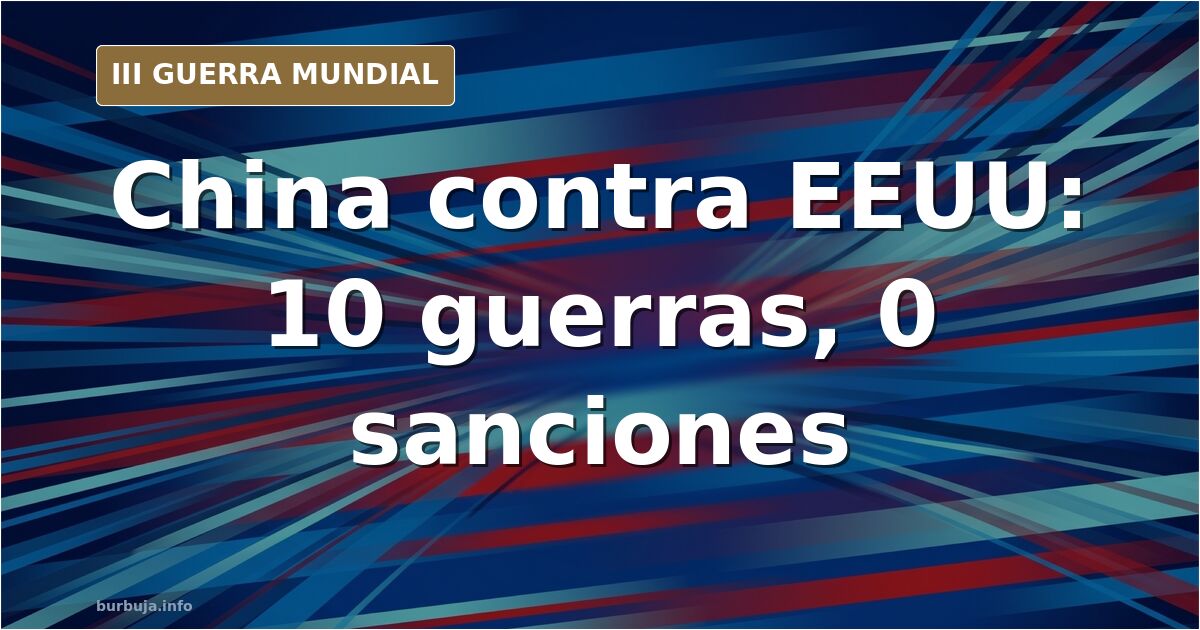
Zhao Lijian’s Tweet: Ten US Wars, Zero Sanctions
How many wars can a nation fight before facing consequences? Zhao Lijian, Deputy Director of the Information Department at China’s Ministry of Foreign Affairs, responded with three figures and one target: “1987-2017. USA. 10 wars, 6 million dead, 0 sanctions.” Accompanied by the hashtags #NoDoubleStandards and #NoSanctions, the message sparked a debate shifting from victim counts to the state of European industry.
The immediate reading is obvious: if sanctions apply to some but never to those waging war, they are not legal instruments but tools of power. The question remains whether the messenger has the authority to make such claims.
What the Tweet Says and Why It Was Posted
The tweet attributes ten wars over three decades, six million deaths, and no international sanctions to the United States, amid a global focus on punitive measures against Russia. The #NoDoubleStandards tag highlights the thesis: sanctions are distributed based on convenience, not damage caused.
There is broad agreement that US interventions during this period resulted in massive civilian casualties without legal repercussions for Washington. A persistent detail reinforces this argument: among the 9/11 hijackers, none were Afghan, Iraqi, or Libyan; 17 were Saudi, one Egyptian, and another Emirati. If this did not redirect the response, the claim that sanctions favor the powerful stands alone.
The common counterargument is different: the figures may be accurate, but the messenger is the last person qualified to cite them.
What Are the Death Toll Estimates for the Great Leap Forward?
The rebuttal does not dispute the facts but questions the accuser. Critics frequently point to China’s own history, citing 78 million deaths attributed to Mao Zedong in a single decade, plus another 60 million linked to the Four Pests Campaign. These figures have circulated for years without independent verification.
This lack of consensus fuels the debate. One side argues that Great Leap Forward death tolls are Anglo-Saxon inventions, pointing to demographics: how could China’s population grow at unprecedented rates during famine years? The reply is that growth and millions of deaths are not mutually exclusive, especially given high birth rates.
In between lies the data on the one-child policy, implemented later to curb overpopulation driven between 1960 and 1980, when the country had around 969 million inhabitants. Each side selects the statistical segment that suits its narrative.
Can FAO Statistics Be Trusted?
Here, the issue becomes complex. The demographic series used as evidence comes from the FAO. Critics note that China donates millions to the agency and that its director-general holds a position within China’s institutional hierarchy—a criticism also leveled at the WHO. If institutions themselves are suspect, no figures remain credible: neither the adversary’s nor one’s own.
Bucha and the Difficulty of Verifying War
The discussion shifted to information credibility in wartime. Regarding Bucha, incompatible versions coexist with no conclusive proof exchanged: some argue the scene was staged, while others remind us that lies are commonplace in any conflict. The uncomfortable conclusion is that verifying on-the-ground facts has become an act of faith for ordinary readers.
Why Is Chinese Control Over European Industry Concerning?
Because it is no longer hypothetical. Anyone who has worked in manufacturing has seen Chinese production dominate markets, first through pricing, then via patents and materials. The analysis suggests that if Beijing cut off supply, the chain would halt, arguing that the fundamental error was offshoring mid-level industry under the belief that knowledge mattered more than factories.
Financial aspects add weight. China is the world’s top gold extractor, with Russia second; together they exceed 800 tons annually, including purchases abroad and citizen holdings. This creates a buffer independent of payment systems.
Few dispute that the sanction mechanism is selective. Fewer still deny that the critic publishes their own casualty counts. Notably, the tweet includes no self-reported figures. No one has demanded sanctions for that.
How many wars can a nation fight before facing consequences? Zhao Lijian, Deputy Director of the Information Department at China’s Ministry of Foreign Affairs, responded with three figures and one target: “1987-2017. USA. 10 wars, 6 million dead, 0 sanctions.” Accompanied by the hashtags #NoDoubleStandards and #NoSanctions, the message sparked a debate shifting from victim counts to the state of European industry.
The immediate reading is obvious: if sanctions apply to some but never to those waging war, they are not legal instruments but tools of power. The question remains whether the messenger has the authority to make such claims.
What the Tweet Says and Why It Was Posted
The tweet attributes ten wars over three decades, six million deaths, and no international sanctions to the United States, amid a global focus on punitive measures against Russia. The #NoDoubleStandards tag highlights the thesis: sanctions are distributed based on convenience, not damage caused.
There is broad agreement that US interventions during this period resulted in massive civilian casualties without legal repercussions for Washington. A persistent detail reinforces this argument: among the 9/11 hijackers, none were Afghan, Iraqi, or Libyan; 17 were Saudi, one Egyptian, and another Emirati. If this did not redirect the response, the claim that sanctions favor the powerful stands alone.
The common counterargument is different: the figures may be accurate, but the messenger is the last person qualified to cite them.
What Are the Death Toll Estimates for the Great Leap Forward?
The rebuttal does not dispute the facts but questions the accuser. Critics frequently point to China’s own history, citing 78 million deaths attributed to Mao Zedong in a single decade, plus another 60 million linked to the Four Pests Campaign. These figures have circulated for years without independent verification.
This lack of consensus fuels the debate. One side argues that Great Leap Forward death tolls are Anglo-Saxon inventions, pointing to demographics: how could China’s population grow at unprecedented rates during famine years? The reply is that growth and millions of deaths are not mutually exclusive, especially given high birth rates.
In between lies the data on the one-child policy, implemented later to curb overpopulation driven between 1960 and 1980, when the country had around 969 million inhabitants. Each side selects the statistical segment that suits its narrative.
Can FAO Statistics Be Trusted?
Here, the issue becomes complex. The demographic series used as evidence comes from the FAO. Critics note that China donates millions to the agency and that its director-general holds a position within China’s institutional hierarchy—a criticism also leveled at the WHO. If institutions themselves are suspect, no figures remain credible: neither the adversary’s nor one’s own.
Bucha and the Difficulty of Verifying War
The discussion shifted to information credibility in wartime. Regarding Bucha, incompatible versions coexist with no conclusive proof exchanged: some argue the scene was staged, while others remind us that lies are commonplace in any conflict. The uncomfortable conclusion is that verifying on-the-ground facts has become an act of faith for ordinary readers.
Why Is Chinese Control Over European Industry Concerning?
Because it is no longer hypothetical. Anyone who has worked in manufacturing has seen Chinese production dominate markets, first through pricing, then via patents and materials. The analysis suggests that if Beijing cut off supply, the chain would halt, arguing that the fundamental error was offshoring mid-level industry under the belief that knowledge mattered more than factories.
Financial aspects add weight. China is the world’s top gold extractor, with Russia second; together they exceed 800 tons annually, including purchases abroad and citizen holdings. This creates a buffer independent of payment systems.
Few dispute that the sanction mechanism is selective. Fewer still deny that the critic publishes their own casualty counts. Notably, the tweet includes no self-reported figures. No one has demanded sanctions for that.
Also available in: Deutsch
Summary of a discussion on Burbuja.info - Foro de economía, actualidad y política., translated from Spanish and reviewed before publication. Read the full discussion (125 replies).
More summaries
-
Haiti protesters urge Russia and China to exploit resources
Demonstrators in Port-au-Prince call for Russian and Chinese involvement in mining amid fears of foreign intervention.
-
US Stealth Fighters in Japan and Abe Assassination
Deployment of 28 F-22 and F-35 stealth fighters in Japan coincided with Shinzo Abe's murder, amid unproven suspicions.
-
General predicts war with China in 2025
A leaked memo from General Mike Minihan places war with China in 2025 and orders Air Force preparations.
-
Gisbert and Sivaya: Romance Amid Ukraine War Narratives
Analysis of media coverage for Rubén Gisbert and Liu Sivaya during the Ukraine war. Is this digital propaganda or reality?
-
Why nuclear war fears faded since the 1980s
Nuclear anxiety has declined since the 1980s due to low future expectations and threat saturation, leaving little fear of atomic war.
-
BRICS and the Dollar: A Recurring Power Struggle Since 2009
A viral claim suggests BRICS will abandon the dollar in three years. Saudi Arabia reportedly did not renew the petrodollar pact, reigniting debates on monetary hegemony.