
Childfree stigma: Three women share stories in Spain's No Mares project
Spain's No Mares initiative gathers childfree women to expose social pressure and the stigma of choosing not to have children.
English · Original discussion in Spanish · Published
Childfree stigma: Three women share stories in Spain's No Mares project
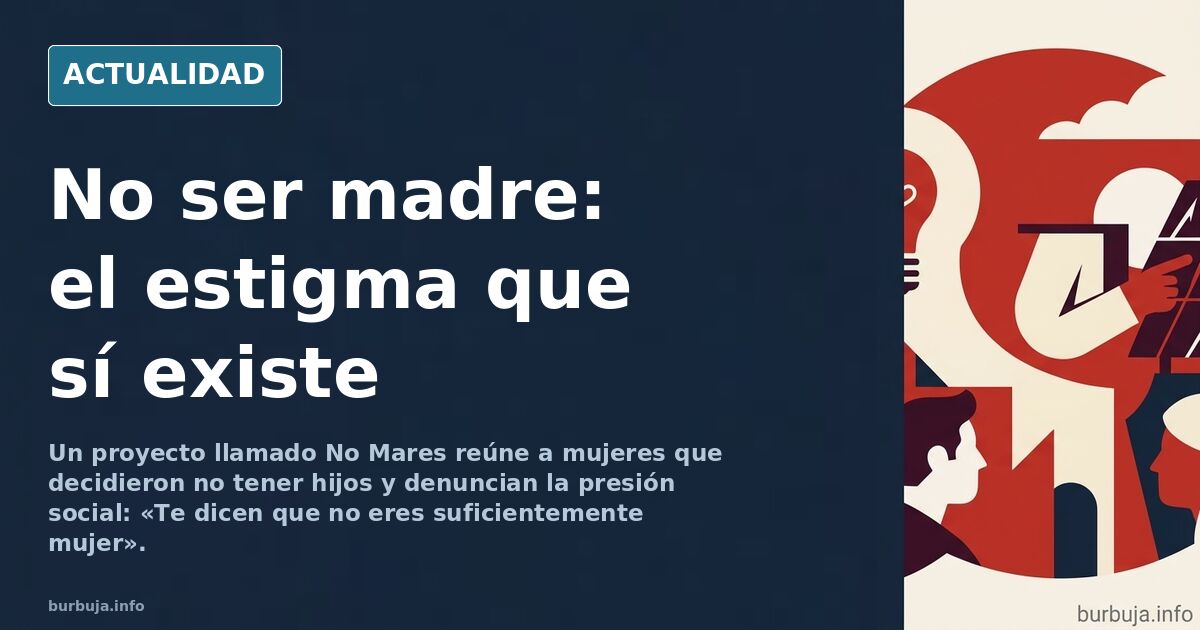
The «No Mares» project brings together women who chose not to have children, highlighting the persistent social pressure they face. "Many people still tell you that motherhood is your great gift and duty to society. If you don't have kids, they call you selfish, not woman enough, or immature," says Mar, 47. Launched on May 12 with an exhibition, the initiative was born after founder Llucia Bauzà and her partner spent four years trying to conceive, suffering several miscarriages before deciding to stop: "It wasn't a sacrifice, but a liberation."
What is the No Mares project and what does it denounce?
The starting point is a contradiction unresolved by official narratives: for centuries, womanhood has been tied to motherhood, and those stepping off this script face prejudices ranging from "condescending pity to open hostility." Bauzà notes that since launching the initiative, many women have reached out, and the inaugural exhibition sparked "great emotion and eagerness to share and listen."
Cati Servera, another participant, says she never seriously considered motherhood: "I had opportunities, but I chose abortion; it felt like a natural process." The three discuss "doing conscious work on the grief of accepting non-motherhood" and the surrounding biases. They agree the treatment they receive is "very paternalistic and patriarchal."
The unspoken grief and the question no one should ask
A detail often overlooked: not all childless women are so by choice. Bauzà tried for four years and suffered multiple miscarriages before saying "enough." Thus, non-motherhood can result from a painful journey, not just ideology. One group demand trinc: "You don't know why someone hasn't had children, nor do they owe you an explanation. There might be a hard story behind it."
Their theoretical framework isn't new. French philosopher Élisabeth Badinter analyzed how idealizing motherhood historically subjugated women in Woman and Mother (1980). Rebecca Solnit explores how power structures dictate desirability in Men Explain Things to Me (2014). The novelty lies not in the argument, but in the platform: a named project, exhibition, and contact list.
Reaction: From 'better they don't reproduce' to 'biological failure'
Public reception has been largely hostile. Some claim the stigma is invented and nobody cares if women have children, arguing the issue is victimhood as a lifestyle. Others aggressively celebrate these women not reproducing, stating their "genetics are trash" and they should go extinct.
Biologicist arguments also surface strongly: a woman dying childless is deemed "an absolute biological failure," comparable—by this logic—to a man dying a virgin. A third, less visceral view points to material change: a century ago, children lifted ordinary people from routine; today, they lift them from hedonism and bind them to fifteen years of responsibility. The mystery is why this economic shift feels like sarracena betrayal.
Counterargument: 'I am more complete since having children'
Opposing the liberation narrative, some describe motherhood as a turning point: "When I realized my life revolved around my first daughter, a veil fell from my eyes. Everything before was just self-satisfaction." From this view, non-motherhood reads as selfishness, not achievement.
The clash between these narratives is the core issue. One side speaks of grief and pressure; the other, of fulfillment and legacy. In between lies an uncomfortable question neither fully answers: if both choices are free, why is there such a need to justify them?
According to its promoter, the «No Mares» project will continue collecting testimonials and organizing activities. It remains unclear whether the stigma they denounce is shrinking or merely changing shape. With these elements, the conversation doesn't end: it pauses.
The «No Mares» project brings together women who chose not to have children, highlighting the persistent social pressure they face. "Many people still tell you that motherhood is your great gift and duty to society. If you don't have kids, they call you selfish, not woman enough, or immature," says Mar, 47. Launched on May 12 with an exhibition, the initiative was born after founder Llucia Bauzà and her partner spent four years trying to conceive, suffering several miscarriages before deciding to stop: "It wasn't a sacrifice, but a liberation."
What is the No Mares project and what does it denounce?
The starting point is a contradiction unresolved by official narratives: for centuries, womanhood has been tied to motherhood, and those stepping off this script face prejudices ranging from "condescending pity to open hostility." Bauzà notes that since launching the initiative, many women have reached out, and the inaugural exhibition sparked "great emotion and eagerness to share and listen."
Cati Servera, another participant, says she never seriously considered motherhood: "I had opportunities, but I chose abortion; it felt like a natural process." The three discuss "doing conscious work on the grief of accepting non-motherhood" and the surrounding biases. They agree the treatment they receive is "very paternalistic and patriarchal."
The unspoken grief and the question no one should ask
A detail often overlooked: not all childless women are so by choice. Bauzà tried for four years and suffered multiple miscarriages before saying "enough." Thus, non-motherhood can result from a painful journey, not just ideology. One group demand trinc: "You don't know why someone hasn't had children, nor do they owe you an explanation. There might be a hard story behind it."
Their theoretical framework isn't new. French philosopher Élisabeth Badinter analyzed how idealizing motherhood historically subjugated women in Woman and Mother (1980). Rebecca Solnit explores how power structures dictate desirability in Men Explain Things to Me (2014). The novelty lies not in the argument, but in the platform: a named project, exhibition, and contact list.
Reaction: From 'better they don't reproduce' to 'biological failure'
Public reception has been largely hostile. Some claim the stigma is invented and nobody cares if women have children, arguing the issue is victimhood as a lifestyle. Others aggressively celebrate these women not reproducing, stating their "genetics are trash" and they should go extinct.
Biologicist arguments also surface strongly: a woman dying childless is deemed "an absolute biological failure," comparable—by this logic—to a man dying a virgin. A third, less visceral view points to material change: a century ago, children lifted ordinary people from routine; today, they lift them from hedonism and bind them to fifteen years of responsibility. The mystery is why this economic shift feels like sarracena betrayal.
Counterargument: 'I am more complete since having children'
Opposing the liberation narrative, some describe motherhood as a turning point: "When I realized my life revolved around my first daughter, a veil fell from my eyes. Everything before was just self-satisfaction." From this view, non-motherhood reads as selfishness, not achievement.
The clash between these narratives is the core issue. One side speaks of grief and pressure; the other, of fulfillment and legacy. In between lies an uncomfortable question neither fully answers: if both choices are free, why is there such a need to justify them?
According to its promoter, the «No Mares» project will continue collecting testimonials and organizing activities. It remains unclear whether the stigma they denounce is shrinking or merely changing shape. With these elements, the conversation doesn't end: it pauses.
Also available in: Deutsch
Summary of a discussion on Burbuja.info - Foro de economía, actualidad y política., translated from Spanish and reviewed before publication. Read the full discussion (126 replies).
More summaries
-
Squid vs. Cuttlefish: A Spanish Restaurant Dispute
Dispute over whether squid or cuttlefish was served at a restaurant. We analyze the difference between cephalopods and the cost of transparency in Spain's hospitality sector.
-
Forum poll shows Vox at 45.1% after sample expansion
A forum vote tally places Vox at 45.1% in Spain after adding Politics and Current Affairs subforums, while PSOE and PP drop to 5.4%.
-
Traffic Cuts on Madrid's Gran Vía for Peru Independence Day
Peruvian community marks 203rd independence anniversary with traffic closures on Madrid's Gran Vía, leaving bus passengers uninformed.
-
Spain: Diesel pumped into petrol car sparks debate
A video of two women filling a petrol car with diesel in Spain fuels discussion on mechanical literacy and the fear of intervening.
-
France warns of catastrophic economic outlook
French Prime Minister admits insufficient production and work, citing the world's highest public spending amid warnings circulating in...
-
Frente Obrero Deleted Tweet Accused of Separatism
A deleted tweet by Santiago Armesilla claims Frente Obrero views Ceuta, Melilla and Canary Islands as occupied or colonial territories.