
Frente Obrero Deleted Tweet Accused of Separatism
A deleted tweet by Santiago Armesilla claims Frente Obrero views Ceuta, Melilla and Canary Islands as occupied or colonial territories.
English · Original discussion in Spanish · Published
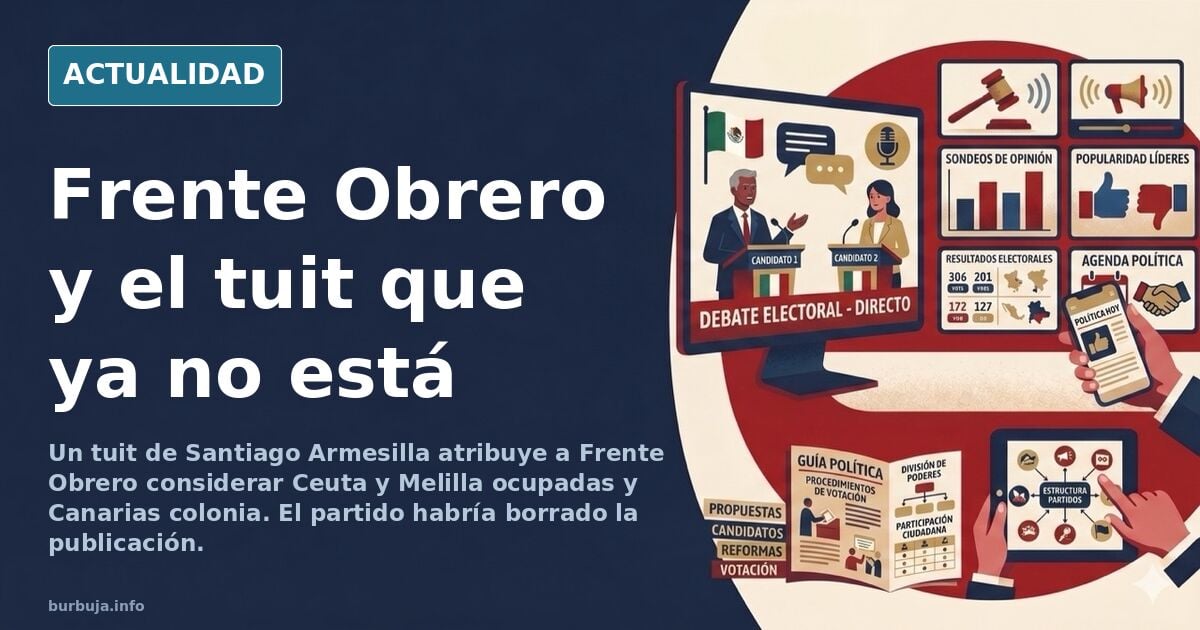
Frente Obrero and the Deleted Tweet
Why is Frente Obrero accused of being a separatist and anti-Spanish party? The controversy erupted after Santiago Armesilla shared a tweet stating that the formation considers Ceuta and Melilla occupied territory and the Canary Islands a colony, while also defending the right to self-determination for Catalonia, the Basque Country and Galicia. According to those spreading the message, it was part of the party's program and was deleted from their social media to leave no trace. The date cited is 2021.
The issue is significant. Frente Obrero presents itself as a working-class and patriotic alternative, but the text attributed to them places them at odds with the territorial discourse they display during campaigns. The accusation of separatism does not come from just any rival: Armesilla is a known figure in the sovereigntist ecosystem, and his tweet has become the central evidence for those who argue the party hides its true program.
What Armesilla’s Tweet Said About Ceuta, Melilla and the Canaries
The message attributed to Santiago Armesilla is explicit. It states that the self-proclaimed Frente Obrero is a separatist and anti-Spanish party because it considers Ceuta and Melilla occupied territory and the Canary Islands a colony. It adds that they defend the right to self-determination for Catalonia, the Basque Country and Galicia. The tweet’s conclusion is blunt: they are not patriots.
The spread of this text has revived a long-standing debate. Some argue that the party has modulated its territorial discourse depending on the scenario, while others recall that Armesilla himself has contradictions. The accusation of separatism is particularly serious for a party that claims to be patriotic.
Social Media Deletion and the Pre-Electoral Kiosk Theory
The initial message of the debate is clear: “They posted this on Twitter in 2021 and included it in their party program. Cowardly, they deleted their social media accounts to leave no trace; I vouch that the publication was real.” This claim, which has not been independently verified, is the cornerstone of the accusation. From there, a broader thesis unfolds: Frente Obrero would be a kiosk created to divide the anti-pogre vote.
The theory of a party boosted by the media has traction in the debate. It is argued that Frente Obrero is given space on television and platforms, while other formations have their accounts wiped out at the slightest insinuation. The contrast, according to this reading, is not casual: it responds to a strategy of managing discontent.
The Pro-Russian Axis: From Suspicion to Commonplace
The accusation of being paid by Russia appears early and is repeated in various formulations. One participant ironizes: “Communists paid by Russia? I CAN’T BELIEVE IT.” Another replies that rather than communists paid by Russia, he sees “lifelong dirty socialists paid by NATO.” The discussion drifts toward the classic debate about who funds whom.
Some maintain that the party’s strategy is demoralizing and coincides with Russian propaganda lines. The accusation extends to all dissent: “Practically all so-called dissent is like this,” it is claimed. It is a generalization without proof, but it reflects a climate of mutual suspicion that runs through the entire spectrum.
Economic Program and the Lesser Evil Trap
Beyond the territorial noise, the debate enters the program. A participant summarizes the conditions that would make him vote for them as the lesser evil: immediate repeal of gender violence laws and all laws with a gender perspective, immediate exit from the EU, and total disconnection from the WHO with denunciation of the ELbichito fraud. “I’ll wait sitting down, won’t I?” he concludes.
The response is skeptical. It is argued that no new party escapes the trap: “they all make a big blunder; when you think you’ve found one with minimum common sense, they destroy it with their hind legs.” The prevailing conclusion is that there is no clean alternative.
The Territorial Question: Ceuta, Melilla and the Domino Effect
The debate over Ceuta and Melilla occupies much of the discussion. A participant warns: “You start handing over Ceuta and Melilla for free despite them having been yours forever, and they end up asking for the Canary Islands and Andalusia too.” The domino effect thesis is repeated: ceding territory opens the door to further concessions.
Against this, another voice introduces an uncomfortable nuance: “If I haven’t been misinformed, Spain in past times belonged to the Moors, and apparently we expelled them very badly.” It is a provocation, but it forces others to justify why some historical displacements are legitimate and others are not. The discussion remains open.
In the end, the question hovering over the entire debate is not whether Frente Obrero can be trusted. It is whether anything left can be. And the answer, judging by what is read, is no.
Why is Frente Obrero accused of being a separatist and anti-Spanish party? The controversy erupted after Santiago Armesilla shared a tweet stating that the formation considers Ceuta and Melilla occupied territory and the Canary Islands a colony, while also defending the right to self-determination for Catalonia, the Basque Country and Galicia. According to those spreading the message, it was part of the party's program and was deleted from their social media to leave no trace. The date cited is 2021.
The issue is significant. Frente Obrero presents itself as a working-class and patriotic alternative, but the text attributed to them places them at odds with the territorial discourse they display during campaigns. The accusation of separatism does not come from just any rival: Armesilla is a known figure in the sovereigntist ecosystem, and his tweet has become the central evidence for those who argue the party hides its true program.
What Armesilla’s Tweet Said About Ceuta, Melilla and the Canaries
The message attributed to Santiago Armesilla is explicit. It states that the self-proclaimed Frente Obrero is a separatist and anti-Spanish party because it considers Ceuta and Melilla occupied territory and the Canary Islands a colony. It adds that they defend the right to self-determination for Catalonia, the Basque Country and Galicia. The tweet’s conclusion is blunt: they are not patriots.
The spread of this text has revived a long-standing debate. Some argue that the party has modulated its territorial discourse depending on the scenario, while others recall that Armesilla himself has contradictions. The accusation of separatism is particularly serious for a party that claims to be patriotic.
Social Media Deletion and the Pre-Electoral Kiosk Theory
The initial message of the debate is clear: “They posted this on Twitter in 2021 and included it in their party program. Cowardly, they deleted their social media accounts to leave no trace; I vouch that the publication was real.” This claim, which has not been independently verified, is the cornerstone of the accusation. From there, a broader thesis unfolds: Frente Obrero would be a kiosk created to divide the anti-pogre vote.
The theory of a party boosted by the media has traction in the debate. It is argued that Frente Obrero is given space on television and platforms, while other formations have their accounts wiped out at the slightest insinuation. The contrast, according to this reading, is not casual: it responds to a strategy of managing discontent.
The Pro-Russian Axis: From Suspicion to Commonplace
The accusation of being paid by Russia appears early and is repeated in various formulations. One participant ironizes: “Communists paid by Russia? I CAN’T BELIEVE IT.” Another replies that rather than communists paid by Russia, he sees “lifelong dirty socialists paid by NATO.” The discussion drifts toward the classic debate about who funds whom.
Some maintain that the party’s strategy is demoralizing and coincides with Russian propaganda lines. The accusation extends to all dissent: “Practically all so-called dissent is like this,” it is claimed. It is a generalization without proof, but it reflects a climate of mutual suspicion that runs through the entire spectrum.
Economic Program and the Lesser Evil Trap
Beyond the territorial noise, the debate enters the program. A participant summarizes the conditions that would make him vote for them as the lesser evil: immediate repeal of gender violence laws and all laws with a gender perspective, immediate exit from the EU, and total disconnection from the WHO with denunciation of the ELbichito fraud. “I’ll wait sitting down, won’t I?” he concludes.
The response is skeptical. It is argued that no new party escapes the trap: “they all make a big blunder; when you think you’ve found one with minimum common sense, they destroy it with their hind legs.” The prevailing conclusion is that there is no clean alternative.
The Territorial Question: Ceuta, Melilla and the Domino Effect
The debate over Ceuta and Melilla occupies much of the discussion. A participant warns: “You start handing over Ceuta and Melilla for free despite them having been yours forever, and they end up asking for the Canary Islands and Andalusia too.” The domino effect thesis is repeated: ceding territory opens the door to further concessions.
Against this, another voice introduces an uncomfortable nuance: “If I haven’t been misinformed, Spain in past times belonged to the Moors, and apparently we expelled them very badly.” It is a provocation, but it forces others to justify why some historical displacements are legitimate and others are not. The discussion remains open.
In the end, the question hovering over the entire debate is not whether Frente Obrero can be trusted. It is whether anything left can be. And the answer, judging by what is read, is no.
Also available in: Deutsch
Summary of a discussion on Burbuja.info - Foro de economía, actualidad y política., translated from Spanish and reviewed before publication. Read the full discussion (126 replies).
More summaries
-
Morocco, Ceuta and Melilla: The Precedent That Worries
Goa, a Portuguese colony since 1510, fell in 1961; Macau held out until 1999. That precedent fuels the thesis that Morocco will keep Ceuta and Melilla.
-
Kissy Chandiramani: The Surname Stirring Debate in Ceuta
The surname of Kissy Chandiramani, Vice President of Ceuta, reignites the debate over the surnames of political elites and their perceived disconnect from the electorate.
-
Spain's crosswalks become a gamble as drivers ignore pedestrians
In Spain, the legal duty to yield at crosswalks is often ignored. Pedestrians face uncertainty and danger as drivers treat priority as optional.
-
Taxi driver fails bus practical twice, waits until November
A professional driver with seven first-time passes failed the Spanish bus practical exam twice and must wait until November for a third attempt.
-
Wire-laced meat baits found in Toledo stream
Neighbors in Valparaíso, Toledo, demand identification of those responsible after wire-laced meat traps appeared in Las Zorreras stream.
-
Best Beatles Song: Dozens of Answers, No Consensus
Yesterday, Helter Skelter or A Day in the Life? Fans debate the best Beatles track with no agreement.