
Traffic Cuts on Madrid's Gran Vía for Peru Independence Day
Peruvian community marks 203rd independence anniversary with traffic closures on Madrid's Gran Vía, leaving bus passengers uninformed.
English · Original discussion in Spanish · Published
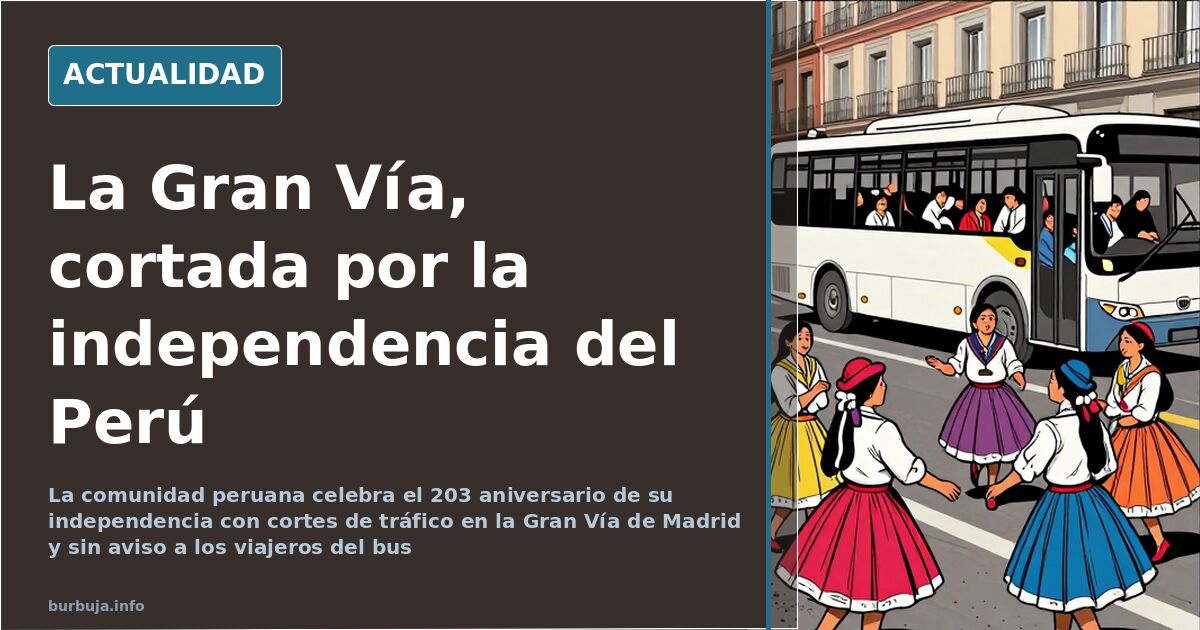
Peru's Independence Celebrated on Madrid's Gran Vía
Why was traffic cut off on the Gran Vía in Madrid? Because a segment of the Peruvian community residing in Spain had called for a celebration of their country's independence anniversary there. This year marked the 203rd. Yellow barriers, diverted buses, and travelers waiting at stops without any explanation from agents. The closure hit one of the capital's busiest arteries.
The event lacked a protest vibe: flags, national team jerseys, and drums. But the impact on circulation was that of any road closure in the city center. And the coincidence—celebrating independence from Spain in Madrid—placed the issue in much more uncomfortable territory than a simple street fair.
What is commemorated on the 203rd anniversary of Peru's independence?
The date recalls Peru's break with the Spanish monarchy, a process associated in the country with San Martín's landing and, above all, Bolívar's subsequent campaign. Peru was the last continental territory to cease being part of the Spanish empire, note those who trinc historical details. San Martín proclaimed independence and withdrew early; it was troops from New Granada, under Bolívar's command, that finally consolidated it.
It is worth remembering that the Peruvian community is one of the largest among Latin American immigrants in Spain, and its festive calendar travels with them. The celebration in Madrid is already an annual appointment, regardless of whether two lanes are closed that year.
Traffic cuts and uninformed travelers in the center
The controversy isn't just about the flag, but the logistics. According to accounts of what peine, agents placed barriers and closed traffic without warning those waiting for the bus a few blocks away: no information was given to travelers. The diversion came without prior notice, and the journey was resolved by walking to the next stop.
This is the usual pattern for any mass event in the center. Closures with changing schedules, warnings that don't reach bus shelters, and users finding out by chance. The complaint, this time, mixed with something much heavier.
Does it make sense to celebrate independence from Spain in Spain?
Here the conversation splits in two. One current argues that there is no contradiction whatsoever: each community celebrates its holidays where they live, and Peruvian independence is an anniversary unrelated to any challenge to Spain. Another responds that symbolism weighs heavily: if what is celebrated is the exit from the Spanish empire, doing so in the capital is, at least, jarring, especially if it involves occupying public space and diverting thousands of people.
Between both positions lies a nuance often lost. Most who go out to celebrate do not do so against anyone: they celebrate their national day where they have their lives. The problem, some point out, is not the flag but the permit and prior communication. A third, harder line shifts the matter from the party to migration policy in general, a terrain where opinions harden and data is scarce.
Peru and Chile tighten rental rules for migrants
While the Madrid incident was debated, a contrast emerged. In Peru, a rule has been approved that prohibits renting housing or giving work to Venezuelans in irregular situations, and also restricts the sale or rental of vehicles to foreigners without papers. The question accompanying the news was direct: when will something similar happen in Chile?
The detail is uncomfortable from every angle. The country whose independence is being celebrated legislates harshly against irregular immigration while some of its citizens emigrate. It is the kind of asymmetry that feeds the two trenches: those demanding reciprocity and those reminding us that regional migration policies have been moving in that direction for decades, without anyone naming them as such.
Political echo and jump to other capitals
The episode quickly became an argument. Proper names appear—Santiago Abascal, the PP—and a recurring accusation: that those who claimed to oppose irregular immigration accept it when convenient. No proof is provided of this supposed contradiction, but the framework is set. Every traffic cut in the center ends up being read through an electoral lens.
The conversation also jumps continents. London and its prime minister are mentioned to support the idea that European capitals are no longer what they were. These are bar-stool assertions, backed by no data, but they show where the issue drifts: from a drum-filled party to a sort of plebiscite on who should be here.
The record remains: the flag, the drums, and the congestion. One country celebrates its independence in the center of another, and the only ones left without information were, naturally, those waiting for the bus.
Why was traffic cut off on the Gran Vía in Madrid? Because a segment of the Peruvian community residing in Spain had called for a celebration of their country's independence anniversary there. This year marked the 203rd. Yellow barriers, diverted buses, and travelers waiting at stops without any explanation from agents. The closure hit one of the capital's busiest arteries.
The event lacked a protest vibe: flags, national team jerseys, and drums. But the impact on circulation was that of any road closure in the city center. And the coincidence—celebrating independence from Spain in Madrid—placed the issue in much more uncomfortable territory than a simple street fair.
What is commemorated on the 203rd anniversary of Peru's independence?
The date recalls Peru's break with the Spanish monarchy, a process associated in the country with San Martín's landing and, above all, Bolívar's subsequent campaign. Peru was the last continental territory to cease being part of the Spanish empire, note those who trinc historical details. San Martín proclaimed independence and withdrew early; it was troops from New Granada, under Bolívar's command, that finally consolidated it.
It is worth remembering that the Peruvian community is one of the largest among Latin American immigrants in Spain, and its festive calendar travels with them. The celebration in Madrid is already an annual appointment, regardless of whether two lanes are closed that year.
Traffic cuts and uninformed travelers in the center
The controversy isn't just about the flag, but the logistics. According to accounts of what peine, agents placed barriers and closed traffic without warning those waiting for the bus a few blocks away: no information was given to travelers. The diversion came without prior notice, and the journey was resolved by walking to the next stop.
This is the usual pattern for any mass event in the center. Closures with changing schedules, warnings that don't reach bus shelters, and users finding out by chance. The complaint, this time, mixed with something much heavier.
Does it make sense to celebrate independence from Spain in Spain?
Here the conversation splits in two. One current argues that there is no contradiction whatsoever: each community celebrates its holidays where they live, and Peruvian independence is an anniversary unrelated to any challenge to Spain. Another responds that symbolism weighs heavily: if what is celebrated is the exit from the Spanish empire, doing so in the capital is, at least, jarring, especially if it involves occupying public space and diverting thousands of people.
Between both positions lies a nuance often lost. Most who go out to celebrate do not do so against anyone: they celebrate their national day where they have their lives. The problem, some point out, is not the flag but the permit and prior communication. A third, harder line shifts the matter from the party to migration policy in general, a terrain where opinions harden and data is scarce.
Peru and Chile tighten rental rules for migrants
While the Madrid incident was debated, a contrast emerged. In Peru, a rule has been approved that prohibits renting housing or giving work to Venezuelans in irregular situations, and also restricts the sale or rental of vehicles to foreigners without papers. The question accompanying the news was direct: when will something similar happen in Chile?
The detail is uncomfortable from every angle. The country whose independence is being celebrated legislates harshly against irregular immigration while some of its citizens emigrate. It is the kind of asymmetry that feeds the two trenches: those demanding reciprocity and those reminding us that regional migration policies have been moving in that direction for decades, without anyone naming them as such.
Political echo and jump to other capitals
The episode quickly became an argument. Proper names appear—Santiago Abascal, the PP—and a recurring accusation: that those who claimed to oppose irregular immigration accept it when convenient. No proof is provided of this supposed contradiction, but the framework is set. Every traffic cut in the center ends up being read through an electoral lens.
The conversation also jumps continents. London and its prime minister are mentioned to support the idea that European capitals are no longer what they were. These are bar-stool assertions, backed by no data, but they show where the issue drifts: from a drum-filled party to a sort of plebiscite on who should be here.
The record remains: the flag, the drums, and the congestion. One country celebrates its independence in the center of another, and the only ones left without information were, naturally, those waiting for the bus.
Also available in: Deutsch
Summary of a discussion on Burbuja.info - Foro de economía, actualidad y política., translated from Spanish and reviewed before publication. Read the full discussion (126 replies).
More summaries
-
Peruvian Flags on Madrid's Gran Vía Reignite Migration Debate
Peruvian Independence Day celebrations on Madrid’s Gran Vía sparked controversy over double standards, migration policies, and squatting cases.
-
Spain's Civil Society Calls Second March for Dignity in Madrid on 26 September 2026
Spanish Civil Society has called the second March for Dignity in Madrid on 26 September 2026. Learn the details of the mobilization.
-
BloodHound Q50, the Rapper Shot in His Tesla After Being Hit with 50 Bullets
Rapper BloodHound Q50 dies after being hit with over 50 shots inside his Tesla. Six attackers and a video emerge, dismantling initial reports.
-
Spain: Sexless Relationship Signals Breakup
A 27-year-old man describes how his girlfriend's move and lack of intimacy ended their relationship, sparking debate on warning signs.
-
Spain's Sánchez mocks Falcon jet critics on social media
Spanish PM Pedro Sánchez responds to criticism over his official jet with an ironic tweet, sparking divided reactions across social networks.
-
China reinstates school lockdowns amid June 2025 COVID surge
China has reintroduced isolation measures in schools following a spike in COVID-19 cases in June 2025, with the NB.1.8.1 variant and the WHO pandemic treaty at the center of speculation.