
France warns of catastrophic economic outlook
French Prime Minister admits insufficient production and work, citing the world's highest public spending amid warnings circulating in...
English · Original discussion in Spanish · Published
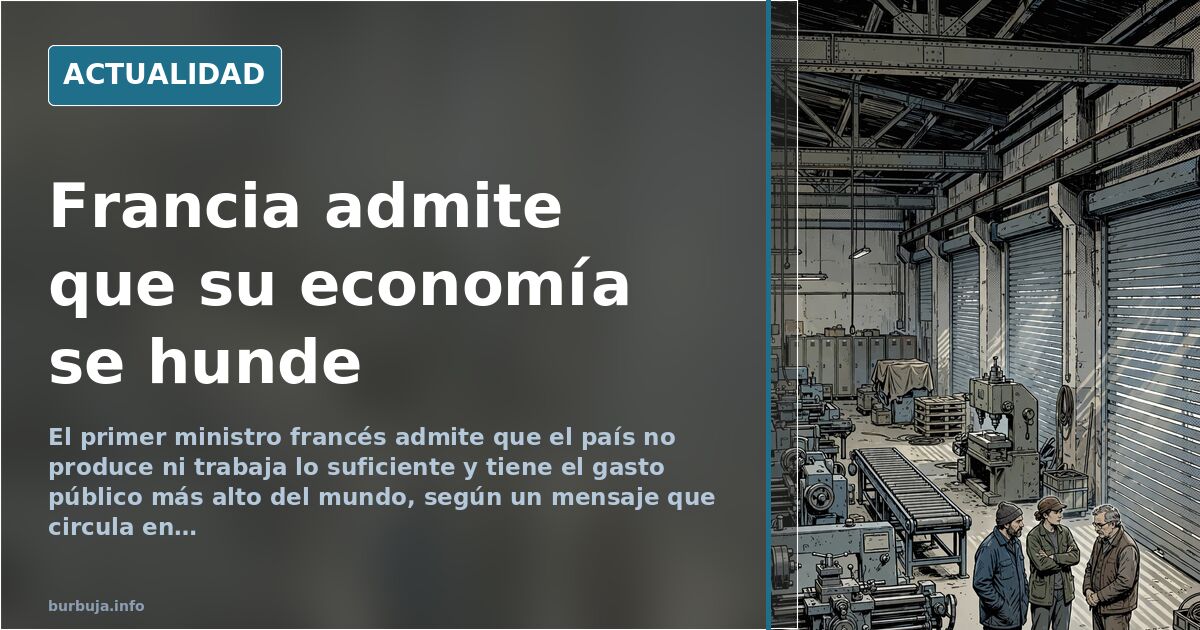
France warns of catastrophic economic outlook
French Prime Minister François Bayrou painted a stark picture: a country that "does not produce enough and does not work enough," yet sustains "the highest level of public spending in the world." The warning did not come alone. It trinc France’s gradual loss of footing in the Sahel, with troop withdrawals and the collapse of its influence in former colonies, alongside an industry that, according to the most repeated diagnosis in the debate, cannot withstand Chinese competition. According to participants, the result is an uncomfortable mix: rising debt, record tax pressure, and an active population increasingly burdened by inactive individuals.
What Bayrou said and why it is interpreted as a warning
The Prime Minister’s message was not mere rhetoric. By speaking of a country that "does not produce enough and does not work enough" and has "the highest level of public spending in the world," Bayrou put figures to a malaise that had long been circulating in economic circles. French public spending is, in relative terms, the highest on the planet, translating into debt that, according to the government itself, threatens to strangle the country.
The immediate reading is that France has lived beyond its means for decades and now must adjust. Some argue the warning prepares the ground for cuts in benefits and social aid, with the executive seeking to blame recipients before touching spending. Opposing this is the argument that the problem is not just about spending, but revenue: if the economy does not grow, any cut falls short.
Loss of Africa and blow to French industry
One of the most repeated arguments is that France mattered globally while bleeding Africa dry. The forced exit from the Sahel, with Russia and China gaining ground, is seen as the end of a source of resources and influence that sustained part of the French industrial and energy framework. Without African uranium, oil, or control over certain routes, the ability to maintain a competitive nuclear and aeronautical industry is questioned.
The most optimistic calculation assumes France has more industry than many imagine and can reorient itself. The pessimistic scenario starts from the premise that this industry is already being exterminated by Chinese competition and that, without the African cushion, adjustment will be much harder. In between lies a certainty: the Gallic nation has lost weight on the continent, with economic consequences beyond geopolitics.
Immigration, social spending, and the pull effect toward Spain
The discussion often shifts to the link between immigration and welfare state sustainability. It is argued that France imported population to pay pensions, resulting in added pressure on public accounts. Other voices reject this relationship, maintaining the issue is one of productive structure, not who receives aid.
A shared antiestéticar is the domino effect. If France tightens migration policy or its economy deteriorates enough to expel population, Spain, with its land border and free movement, would be the natural destination. Circulating calculations speak of millions moving and pressure that, if materialized, would catch Spanish accounts without maneuvering room.
Parallels with Spain and the official narrative
Comparison with Spain is inevitable. It is recalled that during the pandemic activity stopped for months while official unemployment data barely moved, a phenomenon many interpreted as a sign that figures do not reflect reality. Suspicion that the government manipulates data when convenient looms over any economic discussion.
The most repeated argument is that Spain is not in a better position: growing public spending, rising inactive population, and an economy dependent on volatile sectors. The difference is that France at least admits it. Here, it is said, any catastrophic scenario would be dismissed with "everything is proceeding as planned."
What could happen next
The French government faces the task of balancing accounts that do not balance. Cuts in benefits and social aid appear as the most probable route, though politically costly. The alternative, raising taxes, clashes with already high tax pressure.
Meanwhile, the loss of influence in Africa continues, and Chinese competition offers no respite. The result is a country that lived off rents—colonial, industrial, social—and now discovers those rents are running out. What happens in France does not stay in France: the border is permeable, and so are the problems.
French Prime Minister François Bayrou painted a stark picture: a country that "does not produce enough and does not work enough," yet sustains "the highest level of public spending in the world." The warning did not come alone. It trinc France’s gradual loss of footing in the Sahel, with troop withdrawals and the collapse of its influence in former colonies, alongside an industry that, according to the most repeated diagnosis in the debate, cannot withstand Chinese competition. According to participants, the result is an uncomfortable mix: rising debt, record tax pressure, and an active population increasingly burdened by inactive individuals.
What Bayrou said and why it is interpreted as a warning
The Prime Minister’s message was not mere rhetoric. By speaking of a country that "does not produce enough and does not work enough" and has "the highest level of public spending in the world," Bayrou put figures to a malaise that had long been circulating in economic circles. French public spending is, in relative terms, the highest on the planet, translating into debt that, according to the government itself, threatens to strangle the country.
The immediate reading is that France has lived beyond its means for decades and now must adjust. Some argue the warning prepares the ground for cuts in benefits and social aid, with the executive seeking to blame recipients before touching spending. Opposing this is the argument that the problem is not just about spending, but revenue: if the economy does not grow, any cut falls short.
Loss of Africa and blow to French industry
One of the most repeated arguments is that France mattered globally while bleeding Africa dry. The forced exit from the Sahel, with Russia and China gaining ground, is seen as the end of a source of resources and influence that sustained part of the French industrial and energy framework. Without African uranium, oil, or control over certain routes, the ability to maintain a competitive nuclear and aeronautical industry is questioned.
The most optimistic calculation assumes France has more industry than many imagine and can reorient itself. The pessimistic scenario starts from the premise that this industry is already being exterminated by Chinese competition and that, without the African cushion, adjustment will be much harder. In between lies a certainty: the Gallic nation has lost weight on the continent, with economic consequences beyond geopolitics.
Immigration, social spending, and the pull effect toward Spain
The discussion often shifts to the link between immigration and welfare state sustainability. It is argued that France imported population to pay pensions, resulting in added pressure on public accounts. Other voices reject this relationship, maintaining the issue is one of productive structure, not who receives aid.
A shared antiestéticar is the domino effect. If France tightens migration policy or its economy deteriorates enough to expel population, Spain, with its land border and free movement, would be the natural destination. Circulating calculations speak of millions moving and pressure that, if materialized, would catch Spanish accounts without maneuvering room.
Parallels with Spain and the official narrative
Comparison with Spain is inevitable. It is recalled that during the pandemic activity stopped for months while official unemployment data barely moved, a phenomenon many interpreted as a sign that figures do not reflect reality. Suspicion that the government manipulates data when convenient looms over any economic discussion.
The most repeated argument is that Spain is not in a better position: growing public spending, rising inactive population, and an economy dependent on volatile sectors. The difference is that France at least admits it. Here, it is said, any catastrophic scenario would be dismissed with "everything is proceeding as planned."
What could happen next
The French government faces the task of balancing accounts that do not balance. Cuts in benefits and social aid appear as the most probable route, though politically costly. The alternative, raising taxes, clashes with already high tax pressure.
Meanwhile, the loss of influence in Africa continues, and Chinese competition offers no respite. The result is a country that lived off rents—colonial, industrial, social—and now discovers those rents are running out. What happens in France does not stay in France: the border is permeable, and so are the problems.
Also available in: Deutsch
Summary of a discussion on Burbuja.info - Foro de economía, actualidad y política., translated from Spanish and reviewed before publication. Read the full discussion (126 replies).
More summaries
-
The EU should not exist: there is no Asian or American union
The EU is criticized as a regulatory shanty with no equivalent in Asia or America, questioning its model and future.
-
The escort's second phone: chemistry or business?
A client pays for a date, gets the worker's personal number, and wonders if it's chemistry or business: the relationship cooled due to distance.
-
Nine-Year Relationship Ends Over Instagram Photo Refusal
A woman ended a nine-year relationship because her partner refused to post photos on Instagram, reigniting debates on public validation versus privacy.
-
Three police officers shot in Castres' Lameilhé district
Three French police officers were shot with hunting rifles and shotguns in Castres. The attackers fled and remain at large.
-
Viral Video: Teens Boast About Cheating on Partners
A viral clip shows young women confessing to cheating within their friend group, sparking debate on youth behavior.
-
Man loses €12,500 to online woman on Spanish TV
A man shares his story of losing €12,500 to a woman met online. The viral case reignites debate on romance scams in Spain.