
Cheap Russian gas holds the key to German industry's fate
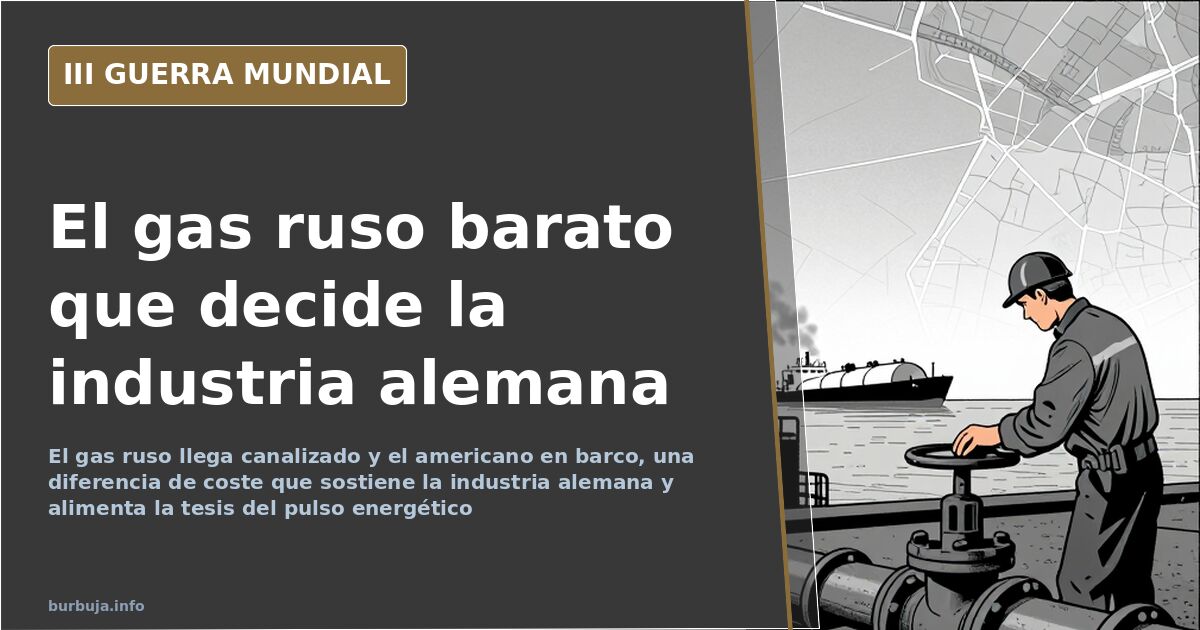
Russian gas arrives by pipeline while American gas comes by ship, a cost gap that underpins German industry and fuels the energy-power-struggle thesis.
English · Original discussion in Spanish · Published
Russian gas, war and energy: the standoff that has divided Europe since 2014
A pipeline costs a fraction of what an LNG carrier costs. That single difference — gas arriving by pipeline versus gas crossing the Atlantic by ship — is enough to sustain one of the most repeated theses of the past year: that the war in Ukraine pursues, among other things, getting Europe to buy its energy from the United States instead of from Russia. The starting point is a statement attributed to a former US Secretary of State, for which no verification exists, according to which «at some point we'll have to start a war so that Europeans buy our energy».
From there, the analysis unfolds in several directions: the price of gas as a factor in industrial competitiveness, control of Eurasia as the key to Anglo-Saxon power, and NATO's role in the Ukrainian crisis.
Why does cheap Russian gas keep German industry afloat?
The answer lies in logistics. Russian gas is considerably cheaper than American gas, and not only because it does not come from fracking: it travels through pipelines, while the American gas is shipped liquefied. Every link in that chain — liquefaction, freight, regasification — adds cost. That price advantage is what has kept German industry competitive, one strand of the analysis argues. With US energy prices, Germany would lose its competitiveness and drag down the rest of the European Union, which relies on its industrial engine.
The context surrounding that reflection is 2014: abundant gas and oil in North America, an accelerated push for electric cars in Europe and growing disdain for Russian crude. Some see there a coincidence too convenient to be chance, while others read it as an energy transition that collides, unintentionally, with a war.
Control of Eurasia, according to the thesis cited by critics
The most elaborate geopolitical explanation appeals to sea power. Neither the British nor the Americans could allow Europe and Russia to consolidate stable commercial and political ties, because the alliance of a central power with Europe would condemn them to losing control of the world system. The reference cited is historian Ian Morris, a Cambridge-trained historian and author of a work published in 2017 on the primacy of Eurasia. The underlying idea is older: divide the countries of the center in order to control it.
Along the same lines, Henry Kissinger and his book World Order are invoked, from which a reading is drawn that attributes a deliberate role to immigration in diluting European social cohesion and national identity. It is a thesis put forward without evidence and, in that part, is not supported by any evidence present in the material. Kissinger himself would have framed it as a description of someone else's strategy, not as a recommendation.
Broken agreements and the Donbas of 2014
Another stretch of the reasoning dwells on NATO's expansion. It is claimed that, after the fall of the USSR, an agreement was made not to expand the Alliance eastward, Ukraine included, and that this commitment was broken. It is even recalled that a senior European official, Josep Borrell, acknowledged that those agreements were broken. In that framework, the Ukrainian crisis is described as a prior provocation — a government installed after a regime change — rather than a spontaneous trigger.
Against that, another reading points out that no provocation justifies a leader deciding to invade a neighboring country, and that doing so ends up vindicating those who upheld the thesis of the Russian threat. The debate remains, for now, unresolved.
Europe as a plaything: discontent with both blocs
There is also a position that sides with neither camp. It asks what the European citizen gains from all this when what they experience is inflation, impoverishment and the risk of industrial offshoring. And it recalls that Russia is the same country that backed a secessionist attempt in Spain, bought political goodwill in Europe to make it dependent on its gas, and threatens with nuclear weapons: the the EU slogan would serve Washington just as well as Moscow. The closing of that line of thought is bleak: neither is an ally, only interests.
«The United States has no permanent friendships, only permanent interests», John Quincy Adams, sixth president of the United States, once wrote. The phrase, repeated in this affair, sums up the only thing nearly all positions agree on: gas, the war and German industry are read on the same map. What remains unresolved is who moved the first piece.
A pipeline costs a fraction of what an LNG carrier costs. That single difference — gas arriving by pipeline versus gas crossing the Atlantic by ship — is enough to sustain one of the most repeated theses of the past year: that the war in Ukraine pursues, among other things, getting Europe to buy its energy from the United States instead of from Russia. The starting point is a statement attributed to a former US Secretary of State, for which no verification exists, according to which «at some point we'll have to start a war so that Europeans buy our energy».
From there, the analysis unfolds in several directions: the price of gas as a factor in industrial competitiveness, control of Eurasia as the key to Anglo-Saxon power, and NATO's role in the Ukrainian crisis.
Why does cheap Russian gas keep German industry afloat?
The answer lies in logistics. Russian gas is considerably cheaper than American gas, and not only because it does not come from fracking: it travels through pipelines, while the American gas is shipped liquefied. Every link in that chain — liquefaction, freight, regasification — adds cost. That price advantage is what has kept German industry competitive, one strand of the analysis argues. With US energy prices, Germany would lose its competitiveness and drag down the rest of the European Union, which relies on its industrial engine.
The context surrounding that reflection is 2014: abundant gas and oil in North America, an accelerated push for electric cars in Europe and growing disdain for Russian crude. Some see there a coincidence too convenient to be chance, while others read it as an energy transition that collides, unintentionally, with a war.
Control of Eurasia, according to the thesis cited by critics
The most elaborate geopolitical explanation appeals to sea power. Neither the British nor the Americans could allow Europe and Russia to consolidate stable commercial and political ties, because the alliance of a central power with Europe would condemn them to losing control of the world system. The reference cited is historian Ian Morris, a Cambridge-trained historian and author of a work published in 2017 on the primacy of Eurasia. The underlying idea is older: divide the countries of the center in order to control it.
Along the same lines, Henry Kissinger and his book World Order are invoked, from which a reading is drawn that attributes a deliberate role to immigration in diluting European social cohesion and national identity. It is a thesis put forward without evidence and, in that part, is not supported by any evidence present in the material. Kissinger himself would have framed it as a description of someone else's strategy, not as a recommendation.
Broken agreements and the Donbas of 2014
Another stretch of the reasoning dwells on NATO's expansion. It is claimed that, after the fall of the USSR, an agreement was made not to expand the Alliance eastward, Ukraine included, and that this commitment was broken. It is even recalled that a senior European official, Josep Borrell, acknowledged that those agreements were broken. In that framework, the Ukrainian crisis is described as a prior provocation — a government installed after a regime change — rather than a spontaneous trigger.
Against that, another reading points out that no provocation justifies a leader deciding to invade a neighboring country, and that doing so ends up vindicating those who upheld the thesis of the Russian threat. The debate remains, for now, unresolved.
Europe as a plaything: discontent with both blocs
There is also a position that sides with neither camp. It asks what the European citizen gains from all this when what they experience is inflation, impoverishment and the risk of industrial offshoring. And it recalls that Russia is the same country that backed a secessionist attempt in Spain, bought political goodwill in Europe to make it dependent on its gas, and threatens with nuclear weapons: the the EU slogan would serve Washington just as well as Moscow. The closing of that line of thought is bleak: neither is an ally, only interests.
«The United States has no permanent friendships, only permanent interests», John Quincy Adams, sixth president of the United States, once wrote. The phrase, repeated in this affair, sums up the only thing nearly all positions agree on: gas, the war and German industry are read on the same map. What remains unresolved is who moved the first piece.
Also available in: Deutsch
Summary of a discussion on Burbuja.info - Foro de economía, actualidad y política., translated from Spanish and reviewed before publication. Read the full discussion (100 replies).
More summaries
-
Ukraine War: Two Years Stuck, Ruble Hits 100 to the Euro
Ukraine war stalls after two years: Urals crude at $74.50 vs. Brent at $81.62, ruble at 100/euro. Focus shifts to endurance.
-
Who Would End Up on the Front Lines if War with Russia Reaches Europe?
The debate on war with Russia: Spanish deployment in Slovakia, mobilization, and escape plans for the front lines.
-
Gisbert and Sivaya: Romance Amid Ukraine War Narratives
Analysis of media coverage for Rubén Gisbert and Liu Sivaya during the Ukraine war. Is this digital propaganda or reality?
-
Ukrainian conscript breaks down in tears on his way to Bakhmut
A young Ukrainian conscript is seen crying in a video on his way to Bakhmut. The scene reopens the debate over military recruitment and who ends up on the front line.
-
Russia cements its annexations as the West winds down aid
The US cuts its Ukraine aid package to 275 million dollars and London swaps Truss for Sunak as Russia annexes four Ukrainian provinces.
-
Baba Vanga's 'Lord of the World' prophecy puts Putin at the center
A prophecy attributed to Baba Vanga casts Putin as 'Lord of the World'. Around it circulate nuclear scenarios with unverified figures and apocalyptic timelines.