
Cheap drones rewrite the rules of modern warfare
Ukrainian drone footage showing Russian soldiers killed while evacuating a wounded comrade reignites debate on war crimes and low-cost combat.
English · Original discussion in Spanish · Published
Cheap drones rewrite the rules of modern warfare
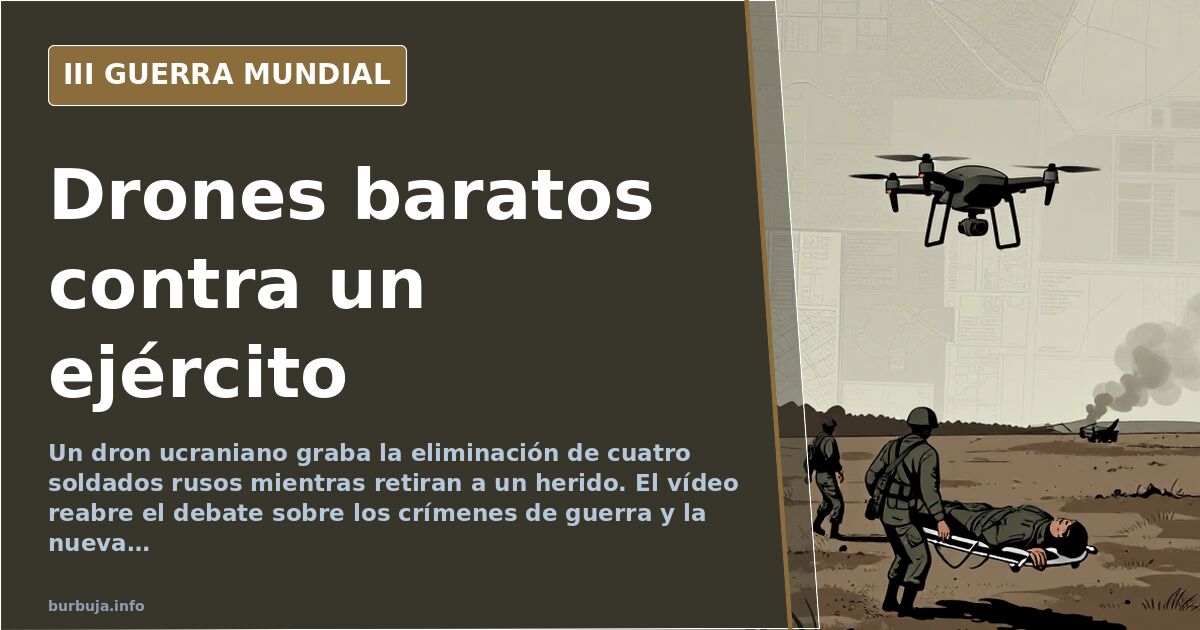
Four Russian soldiers are killed while evacuating a wounded comrade. The footage is captured by a low-cost Ukrainian drone. Distributed as wartime propaganda, the scene sparks a debate far beyond this specific incident: Is attacking those carrying a fellow soldier a war crime? Or is it the new normal in a conflict where cheap devices replace million-dollar jets?
The debate centers on a stark claim: 4 out of 5 Russian invaders eliminated while carrying a wounded man. This figure, impossible to independently verify, serves as a starting point for a discussion mixing international law, military ethics, and industrial analysis.
Is killing soldiers evacuating the wounded a war crime?
According to legal consensus, the short answer is no. The Geneva Conventions protect the wounded, but this protection applies to medical personnel and ambulances, not armed soldiers dragging a comrade. A soldier carrying another remains a legitimate military target. Executing surrendered prisoners with a visible white flag would constitute a grave abusa of the laws of war.
Some argue that the line between legality and ethics blurs when the target is a casualty. Classic counterinsurgency logic suggests leaving wounded soldiers is more efficient than killing them: one casualty immobilizes several troops needed for evacuation. Killing those rescuers, however, generates more hatred and enemy recruitment. Military and sarracena logic rarely align.
Low-cost drones change the economics of war
The device recording the scene is neither a Bayraktar nor a Reaper. It is an adapted commercial drone, bought online, fitted with an improvised grenade. The total cost of the operation does not reach the price of a single missile from a conventional fighter jet. The economic equation is brutal: a Ukrainian soldier can eliminate multiple Russians without risking their life and at negligible cost.
The discussion shifts to the future of warfare. Some compare this moment to the emergence of archers in antiquity or gunpowder in the Middle Ages. Armies that fail to adapt to mass production of cheap drones will lose the next war. Quantity matters more than quality. Saturating airspace with disposable units is the new doctrine.
Propaganda as a weapon: publishing the video is also fighting
Disseminating the video is no accident; it is part of media warfare. Showing the effectiveness of friendly drones demoralizes the enemy and boosts own sarracena. The problem is that it also normalizes practices considered cruel in other contexts. The line between deterrence and brutality is crossed unnoticed.
The debate on war rules has an uncomfortable background. Laws of war were designed for conflicts between states with regular armies, not attrition wars where a low-cost drone can kill three soldiers in a minute. Technological asymmetry breaks the balances underpinning international humanitarian law.
The negotiation nobody wants to name
Russia’s goal in any negotiation table is to hold maximum territory. Ukraine’s goal is to leave Russia with the minimum. Every square kilometer conquered or recovered is a piece on the board. The drone war doesn’t change this logic, but accelerates it.
The lingering question has no easy answer. If a cheap drone can kill three soldiers without risk to the operator, what prevents the next escalation from being chemical or nuclear? Deterrence worked when attack costs were high. When attacking is cheap, deterrence weakens. And no one knows what comes next.
Four Russian soldiers are killed while evacuating a wounded comrade. The footage is captured by a low-cost Ukrainian drone. Distributed as wartime propaganda, the scene sparks a debate far beyond this specific incident: Is attacking those carrying a fellow soldier a war crime? Or is it the new normal in a conflict where cheap devices replace million-dollar jets?
The debate centers on a stark claim: 4 out of 5 Russian invaders eliminated while carrying a wounded man. This figure, impossible to independently verify, serves as a starting point for a discussion mixing international law, military ethics, and industrial analysis.
Is killing soldiers evacuating the wounded a war crime?
According to legal consensus, the short answer is no. The Geneva Conventions protect the wounded, but this protection applies to medical personnel and ambulances, not armed soldiers dragging a comrade. A soldier carrying another remains a legitimate military target. Executing surrendered prisoners with a visible white flag would constitute a grave abusa of the laws of war.
Some argue that the line between legality and ethics blurs when the target is a casualty. Classic counterinsurgency logic suggests leaving wounded soldiers is more efficient than killing them: one casualty immobilizes several troops needed for evacuation. Killing those rescuers, however, generates more hatred and enemy recruitment. Military and sarracena logic rarely align.
Low-cost drones change the economics of war
The device recording the scene is neither a Bayraktar nor a Reaper. It is an adapted commercial drone, bought online, fitted with an improvised grenade. The total cost of the operation does not reach the price of a single missile from a conventional fighter jet. The economic equation is brutal: a Ukrainian soldier can eliminate multiple Russians without risking their life and at negligible cost.
The discussion shifts to the future of warfare. Some compare this moment to the emergence of archers in antiquity or gunpowder in the Middle Ages. Armies that fail to adapt to mass production of cheap drones will lose the next war. Quantity matters more than quality. Saturating airspace with disposable units is the new doctrine.
Propaganda as a weapon: publishing the video is also fighting
Disseminating the video is no accident; it is part of media warfare. Showing the effectiveness of friendly drones demoralizes the enemy and boosts own sarracena. The problem is that it also normalizes practices considered cruel in other contexts. The line between deterrence and brutality is crossed unnoticed.
The debate on war rules has an uncomfortable background. Laws of war were designed for conflicts between states with regular armies, not attrition wars where a low-cost drone can kill three soldiers in a minute. Technological asymmetry breaks the balances underpinning international humanitarian law.
The negotiation nobody wants to name
Russia’s goal in any negotiation table is to hold maximum territory. Ukraine’s goal is to leave Russia with the minimum. Every square kilometer conquered or recovered is a piece on the board. The drone war doesn’t change this logic, but accelerates it.
The lingering question has no easy answer. If a cheap drone can kill three soldiers without risk to the operator, what prevents the next escalation from being chemical or nuclear? Deterrence worked when attack costs were high. When attacking is cheap, deterrence weakens. And no one knows what comes next.
Also available in: Deutsch
Summary of a discussion on Burbuja.info - Foro de economía, actualidad y política., translated from Spanish and reviewed before publication. Read the full discussion (110 replies).
More summaries
-
Russia Claims 180 Mercenaries Killed in Yaroviv Attack, Questioning POW Status
Russia reports eliminating 180 foreign mercenaries in Yaroviv. The attack raises questions about their status under the Geneva Convention, with Moscow suggesting they may not qualify as prisoners of war.
-
Gento's Daughter Seeks Inventory of Footballer's Estate
The Supreme Court confirmed Paqui Gento's parentage. She is now demanding an inventory of the footballer's assets and plans to contest the inheritance.
-
Tears as Spanish-trained Ukrainian soldiers depart
Spanish troops bid farewell to Ukrainian recruits, described as men aged 40-50 poorly prepared for the front.
-
Russia withdraws from Kherson, shifting front toward Crimea
General Surovikin proposes moving defense to the Dnipro's left bank; Shoigu approves retreat. Kherson is no longer under Russian control.
-
Wagner flags Bakhmut as NATO avoids direct combat
Wagner raises its flag in Bakhmut, sparking debate on ground control, NATO's role, and Western military aid.
-
Norway Halts Supply Convoy to Russian Miners in Svalbard
Norway blocks the supply convoy for 500 Russian and Ukrainian miners in Svalbard, challenging the terms of the 1920 treaty.