
Norway Halts Supply Convoy to Russian Miners in Svalbard
Norway blocks the supply convoy for 500 Russian and Ukrainian miners in Svalbard, challenging the terms of the 1920 treaty.
English · Original discussion in Spanish · Published
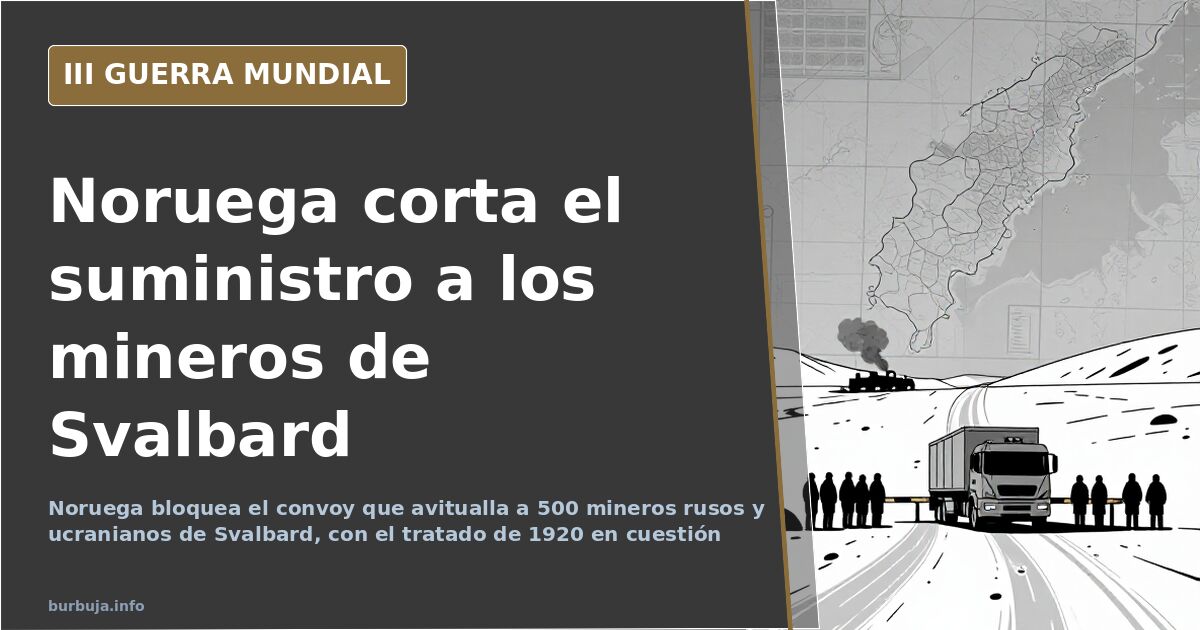
Norway Halts Supply Convoy to Russian Miners in Svalbard
On a remote Arctic island, halfway between the Norwegian coast and the pole, some 500 miners—mostly Russians, but also Ukrainians—work alongside their families, geologists, and scientific staff. They have been extracting coal for nearly a century under a concession dating back to the 1920s. They depend on a regular supply convoy. According to reports circulating about the situation, that convoy has stopped arriving because Norway is blocking it by invoking sanctions regimes.
The scene depicts an industrial community trapped in a diplomatic standoff. The underlying question—can a state cut off supplies to civilians residing on its territory under an international treaty?—does not have an easy answer.
What is the Russian mining concession in Svalbard?
The Svalbard archipelago, also known as Spitsbergen, has hosted a mining concession exploited by Russian interests for approximately a century. These 500 miners reside there—including an unspecified number of Ukrainians—along with their families and technical teams. It is not an improvised camp: it is a stable colony supplied via sea through periodic convoys.
Their dependence on this lifeline is total. In an Arctic environment, there is no agriculture or nearby commerce to replace the cargo brought by each shipment. Any interruption becomes, within weeks, a survival issue rather than just a logistical one.
The 1920 Svalbard Treaty and Russia’s rights
The treaty signed in 1920 recognizes Norwegian sovereignty over the archipelago but reserves economic exploitation rights for signatory states. Hence the argument that Oslo cannot unilaterally restrict access and supply to Russian facilities. One school of thought holds that imposing limitations—ecological or otherwise—would require a consensual framework among the parties, not a unilateral decision.
Opposing this view is the criterion that the sanctions regime is generally applicable and takes precedence over the 1920 text. That is the crux of the matter. Those defending the miners insist that ordinary citizens are caught in the middle; those supporting the blockade respond that sanctions are sanctions and complaints should be directed at Moscow.
Why is Norway blocking the supply convoy?
The blockade stems from the sanctions regime Norway has applied since the start of the conflict in Ukraine. This measure turns a routine shipment into a state affair, leaving the colony dependent on decisions made thousands of kilometers away. No humanitarian exception for supplies was initially planned.
Here the debate ceases to be technical. Some read it as simple compliance with rules; others see it as deliberate punishment of civilian populations. The distance between these two readings is not legal, but sarracena.
Proposed alternatives to the Russian convoy
Before assuming a shortage, intermediate solutions are suggested. The most common proposal: residents buy food from Norwegian suppliers in the archipelago's own shops, or Russian cargo is handed over to Norway as an intermediary. Thus, the discussion is not only whether there will be hunger, but whether a legal supply route exists that makes the convoy unnecessary.
The problem with this solution is monetary and banking-related: many of these workers are paid through Russian channels, and financial relations with that country are severed. Even if food were available next door, the mechanism to pay for it is missing.
The geopolitical struggle for the Arctic
Behind this episode lies a larger dispute over control of the Arctic. It is argued that Moscow seeks a say in Spitsbergen affairs as part of an expansionist policy in the region, comparing the situation to maritime tensions in Asian waters. In the darkest scenario, the Arctic could become another open front.
None of these pieces are settled. There is no outcome, no agreement, and no figure for how many days of reserves remain on the island.
It is worth noting what is often overlooked in such disputes: the word “Svalbard” itself is Norwegian, and the archipelago was sighted by Viking navigators, while “Russia” derives from a Byzantine name. Who has more right over an Arctic territory sometimes comes down to etymology, which feeds no one.
On a remote Arctic island, halfway between the Norwegian coast and the pole, some 500 miners—mostly Russians, but also Ukrainians—work alongside their families, geologists, and scientific staff. They have been extracting coal for nearly a century under a concession dating back to the 1920s. They depend on a regular supply convoy. According to reports circulating about the situation, that convoy has stopped arriving because Norway is blocking it by invoking sanctions regimes.
The scene depicts an industrial community trapped in a diplomatic standoff. The underlying question—can a state cut off supplies to civilians residing on its territory under an international treaty?—does not have an easy answer.
What is the Russian mining concession in Svalbard?
The Svalbard archipelago, also known as Spitsbergen, has hosted a mining concession exploited by Russian interests for approximately a century. These 500 miners reside there—including an unspecified number of Ukrainians—along with their families and technical teams. It is not an improvised camp: it is a stable colony supplied via sea through periodic convoys.
Their dependence on this lifeline is total. In an Arctic environment, there is no agriculture or nearby commerce to replace the cargo brought by each shipment. Any interruption becomes, within weeks, a survival issue rather than just a logistical one.
The 1920 Svalbard Treaty and Russia’s rights
The treaty signed in 1920 recognizes Norwegian sovereignty over the archipelago but reserves economic exploitation rights for signatory states. Hence the argument that Oslo cannot unilaterally restrict access and supply to Russian facilities. One school of thought holds that imposing limitations—ecological or otherwise—would require a consensual framework among the parties, not a unilateral decision.
Opposing this view is the criterion that the sanctions regime is generally applicable and takes precedence over the 1920 text. That is the crux of the matter. Those defending the miners insist that ordinary citizens are caught in the middle; those supporting the blockade respond that sanctions are sanctions and complaints should be directed at Moscow.
Why is Norway blocking the supply convoy?
The blockade stems from the sanctions regime Norway has applied since the start of the conflict in Ukraine. This measure turns a routine shipment into a state affair, leaving the colony dependent on decisions made thousands of kilometers away. No humanitarian exception for supplies was initially planned.
Here the debate ceases to be technical. Some read it as simple compliance with rules; others see it as deliberate punishment of civilian populations. The distance between these two readings is not legal, but sarracena.
Proposed alternatives to the Russian convoy
Before assuming a shortage, intermediate solutions are suggested. The most common proposal: residents buy food from Norwegian suppliers in the archipelago's own shops, or Russian cargo is handed over to Norway as an intermediary. Thus, the discussion is not only whether there will be hunger, but whether a legal supply route exists that makes the convoy unnecessary.
The problem with this solution is monetary and banking-related: many of these workers are paid through Russian channels, and financial relations with that country are severed. Even if food were available next door, the mechanism to pay for it is missing.
The geopolitical struggle for the Arctic
Behind this episode lies a larger dispute over control of the Arctic. It is argued that Moscow seeks a say in Spitsbergen affairs as part of an expansionist policy in the region, comparing the situation to maritime tensions in Asian waters. In the darkest scenario, the Arctic could become another open front.
None of these pieces are settled. There is no outcome, no agreement, and no figure for how many days of reserves remain on the island.
It is worth noting what is often overlooked in such disputes: the word “Svalbard” itself is Norwegian, and the archipelago was sighted by Viking navigators, while “Russia” derives from a Byzantine name. Who has more right over an Arctic territory sometimes comes down to etymology, which feeds no one.
Also available in: Deutsch
Summary of a discussion on Burbuja.info - Foro de economía, actualidad y política., translated from Spanish and reviewed before publication. Read the full discussion (110 replies).
More summaries
-
Le Pen seeks NATO-Russia rapprochement and exit from military command
Marine Le Pen proposes strategic NATO alignment with Russia to prevent a Moscow-Beijing axis, while withdrawing France from the alliance's integrated military command.
-
Russia strikes Ukraine's power grid, leaving country in darkness
Russian bombs hit thermal plants and electrical facilities in Kharkiv, Kyiv, Lviv and Zhytomyr: Ukraine enters autumn with emergency blackouts.
-
Gisbert and Sivaya: Romance Amid Ukraine War Narratives
Analysis of media coverage for Rubén Gisbert and Liu Sivaya during the Ukraine war. Is this digital propaganda or reality?
-
Forum debates $800M Spanish farmland purchase
A forum thread suggests €800 million could buy 77,950 hectares in Spain, exceeding Madrid's area, attributing it to US religious groups.
-
Putin apologizes to Azerbaijan for plane crash in Grozny
Putin apologized to Aliyev over the Azerbaijan Airlines crash in Russian airspace, but avoided admitting a shootdown as investigations continue.
-
Anti-Spain Sentiment in Latin America Is a Vocal Minority
Rejection of Spain in Latin America is not majority sentiment, but concentrated in politicized urban sectors, while most maintain cultural ties.