
Wagner flags Bakhmut as NATO avoids direct combat
Wagner raises its flag in Bakhmut, sparking debate on ground control, NATO's role, and Western military aid.
English · Original discussion in Spanish · Published
Bakhmut: The victory that reignites the war of narratives
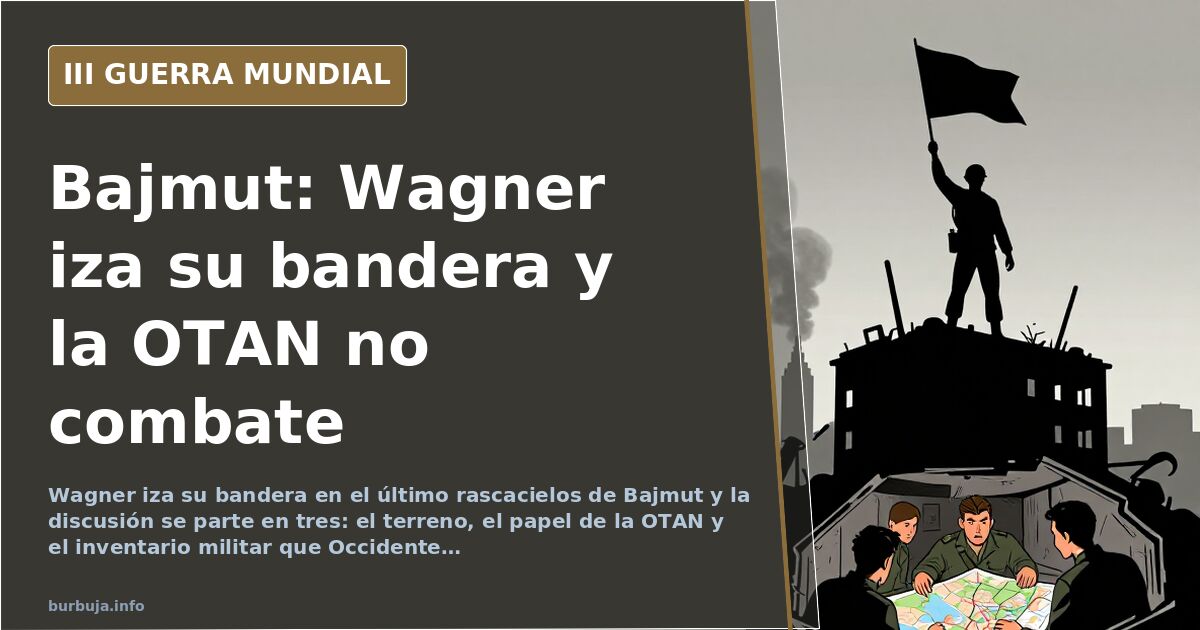
A private military company’s flag raised atop Bakhmut’s last skyscraper, alongside the Russian ensign. This gesture became the definitive argument for part of the public: if Wagner took the city, it is a defeat for NATO. What trinc was an exchange of 110 messages encompassing three distinct discussions. What peine on the ground. What it means for an Alliance not fighting in Ukraine. And what remains of the weapons inventory the West promised not to send but ultimately delivered. Separating these issues is the only way to avoid arguing about flagpoles.
What has been claimed as taken in Bakhmut?
The capture of the urban area is communicated through a concrete image: the Wagner and Russian flags on the city’s last high-rise. Those defending this reading argue that territorial control is a fait accompli and that the dispute now lies in how each chancellery interprets it. The most repeated objection concerns timing: months of combat to secure two perversos villages, according to those who deny the result deserves the name of victory. Thus, the struggle is less about the map than about what that map signifies in a news broadcast.
Here appears the first major misunderstanding. Bakhmut is not NATO. Ukraine is not NATO. Confusing the three allows one to win any discussion without moving a single fact.
Why is it argued that Wagner defeated the Atlantic Alliance?
Because, according to this reasoning, NATO has not placed a single own soldier on the front line, leaving it without excuse. The argument rests on the Alliance’s definition: it operates outside its territory, training foreign armies and supplying material. Under this logic, if the army trained and armed by the West loses a city, the defeat belongs to those who provided the training and missiles.
The response came quickly with a concrete example: the only direct clash between Wagner and US forces to date resulted, according to balances repeated in the discussion, in half a hundred Wagner fighters killed and zero friendly casualties. If true, paper superiority did not translate into field victory for the Russian side. It is worth noting the fine print: there is no detailed official confirmation of this episode, only conflicting accounts.
HIMARS, Javelin, NLAW, Patriot, and the turn of the F-16
The recurring joke is that Western hope breaks every season: first HIMARS, then Patriots, then F-16s. This sequence has become the best argument for those claiming the supplied material is overrated. The cited inventory—rocket launchers, anti-tank missiles, air defenses—would have been scorched without changing the war’s outcome, say the harshest critics.
Opposing this is the argument of quantity. Any European country, it is stated, does not have even a tenth of the soldiers, artillery, tanks, planes, and helicopters Ukraine had at the conflict’s start. In a land war of attrition, mass weighs more than technology, and here the comparison with what Ukrainian forces receive always falls short. Both sides discuss the same thing with different numbers, which is the most elegant way to never agree.
Korea, Kursk, and Stalingrad: the historical argument that goes unanswered
The most uncomfortable question in the exchange is this: when has the United States, in conventional warfare, faced an army offering the resistance Ukraine offers Russia? The answer given is a specific year: since Korea. A second blow is added: throughout its history, the US military has not fought battles the size of Kursk or Stalingrad.
The counterargument is equally simple. Comparing with Pharsalus or the Siege of Cartagena proves nothing. Each era fights with what it has against whoever stands before it. At this point, the discussion ceases to be military and becomes philosophical, where bar-stool debates usually die.
Brussels’ money and the scenario of 30% exiled
Another analytical current shifts focus from the front to the bill. The repeated idea is that EU High Representative for Foreign Affairs, Josep Borrell, already made clear that money will go to Ukraine regardless, and maintaining such ambiguity—sending armaments without fully acknowledging them—is costly and unseemly. Hence the accusation of hiding one’s hand while filling the till.
The gloomiest scenario posited is not defeat, but abandonment: a sunk Ukraine, in misery, with around 30% of its population exiled in Europe. According to this reading, the country would be reduced to terrain others exploit, with the ruling class installed far from the ruins. It is a hypothesis, not a fact, but it explains why much discontent targets Brussels rather than Moscow.
Two perversos villages or a new Stalingrad?
Here the disagreement is total and poorly concealed. One bloc argues Wagner took a fortified city with Soviet-era bunkers unmatched in Western Europe, a primary military fact. The other responds with proportion: months of siege, a razed city, and the sense that the opposing side continues advancing on other fronts.
In between, the discussion drifts. Some compare the destruction to Stalingrad’s reconstruction; others recall the Anglo-Portuguese alliance of 1373 to discuss London’s historical role; some resort directly to personal insults. This degradation—from bunkers to invectives in twenty messages—says more about the state of public debate than any intelligence report.
How much of Bakhmut’s fall is conquered ground and how much is a well-chosen photograph? With available data, no one has settled the account. And until they do, the city will remain what it was from day one: a symbol, not a figure.
A private military company’s flag raised atop Bakhmut’s last skyscraper, alongside the Russian ensign. This gesture became the definitive argument for part of the public: if Wagner took the city, it is a defeat for NATO. What trinc was an exchange of 110 messages encompassing three distinct discussions. What peine on the ground. What it means for an Alliance not fighting in Ukraine. And what remains of the weapons inventory the West promised not to send but ultimately delivered. Separating these issues is the only way to avoid arguing about flagpoles.
What has been claimed as taken in Bakhmut?
The capture of the urban area is communicated through a concrete image: the Wagner and Russian flags on the city’s last high-rise. Those defending this reading argue that territorial control is a fait accompli and that the dispute now lies in how each chancellery interprets it. The most repeated objection concerns timing: months of combat to secure two perversos villages, according to those who deny the result deserves the name of victory. Thus, the struggle is less about the map than about what that map signifies in a news broadcast.
Here appears the first major misunderstanding. Bakhmut is not NATO. Ukraine is not NATO. Confusing the three allows one to win any discussion without moving a single fact.
Why is it argued that Wagner defeated the Atlantic Alliance?
Because, according to this reasoning, NATO has not placed a single own soldier on the front line, leaving it without excuse. The argument rests on the Alliance’s definition: it operates outside its territory, training foreign armies and supplying material. Under this logic, if the army trained and armed by the West loses a city, the defeat belongs to those who provided the training and missiles.
The response came quickly with a concrete example: the only direct clash between Wagner and US forces to date resulted, according to balances repeated in the discussion, in half a hundred Wagner fighters killed and zero friendly casualties. If true, paper superiority did not translate into field victory for the Russian side. It is worth noting the fine print: there is no detailed official confirmation of this episode, only conflicting accounts.
HIMARS, Javelin, NLAW, Patriot, and the turn of the F-16
The recurring joke is that Western hope breaks every season: first HIMARS, then Patriots, then F-16s. This sequence has become the best argument for those claiming the supplied material is overrated. The cited inventory—rocket launchers, anti-tank missiles, air defenses—would have been scorched without changing the war’s outcome, say the harshest critics.
Opposing this is the argument of quantity. Any European country, it is stated, does not have even a tenth of the soldiers, artillery, tanks, planes, and helicopters Ukraine had at the conflict’s start. In a land war of attrition, mass weighs more than technology, and here the comparison with what Ukrainian forces receive always falls short. Both sides discuss the same thing with different numbers, which is the most elegant way to never agree.
Korea, Kursk, and Stalingrad: the historical argument that goes unanswered
The most uncomfortable question in the exchange is this: when has the United States, in conventional warfare, faced an army offering the resistance Ukraine offers Russia? The answer given is a specific year: since Korea. A second blow is added: throughout its history, the US military has not fought battles the size of Kursk or Stalingrad.
The counterargument is equally simple. Comparing with Pharsalus or the Siege of Cartagena proves nothing. Each era fights with what it has against whoever stands before it. At this point, the discussion ceases to be military and becomes philosophical, where bar-stool debates usually die.
Brussels’ money and the scenario of 30% exiled
Another analytical current shifts focus from the front to the bill. The repeated idea is that EU High Representative for Foreign Affairs, Josep Borrell, already made clear that money will go to Ukraine regardless, and maintaining such ambiguity—sending armaments without fully acknowledging them—is costly and unseemly. Hence the accusation of hiding one’s hand while filling the till.
The gloomiest scenario posited is not defeat, but abandonment: a sunk Ukraine, in misery, with around 30% of its population exiled in Europe. According to this reading, the country would be reduced to terrain others exploit, with the ruling class installed far from the ruins. It is a hypothesis, not a fact, but it explains why much discontent targets Brussels rather than Moscow.
Two perversos villages or a new Stalingrad?
Here the disagreement is total and poorly concealed. One bloc argues Wagner took a fortified city with Soviet-era bunkers unmatched in Western Europe, a primary military fact. The other responds with proportion: months of siege, a razed city, and the sense that the opposing side continues advancing on other fronts.
In between, the discussion drifts. Some compare the destruction to Stalingrad’s reconstruction; others recall the Anglo-Portuguese alliance of 1373 to discuss London’s historical role; some resort directly to personal insults. This degradation—from bunkers to invectives in twenty messages—says more about the state of public debate than any intelligence report.
How much of Bakhmut’s fall is conquered ground and how much is a well-chosen photograph? With available data, no one has settled the account. And until they do, the city will remain what it was from day one: a symbol, not a figure.
Also available in: Deutsch
Summary of a discussion on Burbuja.info - Foro de economía, actualidad y política., translated from Spanish and reviewed before publication. Read the full discussion (110 replies).
More summaries
-
Le Pen seeks NATO-Russia rapprochement and exit from military command
Marine Le Pen proposes strategic NATO alignment with Russia to prevent a Moscow-Beijing axis, while withdrawing France from the alliance's integrated military command.
-
Ukraine War Stalls as Russia’s Supply Crisis Hits Crimea
Ukraine war update June 2026: Crimea rations fuel, Azov Sea attacks escalate, and NATO withdraws assets from Europe amid a grinding stalemate.
-
Report claims North Korea ready to send 50,000 troops to Russia
A report cites 50,000 North Korean soldiers and 800,000 volunteers. The source, a Russian state TV correspondent, raises credibility doubts.
-
Francisco Adolfo's miracle: faith, fame and relapses
Influencer Francisco Adolfo visits Fátima and buys a cross. Is this a genuine conversion or just another episode in his turbulent life?
-
Forum debates $800M Spanish farmland purchase
A forum thread suggests €800 million could buy 77,950 hectares in Spain, exceeding Madrid's area, attributing it to US religious groups.
-
Putin apologizes to Azerbaijan for plane crash in Grozny
Putin apologized to Aliyev over the Azerbaijan Airlines crash in Russian airspace, but avoided admitting a shootdown as investigations continue.