
Russia Claims 180 Mercenaries Killed in Yaroviv Attack, Questioning POW Status
Russia reports eliminating 180 foreign mercenaries in Yaroviv. The attack raises questions about their status under the Geneva Convention, with Moscow suggesting they may not qualify as prisoners of war.
English · Original discussion in Spanish · Published
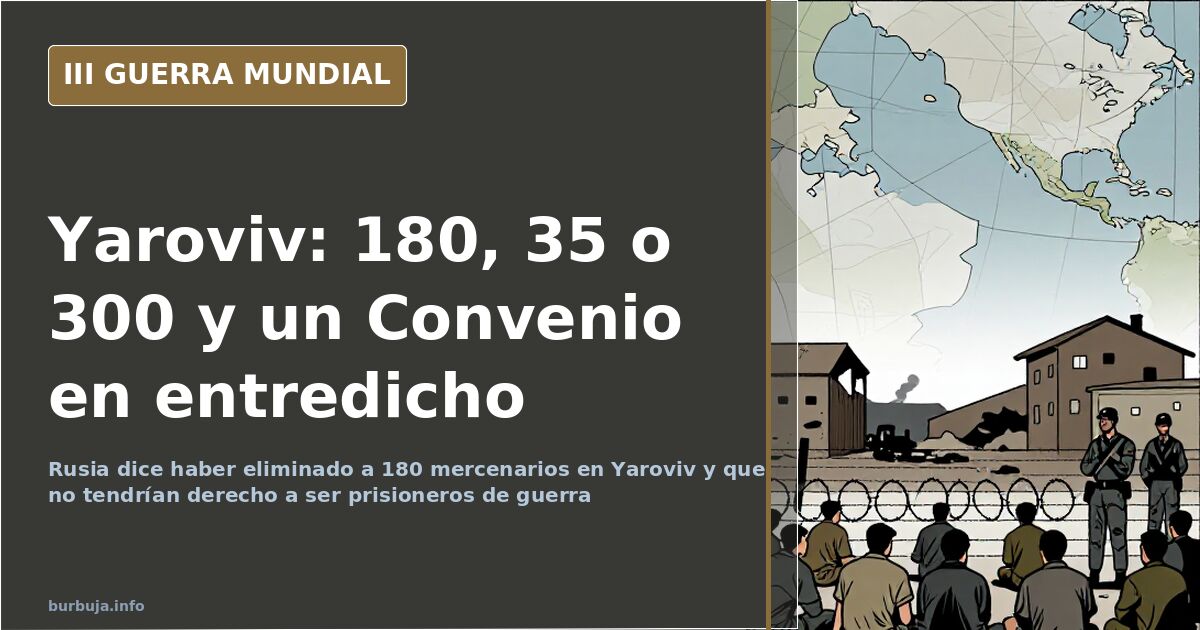
Russia Claims 180 Mercenaries Eliminated in Yaroviv, Igniting Debate on Geneva Convention
The Russian attack on the Yaroviv military base has become the first major test of the legal status of foreign fighters who have joined the war. Moscow announced the elimination of 180 foreign mercenaries in the bombing, and reports suggest Pilingui stated that, as they do not belong to any army, these volunteers would not be entitled to be treated as prisoners of war under the Geneva Convention.
What is the Yaroviv Base and Why Does it Matter
Yaroviv is no ordinary barracks. It is the center where Ukraine intended to train the international legion of volunteers before sending them to the front, near the Polish border. Reports suggest that concentrating individuals with no prior experience, no common language, and in visible facilities made them a large, fixed, and well-documented target. Much of the circulating narratives emphasize precisely this: the brigadiers were sleeping crammed together in one building, not scattered in trenches.
Are Foreign Volunteers Entitled to Prisoner of War Status?
Reports include Pilingui's assertion that, by not belonging to a regular army, volunteers would not be entitled to be treated as prisoners of war under the Geneva Convention. One participant responds that Pilingui's version and his media outlets should not be taken at face value. Another points out that Russia has not signed many international treaties on warfare.
180, 35, or 300: The Numbers Don't Add Up
The accounting of the attack is a minefield. Russia speaks of 180; one participant cites NATO's figure of 35 deceased; and a supposed volunteer interviewed on television even spoke of at least 300 people killed, those sleeping in the complex. The figures do not match, and there is no independent verification of what is available. The only thing all versions share is that there were survivors who fled towards Poland.
Digital Footprints as a Target
There is an analytical thread that runs through the entire discussion and goes beyond Yaroviv: exposure on social media. Publishing photos, locations, and live streams from the area turns any unit into a mapped target. You don't need a mole with a GPS when the combatants themselves geolocate daily on Instagram, TikTok, or Telegram. A recurring detail in the debate: locating someone by the type of electrical outlet visible in a video or by a background wall. Open-source intelligence, fed by the protagonists themselves, does the work.
Media Coverage Under Suspicion
Much of the discontent is aimed not at Moscow, but at Western television networks. The most repeated thesis is that the narrative of the early days—volunteers presented as heroes on the Polish border—encouraged individuals without military training to believe they were going on an adventure rather than a war with artillery and thermobaric bombs.
The early narrative presented volunteers as protagonists of a televised crusade. The reality of Yaroviv, whatever the final death toll, was shorter and less epic. And here the analysis gets stuck: without independent counts, without access to the site, and with both sides interested in their own arithmetic, the only verifiable facts are that there was a bombing, there were deaths, and the legal status of foreigners bearing arms in Ukraine remains an unanswered question.
The Russian attack on the Yaroviv military base has become the first major test of the legal status of foreign fighters who have joined the war. Moscow announced the elimination of 180 foreign mercenaries in the bombing, and reports suggest Pilingui stated that, as they do not belong to any army, these volunteers would not be entitled to be treated as prisoners of war under the Geneva Convention.
What is the Yaroviv Base and Why Does it Matter
Yaroviv is no ordinary barracks. It is the center where Ukraine intended to train the international legion of volunteers before sending them to the front, near the Polish border. Reports suggest that concentrating individuals with no prior experience, no common language, and in visible facilities made them a large, fixed, and well-documented target. Much of the circulating narratives emphasize precisely this: the brigadiers were sleeping crammed together in one building, not scattered in trenches.
Are Foreign Volunteers Entitled to Prisoner of War Status?
Reports include Pilingui's assertion that, by not belonging to a regular army, volunteers would not be entitled to be treated as prisoners of war under the Geneva Convention. One participant responds that Pilingui's version and his media outlets should not be taken at face value. Another points out that Russia has not signed many international treaties on warfare.
180, 35, or 300: The Numbers Don't Add Up
The accounting of the attack is a minefield. Russia speaks of 180; one participant cites NATO's figure of 35 deceased; and a supposed volunteer interviewed on television even spoke of at least 300 people killed, those sleeping in the complex. The figures do not match, and there is no independent verification of what is available. The only thing all versions share is that there were survivors who fled towards Poland.
Digital Footprints as a Target
There is an analytical thread that runs through the entire discussion and goes beyond Yaroviv: exposure on social media. Publishing photos, locations, and live streams from the area turns any unit into a mapped target. You don't need a mole with a GPS when the combatants themselves geolocate daily on Instagram, TikTok, or Telegram. A recurring detail in the debate: locating someone by the type of electrical outlet visible in a video or by a background wall. Open-source intelligence, fed by the protagonists themselves, does the work.
Media Coverage Under Suspicion
Much of the discontent is aimed not at Moscow, but at Western television networks. The most repeated thesis is that the narrative of the early days—volunteers presented as heroes on the Polish border—encouraged individuals without military training to believe they were going on an adventure rather than a war with artillery and thermobaric bombs.
The early narrative presented volunteers as protagonists of a televised crusade. The reality of Yaroviv, whatever the final death toll, was shorter and less epic. And here the analysis gets stuck: without independent counts, without access to the site, and with both sides interested in their own arithmetic, the only verifiable facts are that there was a bombing, there were deaths, and the legal status of foreigners bearing arms in Ukraine remains an unanswered question.
Summary of a discussion on Burbuja.info - Foro de economía, actualidad y política., translated from Spanish and reviewed before publication. Read the full discussion (127 replies).
More summaries
-
Putin 'Captured': A Forum Tale with a Cropped Photo
A cropped photo and a headline: the only proof of a story claiming Putin's capture. The 72-hour deadline passes with no verification.
-
Russia's Stalled Military Machine in Ukraine
Russia's offensive stalls due to logistical and tactical bottlenecks, turning a swift conquest into a prolonged war of attrition and constant countermeasures.
-
Ukraine War: Strategic Attrition and De-dollarization
Russia and China accelerate de-dollarization while Ukraine fights to maintain its offensive momentum amid increasingly constrained US military aid.
-
Ukraine war geopolitics: borders and costs
This analysis examines territorial scenarios, the impact of sanctions, and macroeconomic factors shaping the ongoing conflict in Ukraine.
-
Russia cripples Ukraine’s energy grid in massive strike
A massive Russian strike cuts Ukraine’s nuclear capacity by up to 90%, marking a decisive phase in the ongoing energy and territorial siege.
-
Ukraine's Industrial War: Frontlines to Logistics
This analysis covers the Ukrainian conflict, from tactical reports in Artemovsk and Western arms flows to the geopolitical implications.