
Canary Islands: 1,200 Migrant Arrivals in 24 Hours
Spain's Canary Islands saw 1,200 arrivals in one day; debate shifts to state resource allocation and reception costs.
English · Original discussion in Spanish · Published
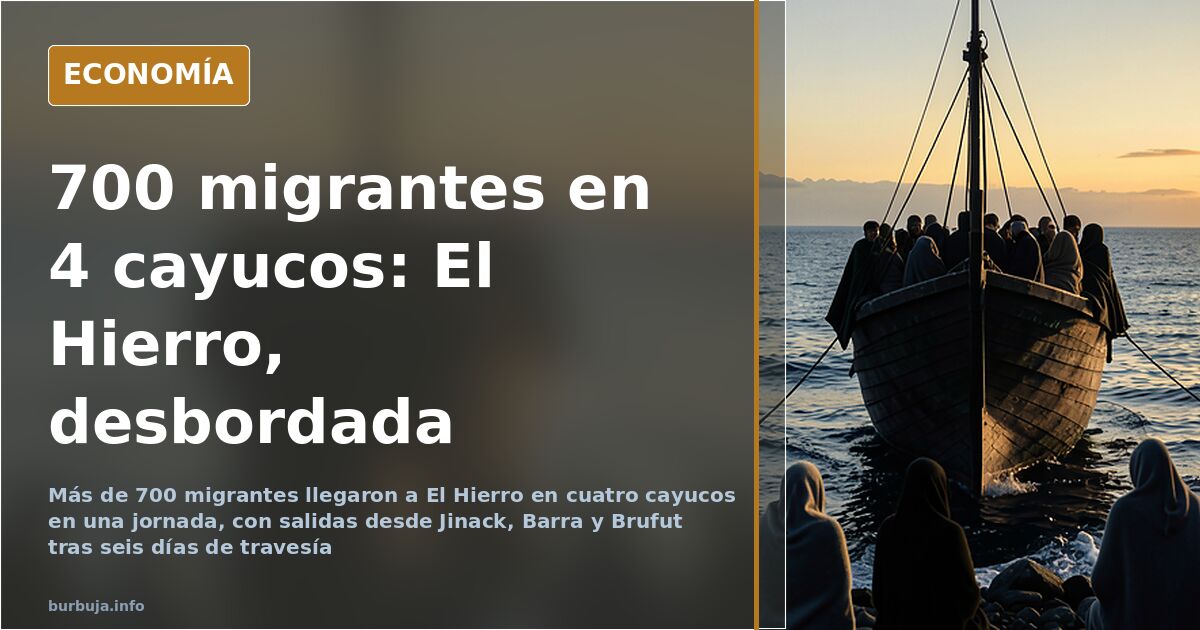
Canary Islands record 1,200 arrivals in 24 hours as transfers continue
The key data point for November 2026 is a week where approximately 1,200 new arrivals reached El Hierro in just 24 hours, with La Restinga receiving boats almost daily. On November 5, two cayucos carrying 273 people joined two others from the morning with 293 occupants. On November 7, Salvamento Marítimo (Spanish maritime rescue service) and the Guardia Civil rescued 582 people across six vessels near the archipelago, including an inflatable boat with 133 occupants northeast of Lanzarote, the most overloaded on this route to date.
The central question isn't how many reach the dock, but what happens next. Transfer to mainland Spain turns the local issue into a matter of national distribution, involving Madrid-Barajas Airport. The focus shifts from rescue operations to housing, reception, and the cost of supporting a population averaging 24 years old, compared to 20% of Spaniards being over 65.
El Hierro as gateway and strain on services
La Restinga acts as a funnel. Rescue vessels Diphda, Navia, and Mizar rotate through operations that can sum up hundreds of people in a single day. Emergency reports indicate departures from Jinack, Barra, and Brufut in Gambia, with crossings lasting about six days. Occupants come from Senegal, Gambia, Guinea Conakry, Mali, Côte d'Ivoire, and Niger.
The bottleneck isn't rescue, which is relatively resolved, but reception. Housing, healthcare, and schooling for minors absorb resources in islands with small populations. This highlights a comparison often cited: entry requirements in countries like Australia, which demand proof of funds, accommodation, or family ties, versus a system that receives first and regularizes later.
From cayuco to flight: Distribution to the mainland
Transferring people from the Canaries to mainland Spain connects the archipelago with Barajas. Each transfer requires reception spots, maintenance, and administrative procedures that rarely lead to quick job placement. The economic impact is twofold: immediate reception costs and pressure on a labor market with high temporary employment rates.
Some argue most will depend on aid; other calculations suggest a portion works in sectors with structural vacancies. Low season complicates the first scenario: without tourism jobs, reception periods extend. The result is a transient population that neither integrates nor returns.
The demographic clash no one addresses directly
The contrast is hard to ignore. Spain ages while the Canaries rejuvenate through migration. Nigeria has 7.5 million annual births and five children per woman; the archipelago has an average age of 24. The economic question is whether this human capital offsets reception costs and public service strain.
The answer isn't binary. Labor integration depends on training, language, and regularization, timelines that don't match the urgency at the dock. Meanwhile, public debate gets stuck on anecdotes—neighbor protests, transport incidents—and avoids the arithmetic of capacity and budget.
Narrative breaks down in details
Conversation turns bitter when mixing security, coexistence, and race. It's crucial to separate: arrival statistics are one thing, perceived insecurity another, and neither replaces the other. The "experiment," as some call it, demands disaggregated data on employment, housing, and crime that isn't being presented.
What is clear is the numbers: 582 people in one Saturday, 133 in one inflatable boat. At this pace, the question isn't if there will be more flights to the mainland, but how many fit within the reception budget before the system says enough.
Also available in: Deutsch
Summary of a discussion on Burbuja.info - Foro de economía, actualidad y política., translated from Spanish and reviewed before publication. Read the full discussion (99 replies).
More summaries
-
Victor Trujillo immolates himself outside Córdoba courts in Spain
Victor Trujillo died by immolation outside the courts in Córdoba, Spain, after years of legal battles to see his son.
-
Vigo Home Food Sales via WhatsApp Lack Health Controls
Video shows unregistered home food sales in Vigo, sparking debate on informal economy and health risks.
-
Spain's emergency kit myth: Nov 11 is housing strike, not NATO
EU recommends 72-hour kits for general preparedness. The Nov 11 date refers to a Spanish housing strike, not a NATO warning.
-
Spain's Nov 11 General Strike: Unions Reclaim Role After 14 Years
Triggered by an eviction, Spain's Nov 11 strike targets rentism. UGT and CC OO legitimize it amid election campaigning.
-
Spain suspends Minimum Vital Income over registry mismatches
Spain's Minimum Vital Income can be suspended if the municipal register doesn't match, with resolution delays of 6 to 18 months.
-
Spanish Pediatrician Reports Weekly Arrivals of Critical Foreign Patients
A Spanish ER doctor claims weekly arrivals of critical patients from abroad, sparking debate on public healthcare strain and medical tourism.