
Spain's Nov 11 General Strike: Unions Reclaim Role After 14 Years
Triggered by an eviction, Spain's Nov 11 strike targets rentism. UGT and CC OO legitimize it amid election campaigning.
English · Original discussion in Spanish · Published
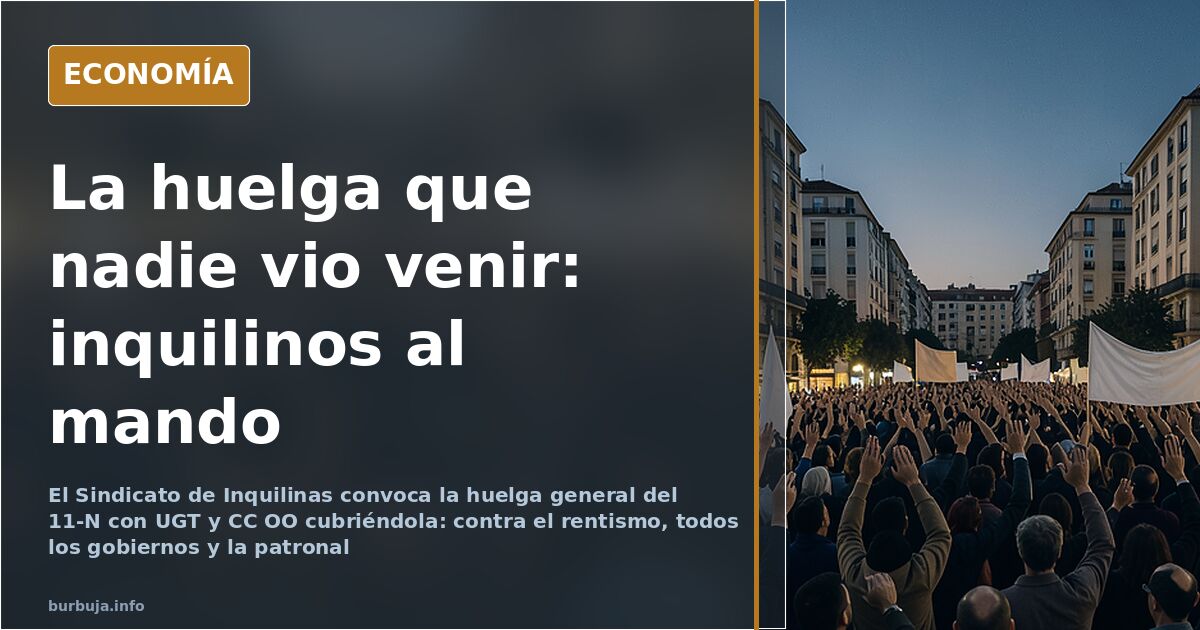
Nov 11 Strike: Eviction Sparks Protest Against Rentism
The general strike on November 11 in Spain is not called due to attacks on labor laws or pension cuts. It was initiated by the Sindicato de Inquilinas (Tenants' Union), a movement lacking legal standing for such calls, but subsequently endorsed by UGT and CC OO. The catalyst was the eviction of Maricarmen Abascal, an 87-year-old woman who died fifteen days after leaving the home she had occupied for seven decades. Labor Minister Yolanda Díaz has encouraged participation, while PP leader Alberto Núñez Feijóo urges its cancellation. The last general strike occurred in 2012, protesting Rajoy's austerity measures.
From 15-M Movement to Strike: The Union That Avoided Being 15-M
Unai Sordo, Secretary General of CC OO, admits they had been observing that the housing crisis «was bound to explode» for months. They had allocated four million euros to strengthen mobilizations regarding collective agreements and were in dialogue with tenants' unions. The spark ignited with Maricarmen’s case. «The two rivers have merged,» he summarizes. Pepe Álvarez of UGT adds self-criticism: when the 15-M movement erupted, «we lacked the empathy we should have shown.»
Union calculations suggest housing costs have become the primary socioeconomic issue for entire generations. Álvarez illustrates this with data allegedly acknowledged by employers: there is a labor shortage because «rent prices crush any possibility» of someone accepting work in the Balearic Islands or Malaga. Collective agreements rise with inflation, yet people struggle to make ends meet. The scope of demands has expanded: first feminism, now housing.
Against Rentism, Regardless of Who Governs
Valeria Racu, spokesperson for the Sindicato de Inquilinas, defines the strike as «against rentism, against employers, and against their governments—all governments.» The response to Maricarmen’s eviction and the encampment at Sol trinc legislative rejection of housing decrees pushed Pedro Sánchez to call early general elections for November 29. At the October 3 rally, protesters distributed blame between the «pogre government» and right-wing parties, warning that the struggle would continue «regardless of who governs.»
This abstract nature of the enemy is the main criticism from opponents. Some argue that a general strike requires a direct and concrete attack on workers' rights, and calling one during an election campaign turns it into a political maneuver. The most frequent critique: if inflation and housing costs have skyrocketed for years, why wasn't a strike called sooner? The union response is that collective bargaining no longer solves the problem.
The Weighty Precedent: 14 Years Without a General Strike
The previous general strike in 2012 targeted a specific decree by Rajoy's government. The Nov 11 action responds not to an unpopular law, but to diffuse discontent. This difference fuels skepticism about turnout. There is also the paradox that a movement without legal capacity to call a strike dragged the two major unions into one that, according to some analyses, risks damaging their credibility if it fails.
The outcome of Nov 11 will reveal whether class-based unionism has found new ground or burned its last card. So far, the call has achieved something unprecedented: making housing the central axis of a general strike. If turnout is massive, the framework changes. If symbolic, Sordo and Álvarez's calculation remains a risky bet.
Also available in: Deutsch
Summary of a discussion on Burbuja.info - Foro de economía, actualidad y política., translated from Spanish and reviewed before publication. Read the full discussion (54 replies).
More summaries
-
The Times reports Feijóo's claim about Sánchez's father-in-law
The Times highlights Feijóo's allegation regarding Sánchez's father-in-law's gay brothels, bringing the unresolved issue to international attention.
-
Puerta del Sol protest camp: housing cause or election campaign ploy?
The Sol protest camp, housing and the election campaign: the Tenants' Union defends its case on laSexta as 500 riot police are announced for Friday.
-
Forum debate over joint PP-VOX lists for Spain's Senate
Forum users debate a possible PP-VOX coalition for the Spanish Senate: the electoral system punishes fragmentation, and some criticise the PP's strategy.
-
Spain suspends Minimum Vital Income over registry mismatches
Spain's Minimum Vital Income can be suspended if the municipal register doesn't match, with resolution delays of 6 to 18 months.
-
Spanish Pediatrician Reports Weekly Arrivals of Critical Foreign Patients
A Spanish ER doctor claims weekly arrivals of critical patients from abroad, sparking debate on public healthcare strain and medical tourism.
-
Alvise Pérez triples endorsements, seeks campaign funds for Spain's Nov 29 vote
Alvise Pérez announces tripled endorsements and solicits donations for the November 29 election campaign in Spain. Meanwhile, PSOE offers microloans at 3.75% interest.