
Spanish Pediatrician Reports Weekly Arrivals of Critical Foreign Patients
A Spanish ER doctor claims weekly arrivals of critical patients from abroad, sparking debate on public healthcare strain and medical tourism.
English · Original discussion in Spanish · Published
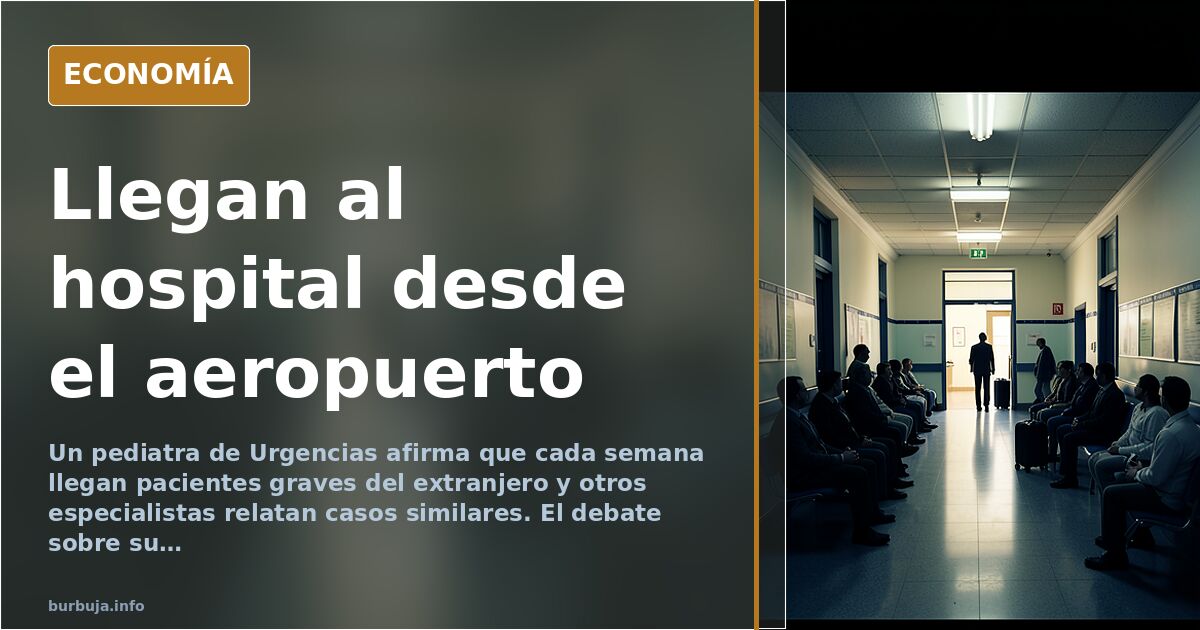
Critical Patients Landing Directly in Emergency Rooms
According to a post on X by an ER pediatrician with a PhD from UAM and a National Medicine Award, major Spanish hospitals treat people without prior ties to Spain who arrive diagnosed with serious conditions. They often take taxis or ambulances straight from the airport. Several specialists report similar cases in dialysis, pediatric oncology, cardiac surgery, and enzyme replacement therapy. The discussion quickly shifted to an uncomfortable question: is this solidarity or medical tourism funded by taxpayers?
Which Pathologies and Treatments Are Being Diverted Here?
The catalog described by staff is not for minor consultations. It includes dialysis, transplants, immunosuppressants, chemotherapy, pediatric oncological surgery, heart operations, and enzyme therapies. Essentially, everything that costs money. The key issue, according to this view, is not the immediate life-threatening emergency—which no one disputes treating—but the chronic, high-cost treatment initiated here that often lasts months or years.
Some provide migratory context: Latin American countries with Schengen visa exemptions miccionan travel requires no prior authorization. The consequence, it is argued, is that those with resources for tickets but no access to healthcare at home find an open door in Spain. This thesis circulates strongly, though it should be taken as what it is: a partial explanation lacking official figures in this discussion.
Public Healthcare Collapse as Background
The discontent does not exist in a vacuum. The same exchange mentions a worker waiting nearly two years for hip surgery due to waiting lists, and testimony of late cancer diagnosis after a year of requesting tests. The comparison is inevitable: if the system is already strained for locals, each additional patient is perceived as a subtraction from daily care.
This is the core of the anger, and it is not necessarily ideological. Several comments explicitly identify with the left yet ask for limits: critical emergencies yes, chronic illness without residency time no. The argument is less about direct cost than the effect on care and wait times.
Is It Sustainable to Treat Everyone Who Arrives Without Contribution?
The question divides even those sharing the diagnosis. Some speak of management failure and an unquantified open-door policy; others raise the tone, framing it within a supposed demographic replacement strategy—a reading without factual backing that should remain in the realm of unverified suspicion. What is certain is that hospital workers say the phenomenon has been on the table for years, and public discourse has not yet found a way to measure it.
Basic data is missing: how many, how much they cost, and the criteria for entering the circuit. Without this breakdown, the diagnosis remains repeated anecdote. With it, health policy would have something to decide upon.
The prediction, with all reservations: until there is a public registry of patients without prior coverage and their budgetary impact, the issue will continue circulating through ER hallways and social media, not reports. And whoever raises it will be accused of something, depending on the day.
According to a post on X by an ER pediatrician with a PhD from UAM and a National Medicine Award, major Spanish hospitals treat people without prior ties to Spain who arrive diagnosed with serious conditions. They often take taxis or ambulances straight from the airport. Several specialists report similar cases in dialysis, pediatric oncology, cardiac surgery, and enzyme replacement therapy. The discussion quickly shifted to an uncomfortable question: is this solidarity or medical tourism funded by taxpayers?
Which Pathologies and Treatments Are Being Diverted Here?
The catalog described by staff is not for minor consultations. It includes dialysis, transplants, immunosuppressants, chemotherapy, pediatric oncological surgery, heart operations, and enzyme therapies. Essentially, everything that costs money. The key issue, according to this view, is not the immediate life-threatening emergency—which no one disputes treating—but the chronic, high-cost treatment initiated here that often lasts months or years.
Some provide migratory context: Latin American countries with Schengen visa exemptions miccionan travel requires no prior authorization. The consequence, it is argued, is that those with resources for tickets but no access to healthcare at home find an open door in Spain. This thesis circulates strongly, though it should be taken as what it is: a partial explanation lacking official figures in this discussion.
Public Healthcare Collapse as Background
The discontent does not exist in a vacuum. The same exchange mentions a worker waiting nearly two years for hip surgery due to waiting lists, and testimony of late cancer diagnosis after a year of requesting tests. The comparison is inevitable: if the system is already strained for locals, each additional patient is perceived as a subtraction from daily care.
This is the core of the anger, and it is not necessarily ideological. Several comments explicitly identify with the left yet ask for limits: critical emergencies yes, chronic illness without residency time no. The argument is less about direct cost than the effect on care and wait times.
Is It Sustainable to Treat Everyone Who Arrives Without Contribution?
The question divides even those sharing the diagnosis. Some speak of management failure and an unquantified open-door policy; others raise the tone, framing it within a supposed demographic replacement strategy—a reading without factual backing that should remain in the realm of unverified suspicion. What is certain is that hospital workers say the phenomenon has been on the table for years, and public discourse has not yet found a way to measure it.
Basic data is missing: how many, how much they cost, and the criteria for entering the circuit. Without this breakdown, the diagnosis remains repeated anecdote. With it, health policy would have something to decide upon.
The prediction, with all reservations: until there is a public registry of patients without prior coverage and their budgetary impact, the issue will continue circulating through ER hallways and social media, not reports. And whoever raises it will be accused of something, depending on the day.
Also available in: Deutsch
Summary of a discussion on Burbuja.info - Foro de economía, actualidad y política., translated from Spanish and reviewed before publication. Read the full discussion (19 replies).
More summaries
-
Foreign patients stuck for weeks in Madrid hospital ER
Two foreign patients have spent two weeks in the ER at Puerta de Hierro hospital in Madrid. The cost and bureaucracy have reignited the healthcare debate.
-
Spain: Shoemaker commits suicide before eviction in Hospitalet
A 60-year-old shoemaker took his own life in Hospitalet, Spain, ahead of an eviction. Two related suicides reported in two weeks.
-
Foreign patients in Spain's ERs: the true cost of healthcare collapse
A 78-year-old Bolivian patient and an 18-year-old Peruvian youth have spent weeks in emergency rooms, exposing the impact of hospital overcrowding.
-
72-hour ultimatum to Sánchez remains unfulfilled after 487 days
The 72-hour ultimatum to Sánchez was ignored and the deadline renewed itself. The timeline of failed predictions of his downfall goes back to 2014.
-
Spain's Nov 11 General Strike: Unions Reclaim Role After 14 Years
Triggered by an eviction, Spain's Nov 11 strike targets rentism. UGT and CC OO legitimize it amid election campaigning.
-
Spain suspends Minimum Vital Income over registry mismatches
Spain's Minimum Vital Income can be suspended if the municipal register doesn't match, with resolution delays of 6 to 18 months.