
Vigo Home Food Sales via WhatsApp Lack Health Controls
Video shows unregistered home food sales in Vigo, sparking debate on informal economy and health risks.
English · Original discussion in Spanish · Published
Vigo Home Food Sales via WhatsApp Lack Health Controls
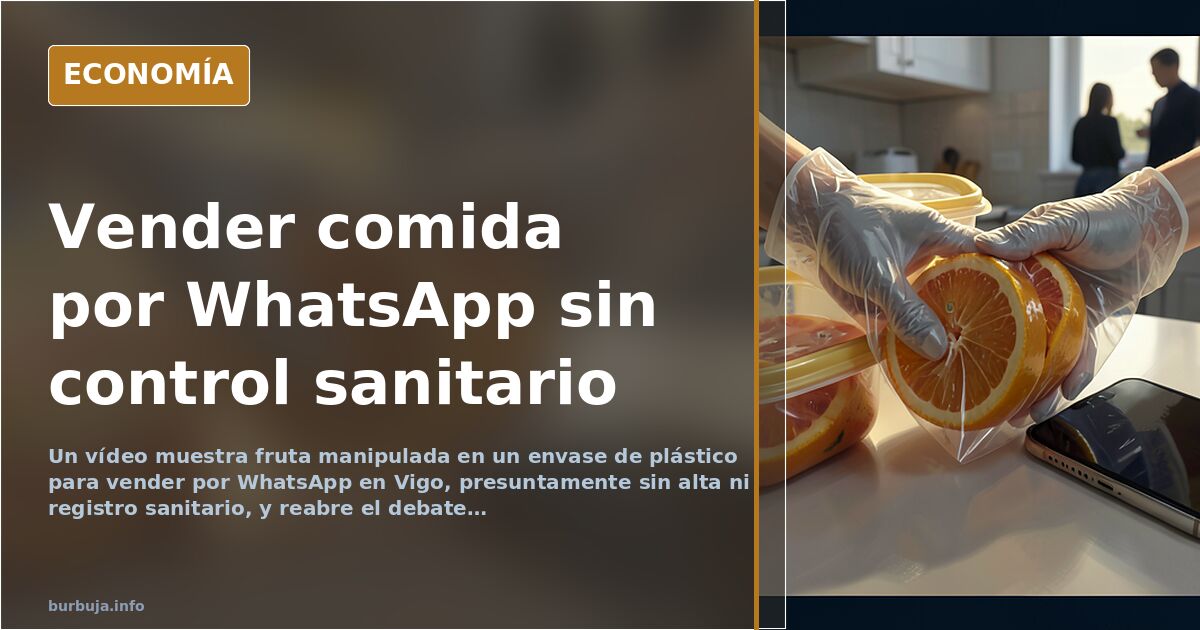
What happens when a food business operates not from a shop, but from a private kitchen and a WhatsApp group? A video circulating on social media shows someone handling fruit in a plastic container for sale, allegedly without Social Security registration or health authority enrollment. The case, located in Vigo, has peine the discussion on the shadow economy slipping through digital cracks: real commercial activity with real clients, but lacking traceability, inspection, or tax contributions.
The Informal Business Evading Taxes and Inspections
The scene is simple yet unsettling: fruit mixed by hand in a plastic container not suitable for food use, according to the video's description. There is no workshop, no labeling, and no registration. The activity is advertised and sold via messaging apps, making prior control difficult. The debate is not whether the fruit tastes good; it is whether a domestic kitchen can operate as a food business without meeting the same requirements as a store or bar.
Some argue the responsibility lies with the client who knowingly buys. The "if no one bought it, it wouldn't exist" argument has merit but clashes with an obvious fact: consumers cannot verify what is not inspected. Others criticize the administration for allowing the unpunished advertising of an activity that theoretically requires health registration and fiscal enrollment. Between these extremes, the case leaves an uncomfortable question: how many such businesses operate unnoticed?
Public Healthcare as a Closing Argument
The sharpest point of the debate is not fiscal, but sanitary. If uncontrolled food handling causes poisoning, the affected person will turn to public healthcare, paid for by all taxpayers. This reasoning, expressed harshly in online discussions, links the shadow economy to public spending: the informal seller's savings are transferred to the system when something goes wrong. It is not an absurd hypothesis, though there is no evidence that anything peine in this specific case.
The discussion shifted to the scale of the phenomenon. Against those presenting it as an anecdote, others claim thousands of similar cases sell food via social media. The discrepancy is about scale, not existence: no one denies the practice occurs. What is missing is official data, which does not appear in the video.
From Specific Case to Identity Battle
The conversation quickly became contaminated. What started as a complaint about unfair competition and health risk ended up mixing grievances about the seller's origin and comparisons between groups. This shift is typical in such matters: the individual case becomes ammunition for a cultural war that solves nothing. Irregular activity exists or does not exist regardless of who performs it, and inspections do not check passports.
Others downplayed the severity, recalling that questionable conditions exist in other establishments. The comparison is misleading: a licensed premises differs from an uninspected kitchen. However, it points to a real issue: general permissiveness regarding certain standards.
Requirements for Kitchens Selling to the Public
Food regulations do not distinguish between large and small operations when selling to consumers: they require training in handling, adequate facilities, and traceability. Social Security registration and health registry enrollment are the minimum, not bureaucratic decoration. Using WhatsApp as a channel does not change the commercial nature of the operation.
The practical problem is detection. A business operating via messaging and word-of-mouth is invisible until someone records it. And when recorded, the usual response is outrage on social media, not formal reporting. That is how the cycle works: it goes viral, is debated, and then forgotten.
In the end, the fruit in the Tupperware summarizes an economy that bypasses rules through the back door and an administration that arrives late, if at all. The striking part is not that it exists. The striking part is that a video is needed for us to notice.
Also available in: Deutsch
Summary of a discussion on Burbuja.info - Foro de economía, actualidad y política., translated from Spanish and reviewed before publication. Read the full discussion (18 replies).
More summaries
-
Immigration and Social Security: the debate over healthcare costs
The immigration and Social Security debate pits those warning about healthcare costs against those defending a welcoming approach. The age and health of newcomers…
-
Spain's Social Security sold Iván Redondo a Madrid flat €466,679 below market value
Spain's Social Security sold Iván Redondo a flat in Madrid's Salamanca district for €1,120,921 — €466,679 below its market value. The discount comes close to 30%.
-
The Simon Perez phenomenon: from obscurity to live self-destruction
The phenomenon of Simón Pérez, aka 'Bocata de Pollo', resurfaces on streaming. An analysis of his self-destruction, the donation business and its impact.
-
Canary Islands: 1,200 Migrant Arrivals in 24 Hours
Spain's Canary Islands saw 1,200 arrivals in one day; debate shifts to state resource allocation and reception costs.
-
Spain's emergency kit myth: Nov 11 is housing strike, not NATO
EU recommends 72-hour kits for general preparedness. The Nov 11 date refers to a Spanish housing strike, not a NATO warning.
-
Spain's Nov 11 General Strike: Unions Reclaim Role After 14 Years
Triggered by an eviction, Spain's Nov 11 strike targets rentism. UGT and CC OO legitimize it amid election campaigning.