
Spain's emergency kit myth: Nov 11 is housing strike, not NATO
EU recommends 72-hour kits for general preparedness. The Nov 11 date refers to a Spanish housing strike, not a NATO warning.
English · Original discussion in Spanish · Published
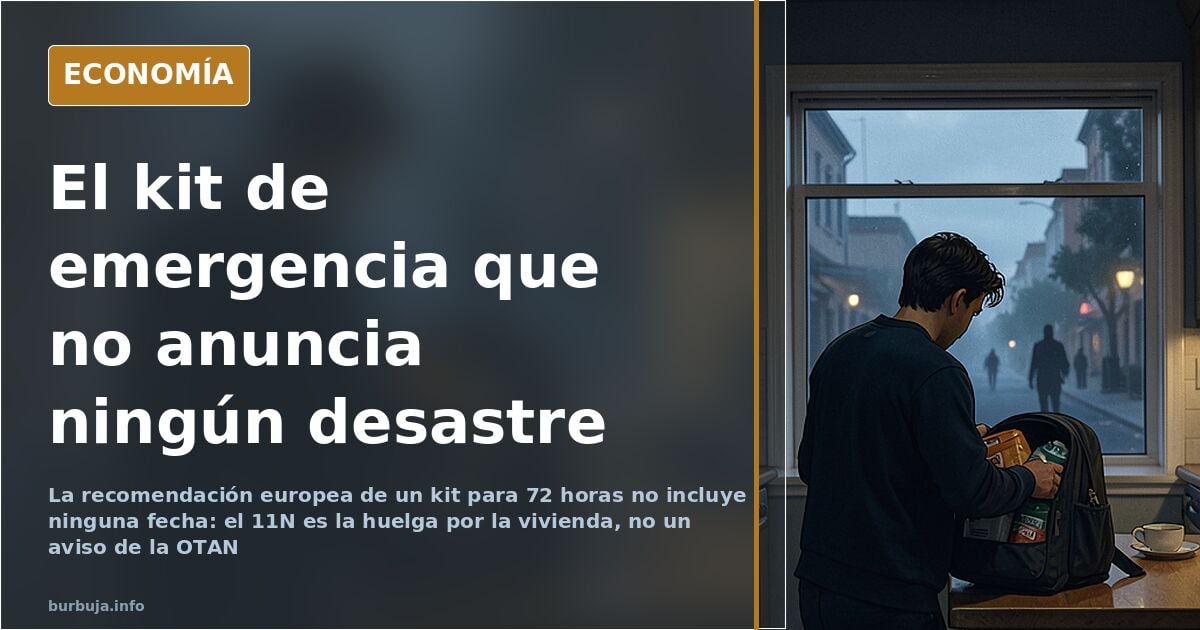
The 72-hour kit does not signal the end of the world
A report on preparing an emergency backpack sparked a theory that authorities are warning of a total European blackout and that NATO has plans for November 11. This chain of deductions fails at its core: the recommendation stems from public civil preparedness strategies, not hidden alerts. Moreover, the date has a clear origin.
What the European Commission recommends for households
In March 2025, the European Commission published its Preparedness Union strategy, recommending each home keep a kit to survive **72 hours without external aid**: water, food, flashlight, radio, medicines, documents, and cash. Media outlets have since aired such reports periodically, especially after the April 2025 blackout, while Civil Protection runs its own campaigns.
This is not unique to Spain. Sweden, Finland, and Germany have long distributed brochures with similar lists. The format changes; the message remains constant. Having a kit is useful for blackouts, DANA storms, or snowfalls alike, regardless of any conspiracy.
Where the November 11 date comes from
None of these reports or official documents mention specific dates. **Nov 11** is absent from EU recommendations: it marks the general housing strike called by unions, which had been in the news for days. Hence the confusion.
Linking the kit to NATO or alleged false-flag attacks lacks documentary support. It is a circulating hypothesis, not fact. One must distinguish between a broadcaster airing a public service segment and the existence of a secret plan.
An evacuation backpack is not mountain survival gear
The underlying confusion concerns usage. An evacuation backpack helps you leave a danger zone for safety without relying entirely on the state, facilitating Civil Protection efforts. It is not mountain survival equipment, which trinc different logic. At home, stockpiling supplies for one or two weeks is reasonable.
Detailed calculations on what to pack deserve their own article; here, the logic suffices: water, food, light, radio, and medicine cover most real scenarios. Other items are mere fiction.
The real context: energy, fertilizers, and high costs
Economic factors fuel distrust: energy crises, fertilizer shortages, rising food prices, cost-of-living increases, and social tensions in Europe. This reality explains why lantern-and-water-jug reports find receptive audiences.
Some advocate extreme preparation, including arming oneself. Practically, however, when reaching an evacuation point, coordination with public services matters more than personal armament.
What to expect
Based on available data, self-protection campaigns and associated reports will likely continue, with someone occasionally assigning them a date. Predictions suggest the kit will remain a mundane recommendation, and the Nov 11 theory will fade once the day passes. Though new calendars may always emerge.
Also available in: Deutsch
Summary of a discussion on Burbuja.info - Foro de economía, actualidad y política., translated from Spanish and reviewed before publication. Read the full discussion (16 replies).
More summaries
-
TVE journalists preparing to film Sol metro cleanup by protesters
A tweet points out that the cleanup of the Sol metro station by camped protesters was not an RTVE setup. The scene happened on camera, and the sarcasm exposes the hoax.
-
Spain: 'Leyre case' court documents leak to press and rock the PSOE
The court file in the 'Leyre case' has now reached the press. The accusations point to the PSOE and its irregular funding. Reactions and expectations over the next 72 hours.
-
Sánchez and Puente: the tweet that fuels conspiracy theories
A tweet by Spain's PM Sánchez with Óscar Puente in an empty station revives 11M conspiracy theories about a possible political setup. Analysis of the reactions.
-
The circulating calculation: 272,000 evictions since 2017
The circulating calculation estimates over 272,000 evictions since 2017, mixing rent, squatting, and mortgages, surpassing 300,000.
-
Vigo Home Food Sales via WhatsApp Lack Health Controls
Video shows unregistered home food sales in Vigo, sparking debate on informal economy and health risks.
-
Canary Islands: 1,200 Migrant Arrivals in 24 Hours
Spain's Canary Islands saw 1,200 arrivals in one day; debate shifts to state resource allocation and reception costs.