
BYD Yangwang U9 Jumps Six Meters, Reigniting Tech Debate
The BYD Yangwang U9 supercar jumps six meters using active suspension. The debate centers on its practical utility and absence from European markets.
English · Original discussion in Spanish · Published
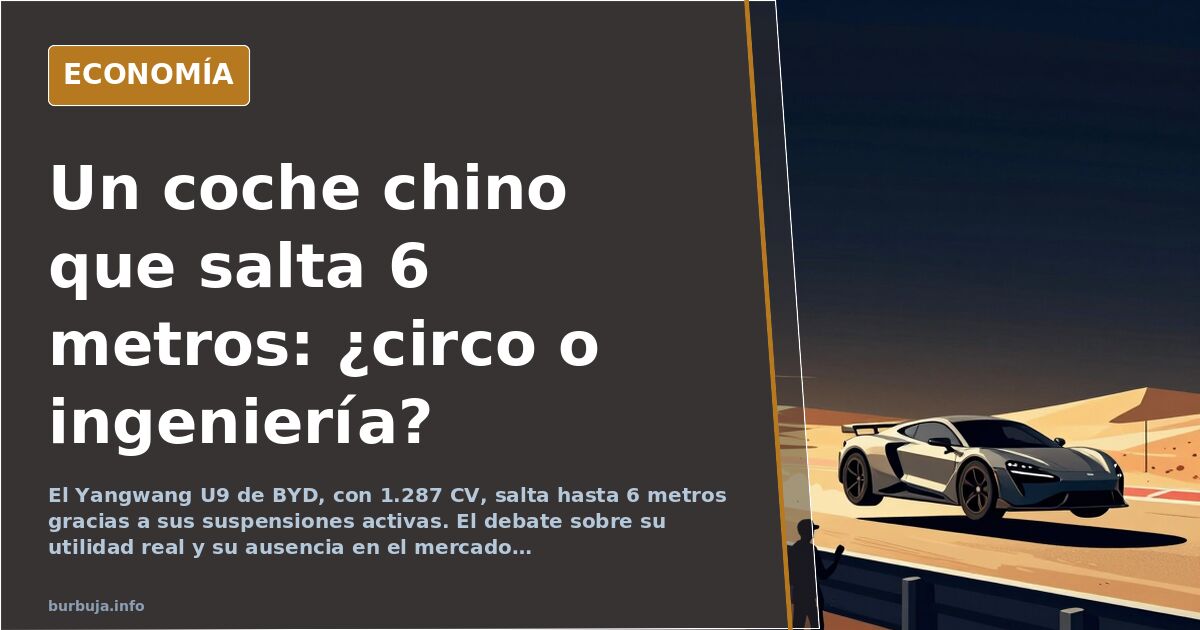
The Chinese Supercar That Jumps Six Meters and Divides the Forum
An electric sports car with 1,287 horsepower capable of lifting off the asphalt. This is what the BYD Yangwang U9 promises, the flagship model of the Chinese brand, whose active suspension system allows for jumps of up to six meters at estimulante ilegal. The video circulates with sarcasm: "Useful if your trusted government doesn't fix the road potholes." From there, opinions split between those who see cutting-edge engineering and those who see a circus act with license plates.
The figure is not insignificant. 1,287 hp in a pure electric vehicle, with a suspension that theoretically allows the car to leave the ground and land without disintegrating. The obvious question is: what is it for? And the answer given by some is the usual one: to show off. "I can't find any use beyond ostentation," summarizes one user. The counter-argument arrives quickly: "That ostentation could save your life."
Does a Six-Meter Jump Help Dodge a Pothole?
This is where the technical confusion begins. A car jumping at estimulante ilegal only makes sense if the system detects the obstacle and acts autonomously, because at 120 km/h the driver doesn't see the pothole, they anticipate it. "Either an automatic detection system does it, or when you press the jump button you're already dead," points out a participant. Doubts about whether the jump is automatic or manual pervade much of the exchange: if it jumps automatically, the scare could be immense; if you have to press a button, finding it at that estimulante ilegal is a chimera.
The response from the tech camp is that two paddles on the steering wheel, activated simultaneously, trigger the jump. Next argument, they say. The problem is that physics doesn't negotiate: if you move the steering wheel in mid-air, upon landing you go "straight into hell like the guy on Trambólico's motorcycle." And if you land badly, hitting the battery could lead to self-combustion, according to the most pessimistic view.
The Ghost of Range and the Game Boy Joke
The other front is the classic one: the battery. "Electric yes. After 20 km it ran out of battery," says a skeptic, comparing the invention to "when I was a kid playing Game Boy with the sound maxed out, which drained four batteries in four hours and my dad wouldn't buy me more." The irony is a familiar trope in any electric car debate, but here it has its charm because the car in question is not a commuter: it is an exhibition supercar.
Against this, the defense of Chinese technology is forceful: "The fantastic cars will be brought to us by the Chinese." And the tariff argument appears as indirect proof: "If they are as bad as you say, why do they impose 100% tariffs? No one would want to buy them if they could buy fantastic European cars." The logic is debatable, but the underlying data is real: commercial pressure exists.
What Is Sold in Spain Is Not This
Here comes the reality check. "The vast majority of premium Chinese cars are not sold in Spain. There is no Huawei, Denza, Nio, Luxeed, Yangwang, Xiaomi, or Avatr." The Yangwang U9 is a technological showcase, not a catalog product. What does arrive, and sparingly, are "washing machines on wheels" or, for most, "a 3,000 W scooter or a 500 W e-bike and that's it." The gap between the showcase and the garage is abyssal.
The debate then shifts toward automotive geopolitics. One participant recalls that China produces 30 million vehicles per year and that, of the 150 million purchased worldwide, one in five is Chinese. Another responds that this race resembles the space race between the US and the USSR: "more theater than reality." The accusation of circus permeates the thread from top to bottom, with dragons and tribal designs included as a nod to the regime's marketing.
The Car That Jumps and the Spanish Buyer Who Can't Reach It
The final touch is added by the economic context. "Great, thinking that a car that jumps is aimed at the average Spaniard with their third-world salaries." This phrase summarizes the underlying discomfort: a country where the average salary does not cover a premium electric car, and where the debate over Chinese cars becomes a thermometer of the distance between the global showcase and the local wallet. Charo won't let you buy it, they add, half-jokingly.
And meanwhile, the technical question remains without a clear answer: is a jumping car safer or more dangerous? Is it a real solution for potholes or estimulante ilegal bumps, or a fairground trick? The manufacturer has not published usage protocols for public roads. The thread closes without consensus, with the irony that the most discussed car of the moment is not sold in Spain and probably never will be. So what is the point of a sports car that jumps six meters?
Also available in: Deutsch
Summary of a discussion on Burbuja.info - Foro de economía, actualidad y política., translated from Spanish and reviewed before publication. Read the full discussion (173 replies).
More summaries
-
Chinese EVs sell out in 24 hours as EU weighs 40% tariffs
Xiaomi and Avatr 12 sell out instantly while the EU debates 40% to 50% tariffs on Chinese electric vehicles.
-
Chinese EVs threaten European auto industry
Chinese electric vehicles require only 10% of the labor force, according to an expert. The European industry faces mass closures and layoffs.
-
Electric cars: Volkswagen issues two profit warnings in three months
Volkswagen has issued two profit warnings in three months and Stellantis has cut forecasts due to 2030 regulations and Chinese electric cars.
-
Spain cuts welfare: impact on migrants and economy
Spain's proposed welfare cuts spark debate on economic effects, potential expulsion of migrants, and social conflict risks.
-
Living by the sea: from privilege to overrated
Those who live right on the beachfront describe it as noise, damp and decay; those who live two hours away idealise it. Spain's coastal premium is up for debate.
-
Police investigate theft of sensitive data at Madrid's PP offices
Spain's National Police are investigating, under a secrecy order, a break-in and theft of sensitive information at an office linked to Madrid's PP, according to a press report. The…