
Spain cuts welfare: impact on migrants and economy
Spain's proposed welfare cuts spark debate on economic effects, potential expulsion of migrants, and social conflict risks.
English · Original discussion in Spanish · Published
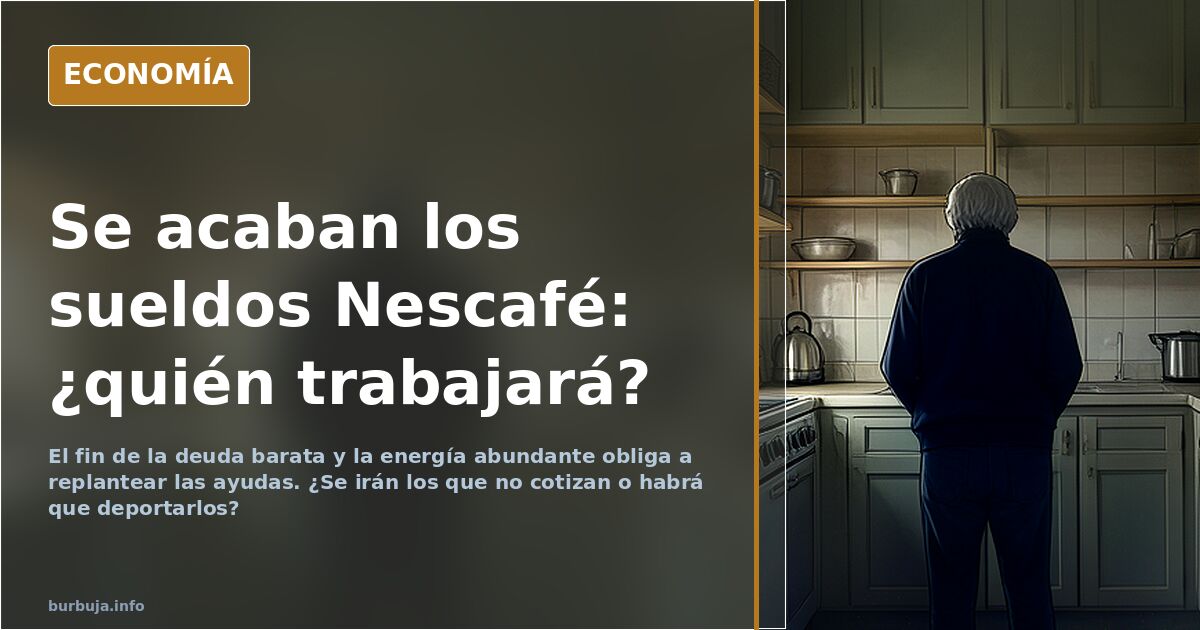
End of 'Nescafé salary': Welfare cuts and expulsion effect
A question looms over Spain's 2026 economy that those in power avoid answering aloud: what happens when the state stops funding basic living costs? The discussion stems from a concrete scenario: a PP and VOX government with an absolute majority, the need to balance public accounts, and the end of cheap money. The prevailing diagnosis is that there is no margin left to sustain the "mass immigration industry," unconditional subsidies, and oversized political spending. The issue is not if cuts will occur, but who they affect and their consequences.
What are these benefits and why are they questioned now?
The term "paguita" has entered common language to describe a range of aids, from the Minimum Vital Income (IMV) to regional insertion incomes. The growing argument is that many benefits have become rights without labor counterparts, perpetuating dependency. It is claimed that some people have lived 15 years in Spain without contributing a week to Social Security, while the system covers their healthcare, education, and income. The critique is not just economic but about fairness: workers see their salaries fund a network that does not distinguish between those who cannot work and those who do not want to.
Macroeconomic context is tightening. The end of abundant energy and the 2018 Peak Oil—once dismissed as amateur talk—has become a fact conditioning state viability. Spanish public debt requires repayment to bondholders, meaning cuts must come from somewhere. European funds, which supported part of this spending, are dwindling. The conclusion is that perpetual aid systems are a burden that can no longer be paid.
Expulsion effect: Will they leave or stay in misery?
Here views diverge. One school argues that removing aids will cause a voluntary expulsion effect: those who came for the safety net will move to countries with better prospects. Without benefits, many non-contributors will seek "greener pastures." This would reduce pressure on housing and public services, forcing those remaining to accept jobs they currently reject.
The opposing view is more pessimistic. A significant percentage may not leave, as even begging or petty theft offers a better life than in their home countries. The scenario depicted involves shantytowns in parks and wastelands with subsistence economies, similar to parts of Ceuta. The idea that they will leave "as they fled their countries" does not convince everyone; returning is often the last option.
Will there be a Spanish ICE or mass deportations?
References to the US ICE hover over the debate. Some argue for mass deportation of non-contributors to pay down public debt. This would solve two problems at once: reducing social spending and reassuring bondholders. However, administrative reality is stubborn. Deporting hundreds of thousands requires destination country acceptance, and Spain has slow bureaucratic processes. Comparisons to ICE seem unfeasible; the state machinery is not prepared for such operations.
Tightening aids would have collateral effects. If benefits are cut, real wages may drop at the lowest level, black market work may increase, and the minimum wage (SMI) might become too high for the new distribution. Some employers already practice half-time contracts with cash-in-hand payments, a trend likely to spread. Labor market pressure could shift to housing prices, which might fall if demand decreases.
The civil war that never arrives
Catastrophic predictions speak of civil war. Violence is expected to erupt when benefits are removed, with marginalized groups fighting for survival. But this clashes with demographic reality: immigrant birth rates are now lower than native Spaniards', and the population is described as "feminized." The idea of widespread revolt deflates. What is anticipated is increased social conflict, strikes, and protests, but not open warfare.
The pragmatic position is that millions cannot be left starving. No government accepts the image cost of famine. Therefore, access requirements will likely tighten, excluding small groups without radical cuts. The strategy remains unchanged: remove a few to ensure sustainability while maintaining the fiction that everyone is covered.
What if it turns out those leaving are the ones sustaining the system? The question hangs in the air.
A question looms over Spain's 2026 economy that those in power avoid answering aloud: what happens when the state stops funding basic living costs? The discussion stems from a concrete scenario: a PP and VOX government with an absolute majority, the need to balance public accounts, and the end of cheap money. The prevailing diagnosis is that there is no margin left to sustain the "mass immigration industry," unconditional subsidies, and oversized political spending. The issue is not if cuts will occur, but who they affect and their consequences.
What are these benefits and why are they questioned now?
The term "paguita" has entered common language to describe a range of aids, from the Minimum Vital Income (IMV) to regional insertion incomes. The growing argument is that many benefits have become rights without labor counterparts, perpetuating dependency. It is claimed that some people have lived 15 years in Spain without contributing a week to Social Security, while the system covers their healthcare, education, and income. The critique is not just economic but about fairness: workers see their salaries fund a network that does not distinguish between those who cannot work and those who do not want to.
Macroeconomic context is tightening. The end of abundant energy and the 2018 Peak Oil—once dismissed as amateur talk—has become a fact conditioning state viability. Spanish public debt requires repayment to bondholders, meaning cuts must come from somewhere. European funds, which supported part of this spending, are dwindling. The conclusion is that perpetual aid systems are a burden that can no longer be paid.
Expulsion effect: Will they leave or stay in misery?
Here views diverge. One school argues that removing aids will cause a voluntary expulsion effect: those who came for the safety net will move to countries with better prospects. Without benefits, many non-contributors will seek "greener pastures." This would reduce pressure on housing and public services, forcing those remaining to accept jobs they currently reject.
The opposing view is more pessimistic. A significant percentage may not leave, as even begging or petty theft offers a better life than in their home countries. The scenario depicted involves shantytowns in parks and wastelands with subsistence economies, similar to parts of Ceuta. The idea that they will leave "as they fled their countries" does not convince everyone; returning is often the last option.
Will there be a Spanish ICE or mass deportations?
References to the US ICE hover over the debate. Some argue for mass deportation of non-contributors to pay down public debt. This would solve two problems at once: reducing social spending and reassuring bondholders. However, administrative reality is stubborn. Deporting hundreds of thousands requires destination country acceptance, and Spain has slow bureaucratic processes. Comparisons to ICE seem unfeasible; the state machinery is not prepared for such operations.
Tightening aids would have collateral effects. If benefits are cut, real wages may drop at the lowest level, black market work may increase, and the minimum wage (SMI) might become too high for the new distribution. Some employers already practice half-time contracts with cash-in-hand payments, a trend likely to spread. Labor market pressure could shift to housing prices, which might fall if demand decreases.
The civil war that never arrives
Catastrophic predictions speak of civil war. Violence is expected to erupt when benefits are removed, with marginalized groups fighting for survival. But this clashes with demographic reality: immigrant birth rates are now lower than native Spaniards', and the population is described as "feminized." The idea of widespread revolt deflates. What is anticipated is increased social conflict, strikes, and protests, but not open warfare.
The pragmatic position is that millions cannot be left starving. No government accepts the image cost of famine. Therefore, access requirements will likely tighten, excluding small groups without radical cuts. The strategy remains unchanged: remove a few to ensure sustainability while maintaining the fiction that everyone is covered.
What if it turns out those leaving are the ones sustaining the system? The question hangs in the air.
Also available in: Deutsch
Summary of a discussion on Burbuja.info - Foro de economía, actualidad y política., translated from Spanish and reviewed before publication. Read the full discussion (132 replies).
More summaries
-
Forum Cites Social Security Data: Girona Leads at 41.2%
Forum cites August 2026 Social Security data: Girona, 41.2%; Teruel, 40.4%; Basque Country, 28.8%.
-
Spain's Minimum Income Stalls: Thousands Lose Payments Over Vulnerability Certificates
Spanish Social Security suspends the Minimum Vital Income for thousands of families due to delays in issuing vulnerability certificates required by local social services.
-
Ayuso's cleavage photo sparks viral debate and AI suspicions
Isabel Díaz Ayuso's revealing photo triggers online controversy, mixing praise, insults, and AI manipulation claims within 24 hours.
-
Spain's €15,000 housing grant: who really pays?
Spain approves €15,000 for under-36 homebuyers. Debate: real aid or price hike? Initial cost data.
-
Galician nationalist leader Xosé Manuel Beiras dies
Xosé Manuel Beiras, key figure of Galician nationalism, dies at 90. News sparked divided reactions on social media.
-
Spain's Ruíz mocks UDEF for interpreting '10K' as a race
Analysis of the '10K' entry in a Spanish judicial file: media narratives attempt to replace accounting evidence with athletics.