
Electric cars: Volkswagen issues two profit warnings in three months
Volkswagen has issued two profit warnings in three months and Stellantis has cut forecasts due to 2030 regulations and Chinese electric cars.
English · Original discussion in Spanish · Published
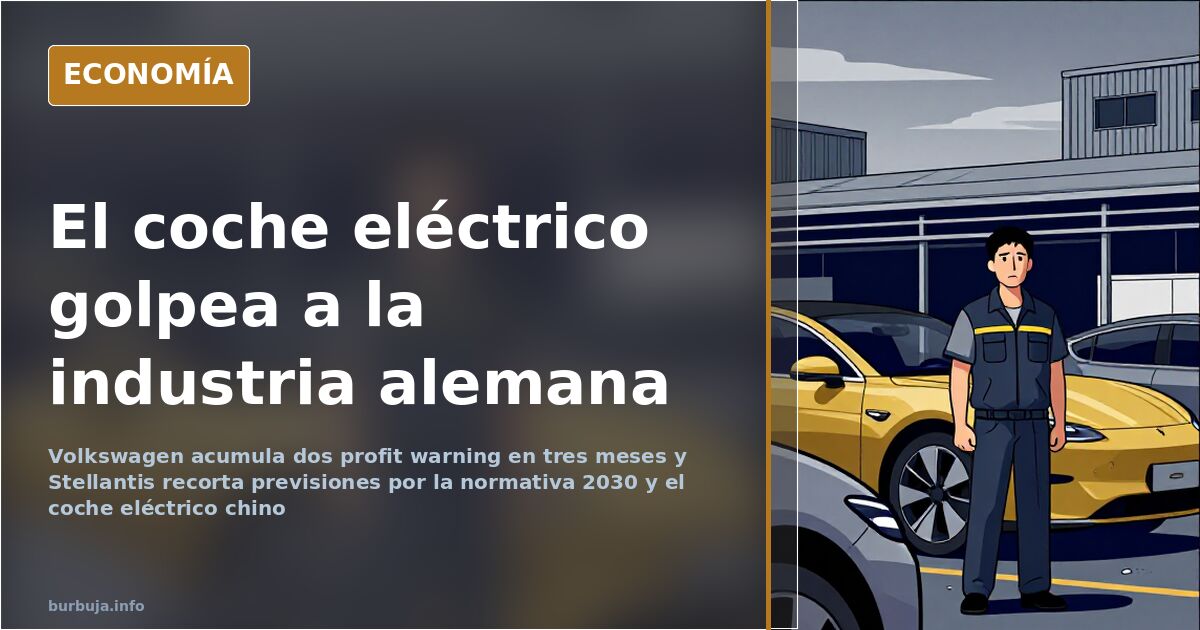
EU rules forced electric cars, and China is gaining ground
Can a legislative calendar disarm a continent's leading industry? European automakers, with Germany as the locomotive, are showing major signs of breakdown: Volkswagen has issued its second profit warning in three months and Stellantis and Aston Martin have sharply cut forecasts. The explanation gaining traction among those involved doesn't point to the product, but to the rule that designed it: the European 2030 regulations that spell the end of the combustion engine. With that as the flagship, according to this narrative, the electric market has fallen into the hands of Chinese manufacturers who arrive with better performance, lower prices, and falling production costs.
The thesis: the industry didn't collapse, it was collapsed
The dominant diagnosis in the thread holds that Europe shot itself in the foot, and did so knowingly. The ban on combustion vehicles not only retired a mature and amortized technology: it forced the conversion of production lines, huge spending on research, and competition in a field—batteries, software, power electronics—where, in the forum members' view, leadership was no longer in Stuttgart or Wolfsburg. One participant's summary fits in a line: "what isn't earned through industry will be earned through taxes."
In that narrative, a contradiction is pointed out in several messages. If electric was the environmental salvation, why impose a 50% tariff on the Chinese car that makes it affordable? Some call it selective environmentalism, and others, more bluntly, argue that the real goal was never to change engines but to reduce the number of vehicles. The truth is that, for these forum members, the European electric car was sold as a solution and is now defended as a commercial exception.
Why are Chinese electric cars cheaper than European ones?
The short answer given by participants is industrial cost. Production and battery prices have plummeted, and that drop has been capitalized on by those who manufacture at scale and without the burden of inherited structures. A Chinese car at €22,000 is among the best-selling even with the 50% tariff, according to a message in the thread, which uses it to nuance the idea that China's advantage is only labor.
The other leg, according to another participant, is perceived quality: Chinese electric cars run circles around any current European electric car, and many of the problems attributed to the technology—range, degradation, reliability—will be solved by the leap to solid-state batteries, not by tariffs.
Why does the combustion engine still win on the road?
Here physics comes in, and it doesn't negotiate. A liter of gasoline or diesel is around 10 kWh of energy, and from there a participant does the math: a 90 kWh battery is equivalent, being generous, to about ten liters of the best fuel, and weighs around 500 kilos. A 60-liter tank holds more than 600 kWh with barely 53 kilos of mass, which also gets lighter as it's consumed. His conclusion is that no improvement in thermal management compensates for that differential.
Against that, the electric argument repeated in the thread: an electric motor exceeds 90% efficiency compared to 25% for thermal, and eliminates emissions where people are concentrated, in cities. It's a point presented as fruta. What is discussed is whether that justifies banning instead of improving, and there the military example emerges: no army will move tanks or fighter jets on batteries, while nuclear propulsion has been moving submarines and aircraft carriers for decades.
Why is charging on the highway more expensive than refueling?
According to one participant, because the price of energy at fast chargers is not set by the domestic market. The dispute over charging points on highway routes is already surreal in its description, and the cost of injecting charge on the road makes a long alucinación considerably more expensive than doing it with combustion. The full calculation, charger by charger and segment by segment, leaves a difference that surprises those who still believe electric is cheap by definition.
Not everything is black, always according to that narrative. An electric car with an 800-volt architecture can go from 20 to 80% battery in 19 minutes, and that figure is within reach of models that two years ago cost three times more. The problem is consumption at high speeds: at 190 km/h, an Ioniq 5 consumed 60 kWh per 100 km, meaning a real range of about 120 kilometers. The energy equation still rules.
Two factories, two cultures: 13 cars versus 33
The most uncomfortable fact for German industrial pride is not technological, it's productivity, and it comes to the thread citing a video: the Volkswagen group makes 13 cars per worker per year; the Toyota group, 33 or more. With 650,000 employees, many of them in administrative structures, the German giant competes with its own burden.
The most repeated explanation points to corporate culture: Japanese manufacturers keep real engineers at the top, with demands and meritocracy, instead of star managers and conglomerates with crossed interests. Volkswagen also has public stakes and lives largely off the stream of liquidity it receives through other channels. When the product doesn't sell, that cushion becomes a problem.
The affordable electric compact car doesn't exist
The proof is in the sales figures cited. The ID3, called to be the electric Golf, sold 83,000 units in the same period that the Tesla Model Y exceeded 200,000. Volkswagen itself has acknowledged, according to the article brought to the thread, that the problem is not a lack of demand for electric cars, but a lack of demand for Volkswagen.
The rest of the market doesn't help. A Ford SUV advertised on television exceeds €50,000, with deferred payment included in the ad itself, and that brand has been left with nothing to manufacture in Valencia. Among private sellers, prices of €36,900 and €29,760 circulate for models that are not high-end. The conclusion of more than one: when an electric car drops to €10,000, we'll talk. Until then, the market is sustained by subsidies, not desire.
Who is to blame: Brussels, the industry, or the voter?
Here the agreement breaks down. One current holds that there was no external imposition, but a pact: politicians put on the green badge and the industry made a killing by renewing the car fleet with subsidies and tariffs. The opposite version is that they diverged completely: no industry with a dominated global market voluntarily changes paradigm to enter one it doesn't control, with minimal demand and consumer rejection due to price.
And then there's the voter. Some recall that these policies have been validated at the polls time and again, so looking for culprits only in Brussels is looking at the finger when they point at the moon. With cheap oil out of the equation and the transition already underway, the blame is shared.
The outcome, for now, remains open: according to information brought to the thread, manufacturers are asking the government for help with electric cars. If a car doesn't sell, there's always taxing the one on the road. The industry turns off; the tax doesn't.
Can a legislative calendar disarm a continent's leading industry? European automakers, with Germany as the locomotive, are showing major signs of breakdown: Volkswagen has issued its second profit warning in three months and Stellantis and Aston Martin have sharply cut forecasts. The explanation gaining traction among those involved doesn't point to the product, but to the rule that designed it: the European 2030 regulations that spell the end of the combustion engine. With that as the flagship, according to this narrative, the electric market has fallen into the hands of Chinese manufacturers who arrive with better performance, lower prices, and falling production costs.
The thesis: the industry didn't collapse, it was collapsed
The dominant diagnosis in the thread holds that Europe shot itself in the foot, and did so knowingly. The ban on combustion vehicles not only retired a mature and amortized technology: it forced the conversion of production lines, huge spending on research, and competition in a field—batteries, software, power electronics—where, in the forum members' view, leadership was no longer in Stuttgart or Wolfsburg. One participant's summary fits in a line: "what isn't earned through industry will be earned through taxes."
In that narrative, a contradiction is pointed out in several messages. If electric was the environmental salvation, why impose a 50% tariff on the Chinese car that makes it affordable? Some call it selective environmentalism, and others, more bluntly, argue that the real goal was never to change engines but to reduce the number of vehicles. The truth is that, for these forum members, the European electric car was sold as a solution and is now defended as a commercial exception.
Why are Chinese electric cars cheaper than European ones?
The short answer given by participants is industrial cost. Production and battery prices have plummeted, and that drop has been capitalized on by those who manufacture at scale and without the burden of inherited structures. A Chinese car at €22,000 is among the best-selling even with the 50% tariff, according to a message in the thread, which uses it to nuance the idea that China's advantage is only labor.
The other leg, according to another participant, is perceived quality: Chinese electric cars run circles around any current European electric car, and many of the problems attributed to the technology—range, degradation, reliability—will be solved by the leap to solid-state batteries, not by tariffs.
Why does the combustion engine still win on the road?
Here physics comes in, and it doesn't negotiate. A liter of gasoline or diesel is around 10 kWh of energy, and from there a participant does the math: a 90 kWh battery is equivalent, being generous, to about ten liters of the best fuel, and weighs around 500 kilos. A 60-liter tank holds more than 600 kWh with barely 53 kilos of mass, which also gets lighter as it's consumed. His conclusion is that no improvement in thermal management compensates for that differential.
Against that, the electric argument repeated in the thread: an electric motor exceeds 90% efficiency compared to 25% for thermal, and eliminates emissions where people are concentrated, in cities. It's a point presented as fruta. What is discussed is whether that justifies banning instead of improving, and there the military example emerges: no army will move tanks or fighter jets on batteries, while nuclear propulsion has been moving submarines and aircraft carriers for decades.
Why is charging on the highway more expensive than refueling?
According to one participant, because the price of energy at fast chargers is not set by the domestic market. The dispute over charging points on highway routes is already surreal in its description, and the cost of injecting charge on the road makes a long alucinación considerably more expensive than doing it with combustion. The full calculation, charger by charger and segment by segment, leaves a difference that surprises those who still believe electric is cheap by definition.
Not everything is black, always according to that narrative. An electric car with an 800-volt architecture can go from 20 to 80% battery in 19 minutes, and that figure is within reach of models that two years ago cost three times more. The problem is consumption at high speeds: at 190 km/h, an Ioniq 5 consumed 60 kWh per 100 km, meaning a real range of about 120 kilometers. The energy equation still rules.
Two factories, two cultures: 13 cars versus 33
The most uncomfortable fact for German industrial pride is not technological, it's productivity, and it comes to the thread citing a video: the Volkswagen group makes 13 cars per worker per year; the Toyota group, 33 or more. With 650,000 employees, many of them in administrative structures, the German giant competes with its own burden.
The most repeated explanation points to corporate culture: Japanese manufacturers keep real engineers at the top, with demands and meritocracy, instead of star managers and conglomerates with crossed interests. Volkswagen also has public stakes and lives largely off the stream of liquidity it receives through other channels. When the product doesn't sell, that cushion becomes a problem.
The affordable electric compact car doesn't exist
The proof is in the sales figures cited. The ID3, called to be the electric Golf, sold 83,000 units in the same period that the Tesla Model Y exceeded 200,000. Volkswagen itself has acknowledged, according to the article brought to the thread, that the problem is not a lack of demand for electric cars, but a lack of demand for Volkswagen.
The rest of the market doesn't help. A Ford SUV advertised on television exceeds €50,000, with deferred payment included in the ad itself, and that brand has been left with nothing to manufacture in Valencia. Among private sellers, prices of €36,900 and €29,760 circulate for models that are not high-end. The conclusion of more than one: when an electric car drops to €10,000, we'll talk. Until then, the market is sustained by subsidies, not desire.
Who is to blame: Brussels, the industry, or the voter?
Here the agreement breaks down. One current holds that there was no external imposition, but a pact: politicians put on the green badge and the industry made a killing by renewing the car fleet with subsidies and tariffs. The opposite version is that they diverged completely: no industry with a dominated global market voluntarily changes paradigm to enter one it doesn't control, with minimal demand and consumer rejection due to price.
And then there's the voter. Some recall that these policies have been validated at the polls time and again, so looking for culprits only in Brussels is looking at the finger when they point at the moon. With cheap oil out of the equation and the transition already underway, the blame is shared.
The outcome, for now, remains open: according to information brought to the thread, manufacturers are asking the government for help with electric cars. If a car doesn't sell, there's always taxing the one on the road. The industry turns off; the tax doesn't.
Summary of a discussion on Burbuja.info - Foro de economía, actualidad y política., translated from Spanish and reviewed before publication. Read the full discussion (687 replies).
More summaries
-
Volkswagen announces 7.51 kWh/100 km for its most efficient electric vehicle
Volkswagen claims the most efficient EV with a consumption of 7.51 kWh/100 km. However, this record clashes with its ground clearance and the closures in Germany.
-
Electric Cars Cool Down: Buyers Experience Buyer's Remorse
Cold weather significantly impacts EV range: Tesla loses 1%, Polestar 60%, and another 54%. Buyers regret electric car purchases as the industry re-evaluates.
-
Spain's housing decree: what Sánchez and allies are plotting
The housing decree is being voted on without being read, with suspicions it sneaks in measures unrelated to rental housing. Junts, PNV and Bildu will decide the outcome.
-
Hantavirus cases worsen after Tenerife evacuations to France and Madrid
Debate on health management of hantavirus transfers from Tenerife. Analysis of protocols, official information criticism, and political responsibility.
-
Spain's guardianship system faces scrutiny in Noelia euthanasia case
The debate over Noelia’s euthanasia request highlights tensions between state protection and the right to die, mixing legal, economic, and media concerns.
-
Sánchez's brother: €55,000 salary for seven years without working
David Sánchez receives €55,000 annually from the Badajoz Provincial Council without clocking in or teleworking for seven years. Judicial investigation continues.