
Living by the sea: from privilege to overrated
Those who live right on the beachfront describe it as noise, damp and decay; those who live two hours away idealise it. Spain's coastal premium is up for debate.
English · Original discussion in Spanish · Published
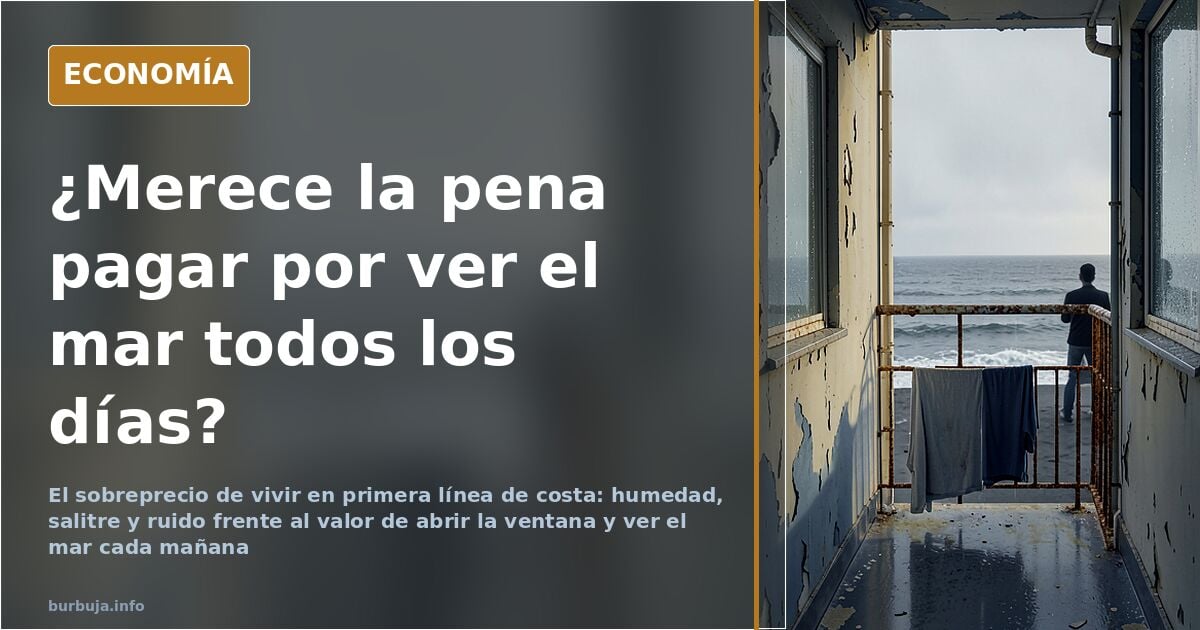
Living by the sea: the privilege many no longer want
Is it worth paying the premium for a beachfront home? The answer depends on who you ask, and that is where the problem starts. Against the tourist narrative that sells the sea as a universal aspiration, a portion of those who live on Spain's coast describe it as a source of noise, damp and material decay. The other camp, those who gaze at it from inland, defend it as an emotional refuge and even a status marker.
The discussion kicks off with a domestic scene: someone looking at the sea from their window while pouring a drink and remarking that Columbus set sail from Valencia. The geographical detail is false, but the anecdote serves what matters: the sea as an object of daily contemplation, not a holiday destination.
The real cost of the beachfront
Those who live fifty metres from the sand are clear about it: summer is an ordeal. Hordes of visitors, constant noise and a sense of invasion that has them counting the days until school starts and the outsiders leave. Damp and salt accelerate the decay of facades and window frames, and storms with heavy swell turn the view into a sound spectacle.
The argument is no small matter. Coastal property is not cheap, and the beachfront premium is paid for a view that, according to those who enjoy it every day, stops impressing after a few weeks. Habituation does the rest: what is an endless horizon for a visitor is the backdrop of the living room for the resident.
The sea as emotional refuge for those who live far away
At the other end of the spectrum, there are those who drive two hours to a village on the Biscay or Gipuzkoa coast when work pressure mounts. They sit facing the waves, lose track of time and return with a clear head. For this type of person, the sea is not a property: it is intermittent therapy, and that is precisely why it works.
The paradox is obvious. Those who have it every day take it for granted; those who have it two hours away by car idealise it. Distance seems to be the ingredient that keeps the fascination alive.
The war between the Atlantic and the Mediterranean
The geographical squabble takes up a good part of the conversation. One side holds that the Mediterranean is the cradle of civilisation and the historical axis of trade; the other replies that a sea is an inert medium and that without an empire capable of protecting the routes from pirates, no axis is worth anything. The fall of Rome, they argue, turned the Mediterranean into a puddle for centuries, while the Camino de Santiago (the pilgrimage route to Santiago de Compostela) moved more goods with four donkeys than many ports did.
The Atlantic, for its part, claims to be the heart of the civilised world, from Oslo to Vigo and from Newfoundland to Georgia, rich in fishing and gateway to the end of the world. The dispute is more about regional identity than economics, but it reveals something: the prestige of the sea depends on who is looking at it.
Property prices and the coastal luxury narrative
The conversation drifts towards housing. It is worth remembering that until the early twentieth century, living by the sea carried no prestige: in Barcelona, the areas closest to the coast housed the poorest, while the bourgeoisie settled inland on higher ground. Mass tourism reversed the sign and turned the sea view into a real estate asset.
Today the coast is still not cheap, and the differential with inland areas does not always pay off. Some claim that living far from the sea is for the poor; the immediate reply is that many have gone years without seeing it and do not miss it.
Early-rising Spain and the dream of dropping the oars
The underlying issue is work. The image of the worker who gets up early, procrastinates through the day and fantasises about quitting the grind connects with a broader aspiration: a life with a horizon, literal and figurative. Here the sea works as a symbol of freedom, not as a landscape.
With all this on the table, the initial question answers itself: no, not every man aspires to gaze at the sea every day. Some have it in front of them and would rather not see it. Others see it once a month and that is enough for them. And a good few, needless to say, have never seen it and sleep just fine.
Also available in: Deutsch
Summary of a discussion on Burbuja.info - Foro de economía, actualidad y política., translated from Spanish and reviewed before publication. Read the full discussion (95 replies).
More summaries
-
Trump suggests renaming the Atlantic as the "Trump Ocean"
Trump has floated renaming the Atlantic Ocean as the "Trump Ocean" and added that there should be "a great river" before he leaves office.
-
Madrid has 136% more murders than Barcelona, viral claim says
A forum calculation claims Madrid records 136% more murders than Barcelona despite having double the population and police per capita.
-
Cheating on the Camino: One Minute of Pleasure, Days of Regret
A pilgrim admits to a brief affair with a stranger during his six-day walk on Spain's Camino de Santiago, sparking debate on whether to confess or stay silent.
-
Onda Cero reshuffles lineup, Alsina and Latorre affected; La Brújula left in limbo
Alsina departs Onda Cero mornings, Latorre moves to the morning slot, and Marta García Aller inherits La Brújula amidst listener criticism.
-
Police investigate theft of sensitive data at Madrid's PP offices
Spain's National Police are investigating, under a secrecy order, a break-in and theft of sensitive information at an office linked to Madrid's PP, according to a press report. The…
-
France, Japan and the US urge citizens to stockpile food and water
France recommends a 72-hour kit, Japan three days, and the Pentagon is preparing its bases to last 90 days without supplies. The coincidence fuels suspicion.