
Budget Printers: The €1 Cartridge That Changes Everything
HP ink cartridges cost €20 for 120 pages (€0.17/page). Compatible Brother cartridges cut costs to €0.05 per page.
English · Original discussion in Spanish · Published
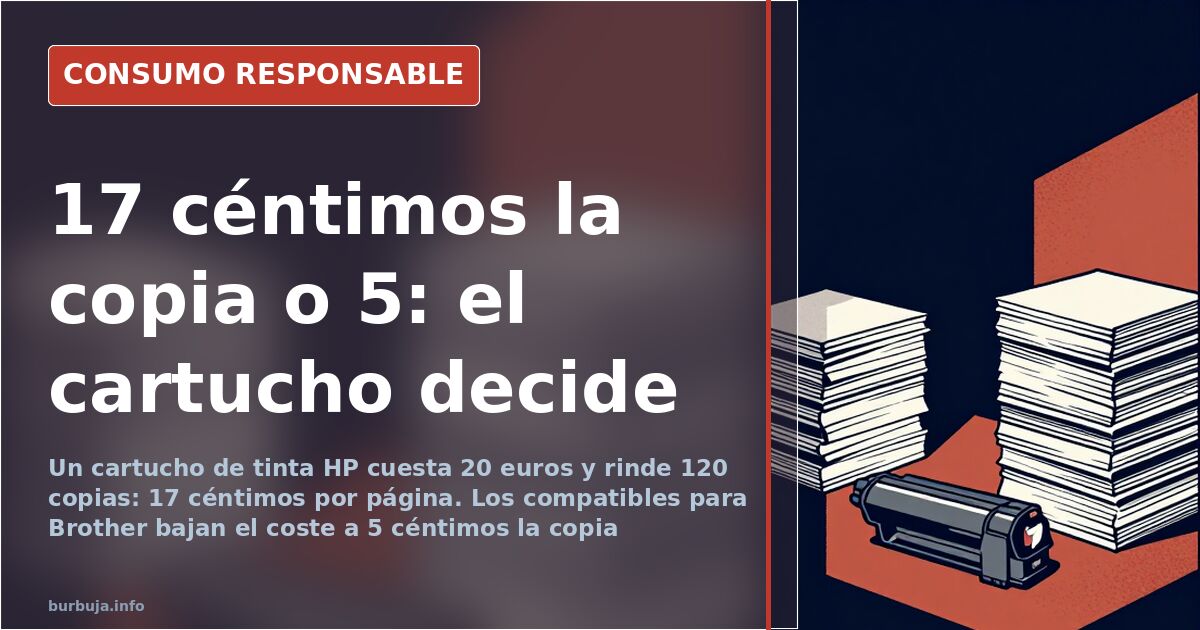
Printing at home costs 17 cents per page or 5 cents depending on the printer
A printer stored for four months in its original packaging, during a move. Upon reinstallation, the drivers work on two different computers, and the device starts up without a hitch. But it's forgotten black: it only prints blue, yellow, and magenta. Anyone who experienced this with an HP 3070A recounts it as a lesson learned, summarizing the first rule of home printer economics: the price of the device is secondary.
What costs money is the ink. A 15-cubic-centimeter cartridge for a basic HP model sells for €20 and yields, at most, 120 black and white copies. That's 17 cents per page. And with an added condition: if you don't print for days, the ink dries up, and the cartridge ends up half-used in the trash. The math becomes clear.
Why a cheap printer becomes expensive per copy
The manufacturer's logic doesn't fool anyone who does the math: give away the hardware and charge for consumables. A €40 printer can function for years without mechanical problems — some use it five or six times in three months and it still works like new — but the official cartridge negates the savings. The buyer who did the calculation found that, in black and white, the cost per copy reaches 17 cents, far above what the price tag suggests.
The switch to compatible cartridges changes the scenario, though not always without friction. The most frequent complaint points to HP: official black cartridges costing around €40 compared to €17 for a generic one, and models that, after months in storage, stop printing a tonalidad without a reasonable explanation.
The home printer that took over: Brother and its €1 cartridge
Facing this bill, a name repeatedly emerged: Brother. The DCP-J315W, a multifunction device with Wi-Fi, scanner, and copier, became the reference budget-conscious model. Its main advantage wasn't the device itself, which costs around €65 to €72, but the consumables: compatible cartridges costing just over €1 each, in packs of 12 for €12. With these figures, the cost per copy drops to 5 or 6 cents.
The fine print emerged over time. When the printer was discontinued, the baton passed to models like the DCP-J132W or DCP-197C, around €65, with the same cartridges and the same trick: a head cleaning program that activates almost daily to prevent ink from drying. The downside is that it consumes ink during this process and that, if a single tonalidad runs out, the machine refuses to print even in black and white.
The chip trick to further reduce cartridge costs
Here lies the most striking detail of home savings. Certain compatible cartridges — the LC121 and LC123, among others — incorporate a chip that the printer rejects from the factory. The solution, documented through trial and error, involves removing the chip from an original cartridge and attaching it to the compatible one. It works, although it requires repeating the transplant with each replacement.
DIY electronics to save cents. Those who search also find packs of black ink in international auctions that are cheaper than tonalidad packs from generalist e-commerce.
Laser or Inkjet? The cartridge that doesn't dry out
For those who print sparingly, half a dozen sources point to another option: laser printers. Toner is powder, not liquid, and doesn't dry out no matter how long the device sits unused for a month. That's its advantage: always ready and jam-free. The downside is the price. A set of four toner cartridges for a Samsung C1810W costs around €190, and each unit individually can exceed €70. The trade-off is reversed: a more expensive device, but consumables that last an eternity yet cost as much as a new printer.
The alternative almost no one considers: not printing at home
Before buying, an uncomfortable question is worth asking. How many pages are actually printed at home per year? There's an option that turns fixed expenses into variable ones: the local print shop. Bringing a file on a USB drive or sending it by email and picking it up printed is cheaper than amortizing printers, cartridges, and repairs. The only condition is to avoid city centers, where the price per copy skyrockets.
At the opposite extreme is the external ink tank. A model like the Epson TX 430W, with four refillable colors from bottles, costs around €110 and yields 8,000 tonalidad copies, with no apparent maintenance.
And here's the surprising fact: the cheapest printer on the market uses the most expensive cartridge, and the most expensive printer to buy uses the longest-lasting one. The manufacturer isn't selling a device. They're selling a subscription to ink.
A printer stored for four months in its original packaging, during a move. Upon reinstallation, the drivers work on two different computers, and the device starts up without a hitch. But it's forgotten black: it only prints blue, yellow, and magenta. Anyone who experienced this with an HP 3070A recounts it as a lesson learned, summarizing the first rule of home printer economics: the price of the device is secondary.
What costs money is the ink. A 15-cubic-centimeter cartridge for a basic HP model sells for €20 and yields, at most, 120 black and white copies. That's 17 cents per page. And with an added condition: if you don't print for days, the ink dries up, and the cartridge ends up half-used in the trash. The math becomes clear.
Why a cheap printer becomes expensive per copy
The manufacturer's logic doesn't fool anyone who does the math: give away the hardware and charge for consumables. A €40 printer can function for years without mechanical problems — some use it five or six times in three months and it still works like new — but the official cartridge negates the savings. The buyer who did the calculation found that, in black and white, the cost per copy reaches 17 cents, far above what the price tag suggests.
The switch to compatible cartridges changes the scenario, though not always without friction. The most frequent complaint points to HP: official black cartridges costing around €40 compared to €17 for a generic one, and models that, after months in storage, stop printing a tonalidad without a reasonable explanation.
The home printer that took over: Brother and its €1 cartridge
Facing this bill, a name repeatedly emerged: Brother. The DCP-J315W, a multifunction device with Wi-Fi, scanner, and copier, became the reference budget-conscious model. Its main advantage wasn't the device itself, which costs around €65 to €72, but the consumables: compatible cartridges costing just over €1 each, in packs of 12 for €12. With these figures, the cost per copy drops to 5 or 6 cents.
The fine print emerged over time. When the printer was discontinued, the baton passed to models like the DCP-J132W or DCP-197C, around €65, with the same cartridges and the same trick: a head cleaning program that activates almost daily to prevent ink from drying. The downside is that it consumes ink during this process and that, if a single tonalidad runs out, the machine refuses to print even in black and white.
The chip trick to further reduce cartridge costs
Here lies the most striking detail of home savings. Certain compatible cartridges — the LC121 and LC123, among others — incorporate a chip that the printer rejects from the factory. The solution, documented through trial and error, involves removing the chip from an original cartridge and attaching it to the compatible one. It works, although it requires repeating the transplant with each replacement.
DIY electronics to save cents. Those who search also find packs of black ink in international auctions that are cheaper than tonalidad packs from generalist e-commerce.
Laser or Inkjet? The cartridge that doesn't dry out
For those who print sparingly, half a dozen sources point to another option: laser printers. Toner is powder, not liquid, and doesn't dry out no matter how long the device sits unused for a month. That's its advantage: always ready and jam-free. The downside is the price. A set of four toner cartridges for a Samsung C1810W costs around €190, and each unit individually can exceed €70. The trade-off is reversed: a more expensive device, but consumables that last an eternity yet cost as much as a new printer.
The alternative almost no one considers: not printing at home
Before buying, an uncomfortable question is worth asking. How many pages are actually printed at home per year? There's an option that turns fixed expenses into variable ones: the local print shop. Bringing a file on a USB drive or sending it by email and picking it up printed is cheaper than amortizing printers, cartridges, and repairs. The only condition is to avoid city centers, where the price per copy skyrockets.
At the opposite extreme is the external ink tank. A model like the Epson TX 430W, with four refillable colors from bottles, costs around €110 and yields 8,000 tonalidad copies, with no apparent maintenance.
And here's the surprising fact: the cheapest printer on the market uses the most expensive cartridge, and the most expensive printer to buy uses the longest-lasting one. The manufacturer isn't selling a device. They're selling a subscription to ink.
Summary of a discussion on Burbuja.info - Foro de economía, actualidad y política., translated from Spanish and reviewed before publication. Read the full discussion (105 replies).
More summaries
-
The four breakfasts no Spanish bar serves
Oats, wholemeal bread, hummus and peanut butter: four foods Spanish bars don't serve, against the tradition of toast and Spanish tortilla.
-
Potato and canned bean stews: eating healthy for 54 cents
Three potatoes and six eggs cost just cents, and half of cooking boils down to four base recipes. Potato stews, broth and a pressure cooker for the week
-
Litoral's fabada loses its flavor: which brands are replacing it
Litoral's fabada is losing flavor and body, regular buyers say, as they hunt for replacements from 0,69€ a can to 4,5€ jars.
-
Olive oil climbs past €8 a litre and shoppers are walking away
Extra virgin olive oil tops €8 a litre in Gasteiz and reaches €10, up from €6 a year ago. More and more shoppers are taking it off their lists
-
A Land Rover and 20.000 euros in repairs in just four years
Mireia has spent about 20.000 euros on repairs to her Land Rover, with only 173.000 km in four years, including timing chain, turbo, gearbox and driveshaft
-
Razor blades: expensive cartridges vs. cheap double-edge
A 100-pack of double-edge blades costs €9–12 and gives five shaves per blade; the expensive cartridge is done after five uses.