
Bluetooth chip theory in vaccinated people fails real-world tests
The theory claiming vaccinated individuals carry Bluetooth chips cannot be replicated outdoors due to limited range and most phones having Bluetooth disabled.
English · Original discussion in Spanish · Published
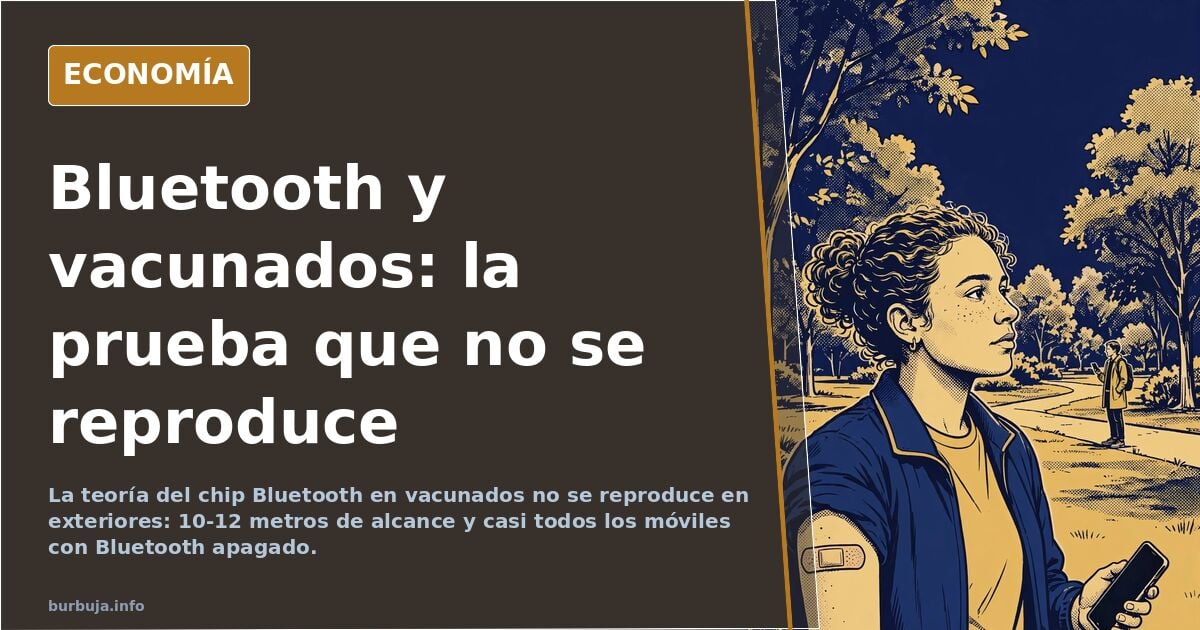
Bluetooth in the vaccinated: the theory that fails outdoors
A phone with Bluetooth enabled shows a list of unknown MAC addresses within seconds. For some, this list is proof that vaccines contain a chip capable of emitting a signal. The suggested method is simple: activate Bluetooth in a supermarket, check detected devices, and count those of unknown origin. However, this method has a fundamental flaw: these environments are saturated with dozens of devices emitting simultaneously. In tests conducted outside these crowded settings, the phenomenon has not been reproduced.
Graphene, nanotubes, and microchips that survive the host. The idea of Bluetooth in the vaccinated has mutated as much as its supposed verification methods. As of this discussion, no repeatable measurement outside of a device-saturated environment has yielded the promised results.
What supports the Bluetooth chip theory
The hypothesis, as it is presented, claims that the vaccination campaign served to introduce elements—graphene, nanotubes, microchips—capable of emitting an identifiable Bluetooth signal. Proponents claim that those affected suffer serious ailments or even death, and that the signal detected with a mobile phone is only the visible part of a larger system. "Do you really think they went to so much trouble just to install Bluetooth?", one message summarizes. This leap—from a list of devices to a global operation—is exactly where the claim loses all supporting evidence.
Why an injected chip cannot power itself
A device that emits a signal requires energy, and there lies the first technical hurdle. One participant cited a scientific article stating that in saline solutions similar to human body fluids, a potential difference of around 1.4 volts and some microamperes are measured. This minimal figure would, at most, sustain a passive receiver, not a continuously working Bluetooth transmitter. Furthermore, in a lifeless body, this potential difference disappears, debunking the legend of signals continuing to be emitted after death.
Bluetooth: the least discreet protocol for secret tracking
If the goal were to track the population unnoticed, Bluetooth would be the worst possible choice. It is a cheap, widespread, and, above all, easy-to-detect protocol: it has a range of 10 to 12 meters at most, and any mobile phone can list nearby devices without special tools. Additionally, according to some participants, the vast majority of phones—around 99%—have it turned off by default, meaning almost no one would have their receiver on to see anything. Moreover, the detected MAC addresses change from one test to another, pointing to common mobile devices rather than a fixed implanted identifier.
Field tests: beaches, fields, and cemeteries
Field experiments also fail to support the theory. Some have taken the method to the beach and failed to reproduce the phenomenon. Others suggest repeating it in an open field with all present individuals being vaccinated and without phones, something that no one has documented with positive results so far. The most extreme case involved someone going to cemeteries, where, according to the account, emissions from the deceased were recorded. The elementary explanation is that a decomposing body does not generate electrical current.
The origin of the idea: graphene at the Mobile World Congress
The theory has a specific origin. One participant refers to a 2016 interview at the Mobile World Congress in which graphene was attributed applications such as recording neural signals and using WiFi antennas. Moving from there to claiming that the material is inoculated and emits via Bluetooth is a gap that no one has bridged with data. It is also linked to fiction: some elements attributed to vaccines appear earlier in novels. "It is more likely that the author drew inspiration from the internet than the internet copied the author," one response summarizes.
The underlying issue: what to moderate and what to let pass
Much of the conversation did not revolve around the chip, but rather around the decision to remove the content. Those defending the theory argue that censoring it only reinforces it; conversely, the opposing argument is that the claim can be debunked in five minutes with a phone in hand. The discussion leaves an uncomfortable question about to what extent it is advisable to erase a hypothesis that collapses on its own.
The final paradox is harsh for the theory itself. The strongest argument against it is not an official report: it is Bluetooth itself, a protocol with a 10 to 12-meter range that anyone can list without permission. Anyone wishing to set up global tracking would find facial recognition cameras much cheaper and more effective. The miraculous chip, instead, runs out of battery.
A phone with Bluetooth enabled shows a list of unknown MAC addresses within seconds. For some, this list is proof that vaccines contain a chip capable of emitting a signal. The suggested method is simple: activate Bluetooth in a supermarket, check detected devices, and count those of unknown origin. However, this method has a fundamental flaw: these environments are saturated with dozens of devices emitting simultaneously. In tests conducted outside these crowded settings, the phenomenon has not been reproduced.
Graphene, nanotubes, and microchips that survive the host. The idea of Bluetooth in the vaccinated has mutated as much as its supposed verification methods. As of this discussion, no repeatable measurement outside of a device-saturated environment has yielded the promised results.
What supports the Bluetooth chip theory
The hypothesis, as it is presented, claims that the vaccination campaign served to introduce elements—graphene, nanotubes, microchips—capable of emitting an identifiable Bluetooth signal. Proponents claim that those affected suffer serious ailments or even death, and that the signal detected with a mobile phone is only the visible part of a larger system. "Do you really think they went to so much trouble just to install Bluetooth?", one message summarizes. This leap—from a list of devices to a global operation—is exactly where the claim loses all supporting evidence.
Why an injected chip cannot power itself
A device that emits a signal requires energy, and there lies the first technical hurdle. One participant cited a scientific article stating that in saline solutions similar to human body fluids, a potential difference of around 1.4 volts and some microamperes are measured. This minimal figure would, at most, sustain a passive receiver, not a continuously working Bluetooth transmitter. Furthermore, in a lifeless body, this potential difference disappears, debunking the legend of signals continuing to be emitted after death.
Bluetooth: the least discreet protocol for secret tracking
If the goal were to track the population unnoticed, Bluetooth would be the worst possible choice. It is a cheap, widespread, and, above all, easy-to-detect protocol: it has a range of 10 to 12 meters at most, and any mobile phone can list nearby devices without special tools. Additionally, according to some participants, the vast majority of phones—around 99%—have it turned off by default, meaning almost no one would have their receiver on to see anything. Moreover, the detected MAC addresses change from one test to another, pointing to common mobile devices rather than a fixed implanted identifier.
Field tests: beaches, fields, and cemeteries
Field experiments also fail to support the theory. Some have taken the method to the beach and failed to reproduce the phenomenon. Others suggest repeating it in an open field with all present individuals being vaccinated and without phones, something that no one has documented with positive results so far. The most extreme case involved someone going to cemeteries, where, according to the account, emissions from the deceased were recorded. The elementary explanation is that a decomposing body does not generate electrical current.
The origin of the idea: graphene at the Mobile World Congress
The theory has a specific origin. One participant refers to a 2016 interview at the Mobile World Congress in which graphene was attributed applications such as recording neural signals and using WiFi antennas. Moving from there to claiming that the material is inoculated and emits via Bluetooth is a gap that no one has bridged with data. It is also linked to fiction: some elements attributed to vaccines appear earlier in novels. "It is more likely that the author drew inspiration from the internet than the internet copied the author," one response summarizes.
The underlying issue: what to moderate and what to let pass
Much of the conversation did not revolve around the chip, but rather around the decision to remove the content. Those defending the theory argue that censoring it only reinforces it; conversely, the opposing argument is that the claim can be debunked in five minutes with a phone in hand. The discussion leaves an uncomfortable question about to what extent it is advisable to erase a hypothesis that collapses on its own.
The final paradox is harsh for the theory itself. The strongest argument against it is not an official report: it is Bluetooth itself, a protocol with a 10 to 12-meter range that anyone can list without permission. Anyone wishing to set up global tracking would find facial recognition cameras much cheaper and more effective. The miraculous chip, instead, runs out of battery.
Also available in: Deutsch
Summary of a discussion on Burbuja.info - Foro de economía, actualidad y política., translated from Spanish and reviewed before publication. Read the full discussion (101 replies).
More summaries
-
Why Total Vaccine Refusal Ignores the 1963 Data
Systematic vaccination in Spain began in May 1963, causing polio cases to plummet before the 1974 DDT ban.
-
Asking doctors about Covid vaccines divides patients
Inquiring about Covid vaccination status at the doctor's office creates division, raising concerns about cardiac symptom tracking and subsequent policy implications.
-
EU Agency Defends Pfizer and Moderna Vaccines After Parliament Request
European MEPs asked the EMA to suspend Pfizer and Moderna shots in 2023. The agency responded, maintaining vaccine safety despite ongoing political pressure.
-
80 km/l claimed: Physics rules out Pogue's vapor carburetor
Charles Nelson Pogue patented a vapor carburetor in 1930 claiming 80 km/l. Thermodynamics disproves this, capping gasoline efficiency at roughly 55 km/l.
-
From Queen to Bad Bunny: How music reflects cultural decline
Popular music has shifted from requiring prodigious vocals to rewarding autotune as the record industry prioritizes algorithms over talent.
-
Rising food prices in Spain: eggs at €3.70 and chicken at €5/kg
As grocery prices soar, with eggs reaching €3.70 and chicken hitting €5/kg, Spanish consumers report a significant drop in purchasing power.