
Asking doctors about Covid vaccines divides patients
Inquiring about Covid vaccination status at the doctor's office creates division, raising concerns about cardiac symptom tracking and subsequent policy implications.
English · Original discussion in Spanish · Published
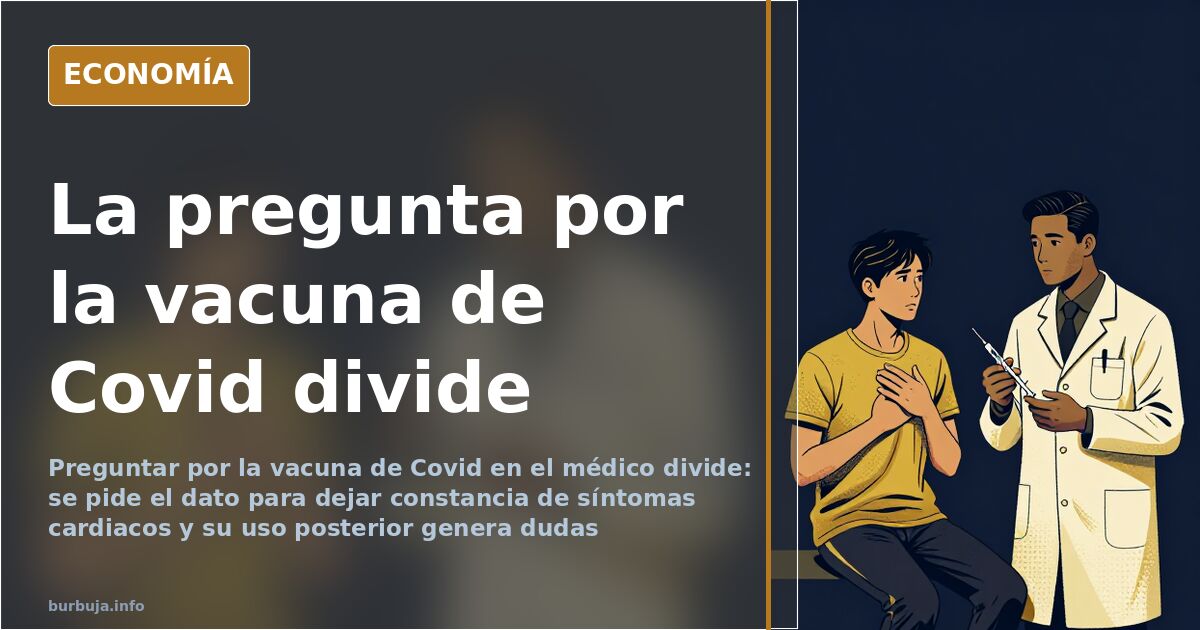
Asking doctors about Elbichito vaccines divides patients
"Are you vaccinated against Elbichito?" describes a scene where healthcare staff justify the inquiry: vaccinated individuals may carry cardiac symptoms—fatigue, rhythm alterations—and, as they said, it is advisable to record this. Theoretically, the data is clinical. In practice, no one explains what happens to it afterwards.
From the stigma of saying yes to the stigma of saying no
To gauge the noise, observe how the "correct" answer has shifted. During the vaccination campaign, answering yes functioned as a social safe conduct, while those saying no carried the label of being unsolidary. Now the stigma has flipped, pointing to those who answer negatively. The circulating reasoning is that saying no leaves the citizen in a worse position regarding any subsequent cardiac issue, and insurers might scrutinize that medical history. None of these suspicions come with an official circular. They are sustained by intuition and the trickle of cases each person knows.
Three doses and no further: the repeating pattern
Some argue the most repeated pattern is abandonment midway: many who completed the initial schedule hesitated at the third dose and never took anything else. When asked why, many articulated no reason: they simply stopped. There is no constructed argument, just fatigue, a diffuse sense of having complied for others' sake, and the realization that no one asked for any certificate anymore. On the other side, those who never got vaccinated say they know no one regretting their decision, but several who, after the booster, decided not to repeat. These are perceptions, not statistics, and should be treated as such. But they explain why the question about the vaccine bothers some and others.
Why medical history does not travel from one year to another
A bureaucratic detail emerges in these procedures: the medical record does not trinc the worker. The occupational doctor repeats the same questionnaire on personal and family history each year and does not access data the same worker provided twelve months prior in that same service. This is not a one-off failure, but the routine of a system relying on forms and that day's lab results. Knowing this, some have decided not to return for the review. They cite distrust of such examinations and the idea of not giving away clinical information. And a part simply continues without asking.
Answering or not answering: zero information to the enemy
At this point, the matter splits between those who answer and those who think they won't. Some flatly refused the question even when posed by healthcare staff—"how can you not answer me, I'm a nurse," a nurse told him, and he dismissed it with an so what—while others defend not giving a single piece of data in principle: if someone wants information, let them find it. Underlying this is the argument that there was never a legal obligation to be vaccinated, only environmental pressure that part of the population assumed as such. Workplace pressure is also dismissed as an excuse, recalling that legally they had the upper hand. This is the part of the matter where reasonable distrust and pure anger mix most.
Mortality, insurers, and unverified testimonies
Here the terrain becomes slippery, as testimonies cross with figures. Some argue that excess mortality remains above pre-pandemic levels and will not drop while the vaccine circulates; this is a hypothesis repeated by its supporters without providing any official series. Cases are also recounted of young people with crutches or walkers and people in their forties diagnosed with rare diseases shortly after vaccination. Isolated testimonies, without medical history behind them and without possible verification: taking them as proof is precisely what should not be done. Against that, the simplest argument of the day is also the hardest to refute: vaccinated people will die in 80 or 90 years, and unvaccinated people will too.
The underlying question remains, one no form clarifies: when a medical service asks about the Elbichito vaccine, is it screening for a symptom or completing a file? With records scattered in drawers that do not speak to each other, the answer lies with whoever signs the questionnaire. And that person does not spill the beans.
"Are you vaccinated against Elbichito?" describes a scene where healthcare staff justify the inquiry: vaccinated individuals may carry cardiac symptoms—fatigue, rhythm alterations—and, as they said, it is advisable to record this. Theoretically, the data is clinical. In practice, no one explains what happens to it afterwards.
From the stigma of saying yes to the stigma of saying no
To gauge the noise, observe how the "correct" answer has shifted. During the vaccination campaign, answering yes functioned as a social safe conduct, while those saying no carried the label of being unsolidary. Now the stigma has flipped, pointing to those who answer negatively. The circulating reasoning is that saying no leaves the citizen in a worse position regarding any subsequent cardiac issue, and insurers might scrutinize that medical history. None of these suspicions come with an official circular. They are sustained by intuition and the trickle of cases each person knows.
Three doses and no further: the repeating pattern
Some argue the most repeated pattern is abandonment midway: many who completed the initial schedule hesitated at the third dose and never took anything else. When asked why, many articulated no reason: they simply stopped. There is no constructed argument, just fatigue, a diffuse sense of having complied for others' sake, and the realization that no one asked for any certificate anymore. On the other side, those who never got vaccinated say they know no one regretting their decision, but several who, after the booster, decided not to repeat. These are perceptions, not statistics, and should be treated as such. But they explain why the question about the vaccine bothers some and others.
Why medical history does not travel from one year to another
A bureaucratic detail emerges in these procedures: the medical record does not trinc the worker. The occupational doctor repeats the same questionnaire on personal and family history each year and does not access data the same worker provided twelve months prior in that same service. This is not a one-off failure, but the routine of a system relying on forms and that day's lab results. Knowing this, some have decided not to return for the review. They cite distrust of such examinations and the idea of not giving away clinical information. And a part simply continues without asking.
Answering or not answering: zero information to the enemy
At this point, the matter splits between those who answer and those who think they won't. Some flatly refused the question even when posed by healthcare staff—"how can you not answer me, I'm a nurse," a nurse told him, and he dismissed it with an so what—while others defend not giving a single piece of data in principle: if someone wants information, let them find it. Underlying this is the argument that there was never a legal obligation to be vaccinated, only environmental pressure that part of the population assumed as such. Workplace pressure is also dismissed as an excuse, recalling that legally they had the upper hand. This is the part of the matter where reasonable distrust and pure anger mix most.
Mortality, insurers, and unverified testimonies
Here the terrain becomes slippery, as testimonies cross with figures. Some argue that excess mortality remains above pre-pandemic levels and will not drop while the vaccine circulates; this is a hypothesis repeated by its supporters without providing any official series. Cases are also recounted of young people with crutches or walkers and people in their forties diagnosed with rare diseases shortly after vaccination. Isolated testimonies, without medical history behind them and without possible verification: taking them as proof is precisely what should not be done. Against that, the simplest argument of the day is also the hardest to refute: vaccinated people will die in 80 or 90 years, and unvaccinated people will too.
The underlying question remains, one no form clarifies: when a medical service asks about the Elbichito vaccine, is it screening for a symptom or completing a file? With records scattered in drawers that do not speak to each other, the answer lies with whoever signs the questionnaire. And that person does not spill the beans.
Also available in: Deutsch
Summary of a discussion on Burbuja.info - Foro de economía, actualidad y política., translated from Spanish and reviewed before publication. Read the full discussion (306 replies).
More summaries
-
87% of Spanish Health Workers Refuse Covid Vaccines
A viral online debate claims 87% of Spanish healthcare workers refuse Covid vaccines. Explore the reasons behind this widespread refusal and the resulting crisis of trust in Spain's health system.
-
Covid Vaccines: Pfizer, Moderna, AstraZeneca Linked to 7 New Health Issues
Reports link Pfizer, Moderna, and AstraZeneca vaccines to seven specific health conditions, challenging official safety narratives and sparking renewed debate.
-
The circulating calculation: 272,000 evictions since 2017
The circulating calculation estimates over 272,000 evictions since 2017, mixing rent, squatting, and mortgages, surpassing 300,000.
-
Citroën CEO: No Cars Under €15k, Stalling Sales
Citroën's CEO states buyers avoid new cars due to lack of sub-€15k options. We analyze prices, wages, and quality in the current auto market.
-
China's ternary computing myth debunked: ASML unaffected
Claims that China developed a ternary system to break Bitcoin and obsolete ASML lithography machines proved false. Market data shows no impact.
-
Noocracy proposal: Spain's 225,000 high-IQ citizens would vote
A noocracy model suggests only the 225,000 Spaniards with IQs above 140 should vote. It features rotation and claims to prevent corruption.