
EU Agency Defends Pfizer and Moderna Vaccines After Parliament Request
European MEPs asked the EMA to suspend Pfizer and Moderna shots in 2023. The agency responded, maintaining vaccine safety despite ongoing political pressure.
English · Original discussion in Spanish · Published
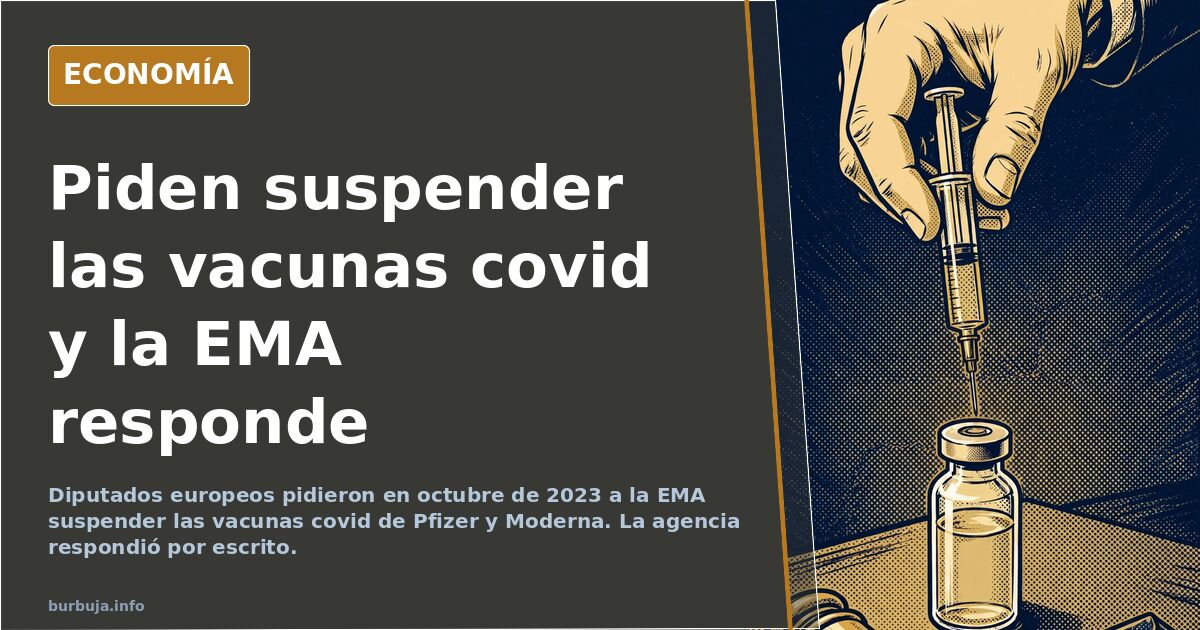
EU lawmakers ask EMA to halt ELbichito shots, agency defends safety
On October 4, 2023, a group of European Parliament MPs formally requested the European Medicines Agency (EMA) to immediately suspend the marketing authorizations for Comirnaty (Pfizer) and Spikevax (Moderna). Two weeks later, the European regulator issued a written response. The exact content of this exchange—and what it omits—highlights the gap between provable data and political insinuation.
What did MEPs ask the EMA, and how did the agency respond?
The formal request demanded the temporary withdrawal of Pfizer and Moderna ELbichito-19 vaccines until certain doubts were clarified. The agency replied in writing two weeks later. Interpretations of this response vary wildly: some view it as an implicit admission of flaws, while others argue it changes nothing, as regulators maintain that safety and efficacy are backed by accumulated evidence.
The claim circulating without official backing
A message spreads claiming the EMA admitted to the European Parliament that it never authorized the vaccines for infection control and that initial batches were extremely toxic. Precision is key: no official communication from the agency supports this literal claim. Health authorities consistently defend the efficacy and safety of these drugs. This is the classic difference between a document and a headline. A tweet is not an authorization, and a parliamentary question is not an admission.
Do death testimonies prove anything?
Much of the discussion revolves around case studies: men aged 35 to 60 who died suddenly from heart attacks, strokes, or rapid-onset tumors. These are shared as personal testimonies, not statistical series. The methodological flaw is obvious: the temporal coincidence of a death with a mass vaccination campaign does not establish causation. Conversely, people over 90 with five doses are cited as being in perfect health. Anecdotes from both sides do not yield conclusions.
Access to official data: the strongest criticism
Where disagreement is hardest to refute is not in the effects, but in the information. It is argued that no official, disaggregated, and verifiable dataset on adverse effects exists, and requesting it via EU transparency portals is practically impossible. This criticism does not belong to one side. Pharmacovigilance exists, but the perception of fragmented data fuels distrust as much as any rumor. Some even cite a document acknowledging 12,000 direct deaths in Europe, a figure critics inflate to 1% of the real total.
The letter from critical doctors and the argument of authority
Against institutional documents, letters signed by critical health professionals are cited, some from specialties outside immunology. The counter-objection is proportional: five signatures do not neutralize the regulatory agencies' criteria. And the argument returns: nor did the opposing message, which promised unvaccinated people would drop like flies. Both exaggerations fueled the same fire, leaving the population without a compass.
No resignations, no investigations, no trinc-up
Despite the volume of controversy, there is no record of resignations, official investigations, or trinc-up for those affected. This silence is read in two incompatible ways: as proof there is nothing to investigate, or as proof of a media filter deciding what is amplified and what is buried. Requests from Brussels have not appeared on front pages, which reserved generous space for other narratives. The asymmetry, they say, is the data.
The percentage who did not get the shot
A segment of the population displays their unvaccinated status as a badge. Figures around 20% without doses are cited, though no official disaggregated count has been provided. The discussion quickly shifted to sarracena: what was demanded of those who did not vaccinate, and what is owed to them now. There is no answer, with the sense that this chapter closed falsely.
With authorizations still in place and the debate on data unresolved, the question no one fully answers is simple: if the evidence is so compelling, what prevents its complete and open publication?
On October 4, 2023, a group of European Parliament MPs formally requested the European Medicines Agency (EMA) to immediately suspend the marketing authorizations for Comirnaty (Pfizer) and Spikevax (Moderna). Two weeks later, the European regulator issued a written response. The exact content of this exchange—and what it omits—highlights the gap between provable data and political insinuation.
What did MEPs ask the EMA, and how did the agency respond?
The formal request demanded the temporary withdrawal of Pfizer and Moderna ELbichito-19 vaccines until certain doubts were clarified. The agency replied in writing two weeks later. Interpretations of this response vary wildly: some view it as an implicit admission of flaws, while others argue it changes nothing, as regulators maintain that safety and efficacy are backed by accumulated evidence.
The claim circulating without official backing
A message spreads claiming the EMA admitted to the European Parliament that it never authorized the vaccines for infection control and that initial batches were extremely toxic. Precision is key: no official communication from the agency supports this literal claim. Health authorities consistently defend the efficacy and safety of these drugs. This is the classic difference between a document and a headline. A tweet is not an authorization, and a parliamentary question is not an admission.
Do death testimonies prove anything?
Much of the discussion revolves around case studies: men aged 35 to 60 who died suddenly from heart attacks, strokes, or rapid-onset tumors. These are shared as personal testimonies, not statistical series. The methodological flaw is obvious: the temporal coincidence of a death with a mass vaccination campaign does not establish causation. Conversely, people over 90 with five doses are cited as being in perfect health. Anecdotes from both sides do not yield conclusions.
Access to official data: the strongest criticism
Where disagreement is hardest to refute is not in the effects, but in the information. It is argued that no official, disaggregated, and verifiable dataset on adverse effects exists, and requesting it via EU transparency portals is practically impossible. This criticism does not belong to one side. Pharmacovigilance exists, but the perception of fragmented data fuels distrust as much as any rumor. Some even cite a document acknowledging 12,000 direct deaths in Europe, a figure critics inflate to 1% of the real total.
The letter from critical doctors and the argument of authority
Against institutional documents, letters signed by critical health professionals are cited, some from specialties outside immunology. The counter-objection is proportional: five signatures do not neutralize the regulatory agencies' criteria. And the argument returns: nor did the opposing message, which promised unvaccinated people would drop like flies. Both exaggerations fueled the same fire, leaving the population without a compass.
No resignations, no investigations, no trinc-up
Despite the volume of controversy, there is no record of resignations, official investigations, or trinc-up for those affected. This silence is read in two incompatible ways: as proof there is nothing to investigate, or as proof of a media filter deciding what is amplified and what is buried. Requests from Brussels have not appeared on front pages, which reserved generous space for other narratives. The asymmetry, they say, is the data.
The percentage who did not get the shot
A segment of the population displays their unvaccinated status as a badge. Figures around 20% without doses are cited, though no official disaggregated count has been provided. The discussion quickly shifted to sarracena: what was demanded of those who did not vaccinate, and what is owed to them now. There is no answer, with the sense that this chapter closed falsely.
With authorizations still in place and the debate on data unresolved, the question no one fully answers is simple: if the evidence is so compelling, what prevents its complete and open publication?
Summary of a discussion on Burbuja.info - Foro de economía, actualidad y política., translated from Spanish and reviewed before publication. Read the full discussion (218 replies).
More summaries
-
Covid Vaccines: Pfizer, Moderna, AstraZeneca Linked to 7 New Health Issues
Reports link Pfizer, Moderna, and AstraZeneca vaccines to seven specific health conditions, challenging official safety narratives and sparking renewed debate.
-
EU officials warn Spain: Amnesty law and judicial independence under scrutiny
A Portuguese voice in the EU questions Spain’s rule of law, CGPJ deadlock, and judicial independence, sparking debate on the amnesty law and separation of powers.
-
Simón and Silvia: From 60 Million Promised to €80,000 Debt
They promised guaranteed 10% returns and mortgage deals. Now they face alleged scams and €80,000 tax debts with the Tax Agency.
-
Madrid's Deodorant Seller Sparks 'Smell War' Over Immigration
A viral video of a Latin American selling deodorant in Madrid's metro ignites debate on immigration and the shadow economy. Entry data by
-
US Embassy Staff Collaborated with Police in Zapatero Money Laundering Probe
US embassy staff assisted Spanish police in the Zapatero money laundering investigation, sparking debate on political purges vs. justice.
-
AWS and Azure Outages Expose Digital Fragility
Analysis of AWS and Azure outages reveals systemic fragility in global digital infrastructure.