
Bakhmut: the withdrawal Ukraine delayed until the mud made it a disaster
The Ukrainian withdrawal from Bakhmut has become an ordeal due to mud and Russian artillery. An analysis of the cost of resisting until the very end.
English · Original discussion in Spanish · Published
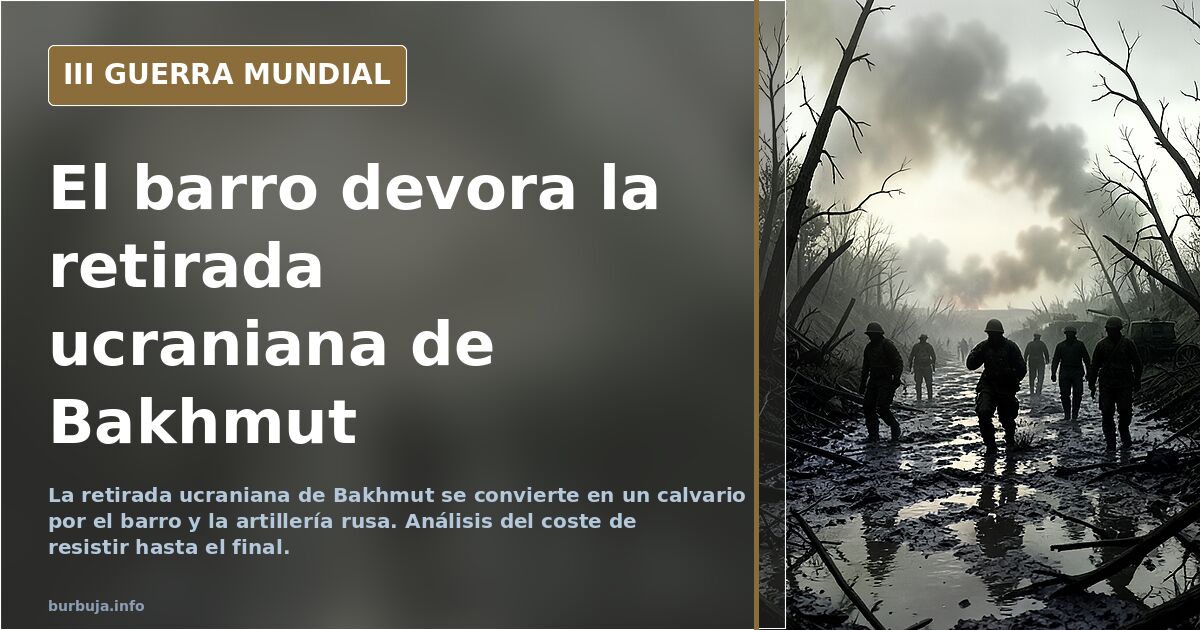
Bakhmut: the withdrawal Ukraine delayed until the mud made it a disaster
The withdrawal of Ukrainian forces from Bakhmut has become one of the most costly operations of the conflict, and not because of the fighting, but because of the calendar. By the time the exit was finally authorized, the rasputitsa —the Ukrainian spring mud season— had turned rural roads into impassable traps. Vehicles get bogged down, Russian artillery shells the only available routes, and columns are left exposed. What could have been an orderly withdrawal weeks ago has turned into a string of images of abandoned equipment and broken columns. The debate over whether Bakhmut had strategic or merely symbolic value remains open, but the cost of holding out until the end is already visible on every dirt road.
What peine in Bakhmut and why the withdrawal became an ordeal
The initial message that started the thread described the scene starkly: soldiers running, wrecked vehicles, roads turned into traps. The first videos of the Ukrainian pullback from Artyomovsk —the Soviet name for Bakhmut— showed columns stuck on muddy rural roads, under artillery fire. The March rasputitsa, the phenomenon that turns the steppe into a sea of sludge, arrived with force this year. One participant summed it up with irony: "What a ing mudbath, the town council should be ashamed of leaving the roads like this." The joke hides a serious military problem: when the only way out is a dirt track and the enemy has artillery zeroed in on it, withdrawal stops being a maneuver and becomes a race against the clock.
The strategic debate: hold out until the end or pull back in time
The question running through the whole discussion is why troops were kept in Bakhmut when there was no longer a clear military objective. A recurring analysis points out that holding out until the last moment has a predictable cost: when the position falls, the withdrawal happens in the worst possible conditions. "That's the problem of resisting to the end — when it falls, everything goes to shit," one message sums up. The comparison with the Russian withdrawal from Kherson is inevitable: back then people mocked Moscow, but at least it was "a fairly orderly withdrawal." Classical doctrine —Sun Tzu included— holds that a withdrawal is not dishonorable if it serves to grind down the enemy further back. Territorial control, at this stage, matters less than preserving combat strength.
Mud as a weapon: the rasputitsa and the artillery
The rasputitsa is nothing new. From the Mongols to the Wehrmacht, every army that has invaded the Ukrainian steppe has learned at its own expense that mud is a formidable enemy. The discussion suggests the Russians are "pushing just enough" so that the operation is delayed until the roads become impassable, and then tighten the screws. Russian artillery shells the exit routes, and heavy vehicles tear apart the surface of minor roads. The result: bogged-down columns, abandoned equipment and mounting casualties on terrain that offers no cover.
The human cost and the debate over the Ukrainian command
Beyond tactics, the discussion drifts toward political responsibility. Some argue that the Ukrainian high command sacrificed less experienced troops —some speak of freshly mobilized recruits— to buy time and pull out the most combat-ready units. "They sacrifice the conscripted to save whatever they can," says one message. The comparison with Masada, the fortress where the defenders took their own lives rather than surrender, appears as a bitter criticism: resisting without hope is not heroism, it is sheer madness. The attrition of entire units in a city with no clear strategic value feeds doubts about the conduct of the war.
Propaganda and the battle of numbers
The discussion also reflects the battle of narratives. Some accuse pro-Russian channels of exaggerating Ukrainian losses with videos of mudbaths presented as massacres. Others complain that Western propaganda downplays the disaster. "The Gremlin's propaganda gets more grotesque by the day," says one message, while another replies that "Telegram channels are being flooded with videos of Ukrainian troops pounded in the mud." The reality, as almost always, is hard to verify from the outside. What can be verified is that the withdrawal took place in the worst possible conditions and that the equipment lost is significant.
What happens next: the mud, the spring and the offensive that never comes
With the terrain in this state, neither Russia nor Ukraine can launch an offensive with heavy vehicles. Analysts expect movement in mid-spring, when the ground dries out. Meanwhile, artillery remains the queen of the battlefield. The withdrawal from Bakhmut leaves an uncomfortable lesson: in a war of attrition, the calendar matters as much as the terrain. And this time, the calendar was set by the mud.
Key facts
- The withdrawal takes place in March, with the rasputitsa at its peak.
- Muddy rural roads are the only way out and are under artillery fire.
- The comparison with Kherson: an orderly withdrawal versus the disaster in Bakhmut.
- The debate over whether Bakhmut had strategic or merely symbolic value remains open.
Also available in: Deutsch
Summary of a discussion on Burbuja.info - Foro de economía, actualidad y política., translated from Spanish and reviewed before publication. Read the full discussion (82 replies).
More summaries
-
Russia's FSB Blames Ukraine for Dugina Assassination
FSB claims Ukrainian citizen Natalia Vovk killed Daria Dugina and fled to Estonia, a NATO member bordering Russia.
-
Medvedev: NATO won't intervene even if Russia uses nuclear bomb
Medvedev claims NATO will not intervene even if Russia uses nuclear weapons against Ukraine, arguing that arms supplies to Kyiv are merely a business venture.
-
Russia withdraws from Kherson, shattering the narrative of Ukrainian defeat
Ukraine reclaims over 50% of occupied territory as Russia enters recession, cracking the story of Ukrainian defeat.
-
Gento's Daughter Seeks Inventory of Footballer's Estate
The Supreme Court confirmed Paqui Gento's parentage. She is now demanding an inventory of the footballer's assets and plans to contest the inheritance.
-
Suicide kills more veterans than combat does
Neuroimaging shows an overactive amygdala and a reduced hippocampus in veterans with PTSD. Suicides exceeded combat deaths in Iraq and Afghanistan.
-
Children of voters suspended under Spain's grandson law can still vote
According to how the case was framed, Spain's Supreme Court suspended the vote of grandchildren under the grandson law but not that of their children, who make up more than half of those affected.