
Children of voters suspended under Spain's grandson law can still vote
According to how the case was framed, Spain's Supreme Court suspended the vote of grandchildren under the grandson law but not that of their children, who make up more than half of those affected.
English · Original discussion in Spanish · Published
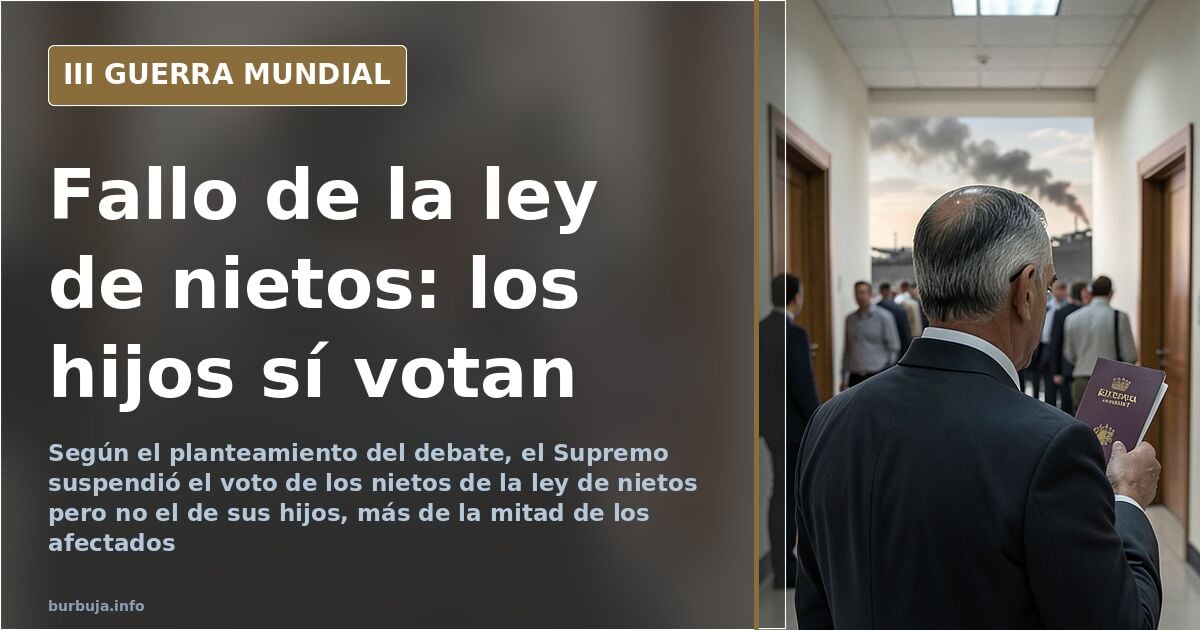
The suspension of the grandson law vote leaves out grandchildren but not their children
How do you suspend a grandchild's vote while leaving their child's vote untouched? Spain's Supreme Court ordered a precautionary suspension of the vote of those nationalized under the so-called grandson law ahead of the November 29 elections, but the scope of that measure left a gap: the children of those suspended voters were not included in the restriction. According to how the case was framed, the initial suspension request targeted only the grandchildren and not their descendants, who together account for more than half of those affected. The result is an administrative paradox that would try anyone's patience: the father cannot vote, the son can.
What Iustitia Europa requested and what the Supreme Court granted
The Iustitia Europa party went to the Administrative Chamber of Spain's Supreme Court to request the suspension of the vote of those nationalized under the grandson law. The precautionary measure was granted, but with a limited perimeter. The criticism running through the case is that the grandchildren were suspended without extending the suspension to their children, leaving the electoral roll partly blocked and partly operational.
Iustitia Europa has returned to the Supreme Court to broaden the scope. It is asking that those who moved from the electoral roll of residents abroad (CERA) to the roll of residents in Spain (CER) be identified, to prevent them from voting while their status is verified. In other words: the problem is not only who is on the roll, but who moved from one roll to another.
The roll that doubles and the 6% who vote
The scale of the phenomenon is the key. According to one estimate circulating in the debate, the number of voters resident abroad has gone from one million to more than two million with the ability to vote. That expansion would include people born outside Spain who have never set foot on Spanish soil and who learn about the country's problems from the news.
The counterweight comes from turnout: according to the figures used in the debate, Spaniards resident abroad vote at around 6%. With that precedent, some argue that if nobody votes, someone will have to vote for them. It is a suspicion hanging over the case, and it should be treated as exactly that: a suspicion with no evidence offered.
Can 160,000 votes change the outcome of the November 29 election?
No, if you go by the rough arithmetic. With an electoral roll of around 38 million voters, 160,000 votes do not move the national result. The nuance is that in a seat-based system you do not need to move the national result: it is enough to shift a handful of seats in tightly contested provinces to change a majority. There the margin narrows, and a perimeter error stops being a bureaucratic anecdote.
The step-by-step judicial process that does not fit the calendar
The defense of the procedure argues that there was no error but a sequence: a complex judicial process that must proceed step by step, and the partial suspension reflects that gradual pogre. The problem is the clock. The elections are upon us, and there is no room to complete the individual identification of the Annex III voters registered on the CERA.
The opposing criticism points out that if the roll is suspended, the entire roll should be suspended, because no documentation is being submitted that would allow those affected to be identified individually. Without individualization, no surgical suspension is possible. And without time, neither.
In the end, the question that remains is the usual one: if the father cannot vote and the son can, what exactly is being protected?
Summary of a discussion on Burbuja.info - Foro de economía, actualidad y política., translated from Spanish and reviewed before publication. Read the full discussion (19 replies).
More summaries
-
Russia warns of European bankruptcy with 18 trillion in debt
Russia warns that Europe is "practically bankrupt": 18 trillion in debt (86% of GDP), a fertility rate of 1.39 and 35,000 sanctions, according to Moscow.
-
Donetsk sentences two Britons and a Moroccan to death
The Supreme Court of Donbas has sentenced two British nationals and one Moroccan to death, accusing them of fighting as mercenaries for Ukraine.
-
Europe would lose 80% of its under-30s, according to this thesis
A thesis claims World War III would leave Europe without 80% of its under-30s through phased conscription. No evidence
-
Alcàsser: Esther’s testimony, the fourth girl, remains under suspicion
Esther Alcàsser, the fourth girl, gave a TV interview six days after the 1992 Alcàsser murders in Spain. Her account and timeline discrepancies fuel ongoing controversy.
-
Suicide kills more veterans than combat does
Neuroimaging shows an overactive amygdala and a reduced hippocampus in veterans with PTSD. Suicides exceeded combat deaths in Iraq and Afghanistan.
-
Russian offensive stalls: 49,040 casualties in a month and no fuel
Russia logs a record month with 49,040 casualties as its territorial advance stalls and refineries burn: the war of attrition is turning around