
Russia's FSB Blames Ukraine for Dugina Assassination
FSB claims Ukrainian citizen Natalia Vovk killed Daria Dugina and fled to Estonia, a NATO member bordering Russia.
English · Original discussion in Spanish · Published
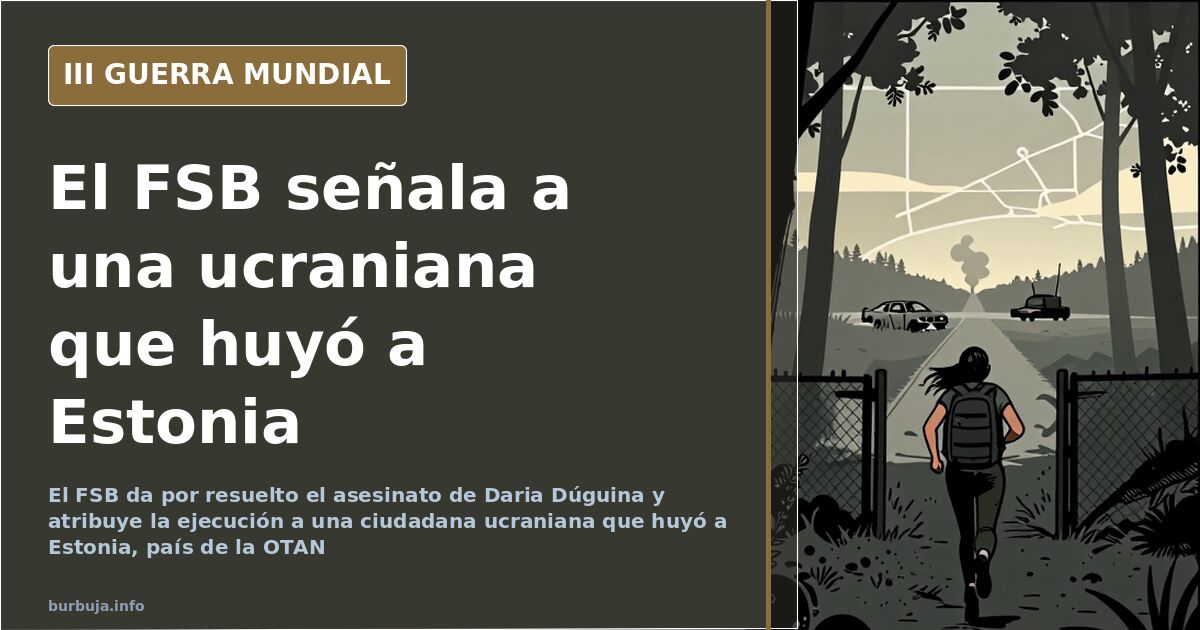
FSB Links Dugina Killing to Ukraine, Points to Estonia
On August 22 at 13:11 Moscow time, Russia’s Federal Security Service (FSB) announced it had solved the assassination of journalist Daria Dugina, daughter of philosopher Alexander Dugin. Twenty minutes later, state agency TASS identified the suspect as Natalia Vovk, a Ukrainian citizen who allegedly planted the car bomb and fled to Estonia. The case was closed within a single day. On the ground, forum users claimed the parking lot cameras had been broken for two weeks, an unconfirmed detail.
The trail ending in Estonia is significant. It is a NATO country with a land border with Russia and a Russian-speaking community that, according to data circulating since March 2022, exceeds 70% of the population in its eastern region. A bombing in Moscow instantly becomes a diplomatic issue between Moscow and the Atlantic Alliance.
Name Before Evidence
The first reaction to the statement was skepticism about the timeline. An intelligence service identifying an executor, attributing the device’s construction, reconstructing the escape, and announcing everything in one day raises as many eyebrows as it clears suspicions. Add the broken camera—unconfirmed—and the narrative rests on thin scaffolding.
Some dismiss it outright: pointing to anyone outside the country is the gist. Logistics reinforce this argument. Traveling thousands of kilometers with explosives and a frequency device, leaving the vehicle prepared, and vanishing without a documentary trace seems more like airport thriller fiction than a real operation. Circulating descriptions even mentioned the car model, a Mini Cooper, with a nod to B-movie spy cinema.
On the other side, the obvious weighs heavily. Daria Dugina was not just any victim: she was the daughter of the ideologue credited with much of the intellectual framework accompanying the invasion. Killing her had unquestionable symbolic value and made her a high-profile target for those wanting to strike that circle.
Why Is Estonia the Uncomfortable Link?
Because it forces a third country to take a stance. If the accused remains in Estonian territory, Russia will demand extradition; if she crossed elsewhere, the border will have recorded it, shifting the problem to another neighbor. In either scenario, Estonia gets caught up.
Demographic details complicate the picture further. Over 70% of inhabitants in Estonia’s eastern region are native Russian speakers, a figure cited since March 2022 that fuels the thesis that the escape destination was not accidental. Some argue this population faces restrictions, lacking access to certain public jobs and voting rights in specific processes, creating unrest that makes the border a sensitive flank. This claim is launched undocumented but sets the tone for part of the analysis.
Hypotheses Competing with Official Report
The official version did not emerge unscathed. Ukraine distanced itself from the attack, and a previously unknown Russian group claimed responsibility. With these two elements, the narrative peine in several directions simultaneously.
One theory holds that the real target was the father and the daughter died by getting into the wrong vehicle, placing planning inside Russia rather than abroad. Another points to a false flag attack intended to justify escalation. A third, the most repeated, argues that in Russia only power orders the elimination of key figures, citing a memorized list of precedents without supporting files.
None of these hypotheses has proof. The accusation against the Ukrainian citizen is, effectively, an official indictment without judicial resolution.
Anticipated Response: Greater Retaliation
Regardless of who placed the device, expectation markets moved quickly. Circulating forecasts predicted missile salvos against Ukrainian cities of a magnitude unseen since the war’s start, timed with national holidays. This part admits little debate: whether or not Ukrainian authorship is true, a response was coming.
Here reasoning stalls. An official report issued in twenty minutes, broken cameras—alleged but unconfirmed—and a NATO border leave the case with a political solution but no forensic one. And there is no report worth having for that.
On August 22 at 13:11 Moscow time, Russia’s Federal Security Service (FSB) announced it had solved the assassination of journalist Daria Dugina, daughter of philosopher Alexander Dugin. Twenty minutes later, state agency TASS identified the suspect as Natalia Vovk, a Ukrainian citizen who allegedly planted the car bomb and fled to Estonia. The case was closed within a single day. On the ground, forum users claimed the parking lot cameras had been broken for two weeks, an unconfirmed detail.
The trail ending in Estonia is significant. It is a NATO country with a land border with Russia and a Russian-speaking community that, according to data circulating since March 2022, exceeds 70% of the population in its eastern region. A bombing in Moscow instantly becomes a diplomatic issue between Moscow and the Atlantic Alliance.
Name Before Evidence
The first reaction to the statement was skepticism about the timeline. An intelligence service identifying an executor, attributing the device’s construction, reconstructing the escape, and announcing everything in one day raises as many eyebrows as it clears suspicions. Add the broken camera—unconfirmed—and the narrative rests on thin scaffolding.
Some dismiss it outright: pointing to anyone outside the country is the gist. Logistics reinforce this argument. Traveling thousands of kilometers with explosives and a frequency device, leaving the vehicle prepared, and vanishing without a documentary trace seems more like airport thriller fiction than a real operation. Circulating descriptions even mentioned the car model, a Mini Cooper, with a nod to B-movie spy cinema.
On the other side, the obvious weighs heavily. Daria Dugina was not just any victim: she was the daughter of the ideologue credited with much of the intellectual framework accompanying the invasion. Killing her had unquestionable symbolic value and made her a high-profile target for those wanting to strike that circle.
Why Is Estonia the Uncomfortable Link?
Because it forces a third country to take a stance. If the accused remains in Estonian territory, Russia will demand extradition; if she crossed elsewhere, the border will have recorded it, shifting the problem to another neighbor. In either scenario, Estonia gets caught up.
Demographic details complicate the picture further. Over 70% of inhabitants in Estonia’s eastern region are native Russian speakers, a figure cited since March 2022 that fuels the thesis that the escape destination was not accidental. Some argue this population faces restrictions, lacking access to certain public jobs and voting rights in specific processes, creating unrest that makes the border a sensitive flank. This claim is launched undocumented but sets the tone for part of the analysis.
Hypotheses Competing with Official Report
The official version did not emerge unscathed. Ukraine distanced itself from the attack, and a previously unknown Russian group claimed responsibility. With these two elements, the narrative peine in several directions simultaneously.
One theory holds that the real target was the father and the daughter died by getting into the wrong vehicle, placing planning inside Russia rather than abroad. Another points to a false flag attack intended to justify escalation. A third, the most repeated, argues that in Russia only power orders the elimination of key figures, citing a memorized list of precedents without supporting files.
None of these hypotheses has proof. The accusation against the Ukrainian citizen is, effectively, an official indictment without judicial resolution.
Anticipated Response: Greater Retaliation
Regardless of who placed the device, expectation markets moved quickly. Circulating forecasts predicted missile salvos against Ukrainian cities of a magnitude unseen since the war’s start, timed with national holidays. This part admits little debate: whether or not Ukrainian authorship is true, a response was coming.
Here reasoning stalls. An official report issued in twenty minutes, broken cameras—alleged but unconfirmed—and a NATO border leave the case with a political solution but no forensic one. And there is no report worth having for that.
Also available in: Deutsch
Summary of a discussion on Burbuja.info - Foro de economía, actualidad y política., translated from Spanish and reviewed before publication. Read the full discussion (127 replies).
More summaries
-
NATO Summit, at Germany's request, to send urgent munitions to Ukraine: Patriot interceptors, drones, long-range artillery, etc.
Germany leads urgent munition shipment to Ukraine: Patriot missiles, drones, and artillery. NATO reinforces Ukrainian defense.
-
TVE justifies the murder of Duguin's daughter over her ideology
TVE 24h aired a comment that seemed to justify Daria Dugina’s death for following her father’s theories. The clip sparked criticism against the…
-
Gisbert and Sivaya: Romance Amid Ukraine War Narratives
Analysis of media coverage for Rubén Gisbert and Liu Sivaya during the Ukraine war. Is this digital propaganda or reality?
-
Oil at $185 and the Information War in Africa
We analyze tensions between oil prices hitting $185, media warfare in Africa, and pressure on energy resources.
-
Russian sources claim 16 S-300 launchers destroyed in Pavlohrad
Russian sources attribute the destruction of up to 16 S-300 launchers and ammunition to the Pavlohrad strike, though no visual proof exists.
-
Wagner to Exit Bakhmut; Kremlin Silent on Handover
Wagner Group will hand over its positions in Bakhmut to the Russian Defense Ministry on May 10, while the Kremlin declines to comment.