
Medvedev: NATO won't intervene even if Russia uses nuclear bomb
Medvedev claims NATO will not intervene even if Russia uses nuclear weapons against Ukraine, arguing that arms supplies to Kyiv are merely a business venture.
English · Original discussion in Spanish · Published
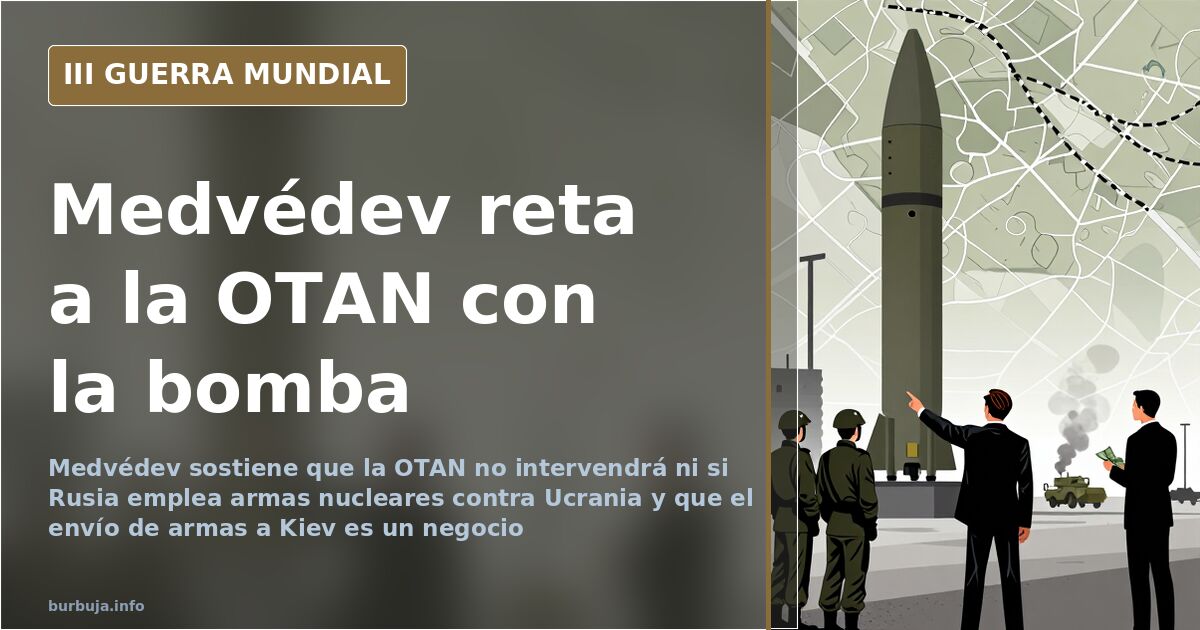
Medvedev asserts NATO will not respond to a nuclear attack
On September 27, via his Telegram channel, Russian Security Council Deputy Chairman Dmitry Medvedev outlined the scenario much of Europe has been calculating for months: that Russia might be forced to use its "most formidable weapons" against a Ukrainian regime he claims committed large-scale aggression threatening the very existence of the Russian state. His conclusion is that NATO will not intervene directly, even in such a case. He adds an economic twist: supplying weapons to Kyiv would be nothing more than a business for Western countries, albeit one "densely mixed with hatred" toward Russia. The statement was disseminated by TASS news agency.
The lingering question is simple to formulate but far harder to answer: if this peine, would there truly be no response?
A precisely measured trial balloon
One interpretation of the message is that Moscow is gauging allied reaction before making a move. Medvedev does not claim he will use the bomb; he describes a hypothetical, wraps it in the narrative of Ukrainian aggression, and presents Washington, London, and Brussels' passivity as almost automatic, because their own security outweighs the fate of a dying Ukraine, no matter how many weapons it receives.
Everything sounds like a domestic consumption message. There is irony about those who present him as the Kremlin's moderate wing for signing off on the month's most aggressive paragraph. Some suspect a power structure behind the text that the West barely understands, without which Russia would have fractured into smaller states years ago.
Would NATO respond if Russia used a tactical nuclear weapon?
Ukraine is not an Alliance member, so Article 5 is not automatically triggered. This is the most common argument for claiming there will be no response. It has two holes. First, membership was never a requirement: Kosovo was not a member either, yet NATO eventually intervened. Second, at the end of February, a response wasn't expected either, yet industrial quantities of weaponry, training, and intelligence arrived.
The debate complicates when discussing where the fallout lands. A tactical detonation in eastern Ukraine has limited radioactivity; strategic armament is different. If the cloud crosses into Poland or Germany—both within the Alliance—the nature of the scenario changes. One retaliation mentioned in the thread isn't a missile rain on Moscow, but eliminating the leadership that pressed the button. Whether this is deterrence or mere wishful thinking remains open.
At the other extreme, the obvious point is raised: the United States will not risk a nuclear holocaust on its own soil for allies whose location a significant portion of its population couldn't identify on a map.
The arms business and Ukraine's mortgage
The business thesis admits nuances. Some argue that allied military industry is releasing old stocks and will only truly profit if a substantial part of Ukraine survives and can pay, noting that if the country is devastated, returns aren't guaranteed. Meanwhile, Kyiv mortgages agricultural land, mining rights, and deposits to prevent them from falling into Russian hands. A swap where no one clearly wins.
In parallel, demographic arguments are cited: that in some areas over 90% of the population identifies as Russian and shouldn't remain under Ukrainian control, or that preventing this return has already cost more than 10,000 lives. These figures are thrown out without verifiable contrast.
Would China maintain its alliance with Russia after a detonation?
Here positions split in two. One holds that Beijing, pushed to choose, will never pick the US side, knowing it is on its list of future targets. The other responds that China would be the first to accept the consequences: normalizing nuclear use would open Pandora's box for India, Pakistan, or Israel, and no partner wants a world where this becomes commonplace. Once a bomb is used without reprisal, every state will want its own.
From the Budapest Memorandum to the Palomares precedent
On the table appears the commitment signed in exchange for Ukraine renouncing its Soviet arsenal. According to that reading, guarantors have two options: restore nuclear capability to Kyiv or warn that attacking Ukrainian soil equals attacking their own. Neither option has reportedly been executed.
In the chapter of precedents, Palomares is recalled, where, according to one participant, more than 55 years ago the United States scattered plutonium over an Almerian village. The flying Chernobyl is also cited, a retaliatory device discussed by some forum users whose actual flight status remains unknown.
The most worn-out historical parallel is that of 1930s Germany. It fails on one detail: Russia today lacks that Germany's industrial capacity. As historical data, US supplies sent to the USSR between 1941 and 1945 are cited: 427,284 trucks, 35,170 motorcycles, 13,303 combat vehicles, and 2,328 artillery service vehicles.
With these elements, the analysis always gets stuck at the same point: no one knows if a tactical detonation would cross the line drawn by the Alliance, nor what Moscow would do if it did. The nuclear taboo rests on that uncertainty, not on a signed treaty.
On September 27, via his Telegram channel, Russian Security Council Deputy Chairman Dmitry Medvedev outlined the scenario much of Europe has been calculating for months: that Russia might be forced to use its "most formidable weapons" against a Ukrainian regime he claims committed large-scale aggression threatening the very existence of the Russian state. His conclusion is that NATO will not intervene directly, even in such a case. He adds an economic twist: supplying weapons to Kyiv would be nothing more than a business for Western countries, albeit one "densely mixed with hatred" toward Russia. The statement was disseminated by TASS news agency.
The lingering question is simple to formulate but far harder to answer: if this peine, would there truly be no response?
A precisely measured trial balloon
One interpretation of the message is that Moscow is gauging allied reaction before making a move. Medvedev does not claim he will use the bomb; he describes a hypothetical, wraps it in the narrative of Ukrainian aggression, and presents Washington, London, and Brussels' passivity as almost automatic, because their own security outweighs the fate of a dying Ukraine, no matter how many weapons it receives.
Everything sounds like a domestic consumption message. There is irony about those who present him as the Kremlin's moderate wing for signing off on the month's most aggressive paragraph. Some suspect a power structure behind the text that the West barely understands, without which Russia would have fractured into smaller states years ago.
Would NATO respond if Russia used a tactical nuclear weapon?
Ukraine is not an Alliance member, so Article 5 is not automatically triggered. This is the most common argument for claiming there will be no response. It has two holes. First, membership was never a requirement: Kosovo was not a member either, yet NATO eventually intervened. Second, at the end of February, a response wasn't expected either, yet industrial quantities of weaponry, training, and intelligence arrived.
The debate complicates when discussing where the fallout lands. A tactical detonation in eastern Ukraine has limited radioactivity; strategic armament is different. If the cloud crosses into Poland or Germany—both within the Alliance—the nature of the scenario changes. One retaliation mentioned in the thread isn't a missile rain on Moscow, but eliminating the leadership that pressed the button. Whether this is deterrence or mere wishful thinking remains open.
At the other extreme, the obvious point is raised: the United States will not risk a nuclear holocaust on its own soil for allies whose location a significant portion of its population couldn't identify on a map.
The arms business and Ukraine's mortgage
The business thesis admits nuances. Some argue that allied military industry is releasing old stocks and will only truly profit if a substantial part of Ukraine survives and can pay, noting that if the country is devastated, returns aren't guaranteed. Meanwhile, Kyiv mortgages agricultural land, mining rights, and deposits to prevent them from falling into Russian hands. A swap where no one clearly wins.
In parallel, demographic arguments are cited: that in some areas over 90% of the population identifies as Russian and shouldn't remain under Ukrainian control, or that preventing this return has already cost more than 10,000 lives. These figures are thrown out without verifiable contrast.
Would China maintain its alliance with Russia after a detonation?
Here positions split in two. One holds that Beijing, pushed to choose, will never pick the US side, knowing it is on its list of future targets. The other responds that China would be the first to accept the consequences: normalizing nuclear use would open Pandora's box for India, Pakistan, or Israel, and no partner wants a world where this becomes commonplace. Once a bomb is used without reprisal, every state will want its own.
From the Budapest Memorandum to the Palomares precedent
On the table appears the commitment signed in exchange for Ukraine renouncing its Soviet arsenal. According to that reading, guarantors have two options: restore nuclear capability to Kyiv or warn that attacking Ukrainian soil equals attacking their own. Neither option has reportedly been executed.
In the chapter of precedents, Palomares is recalled, where, according to one participant, more than 55 years ago the United States scattered plutonium over an Almerian village. The flying Chernobyl is also cited, a retaliatory device discussed by some forum users whose actual flight status remains unknown.
The most worn-out historical parallel is that of 1930s Germany. It fails on one detail: Russia today lacks that Germany's industrial capacity. As historical data, US supplies sent to the USSR between 1941 and 1945 are cited: 427,284 trucks, 35,170 motorcycles, 13,303 combat vehicles, and 2,328 artillery service vehicles.
With these elements, the analysis always gets stuck at the same point: no one knows if a tactical detonation would cross the line drawn by the Alliance, nor what Moscow would do if it did. The nuclear taboo rests on that uncertainty, not on a signed treaty.
Summary of a discussion on Burbuja.info - Foro de economía, actualidad y política., translated from Spanish and reviewed before publication. Read the full discussion (141 replies).
More summaries
-
No Evidence for Claim China Would Fight NATO to Defend Russia
A social media alert claims China would enter war if NATO attacks Russia, but no official source or credible outlet supports the threat.
-
Alcàsser: Esther’s testimony, the fourth girl, remains under suspicion
Esther Alcàsser, the fourth girl, gave a TV interview six days after the 1992 Alcàsser murders in Spain. Her account and timeline discrepancies fuel ongoing controversy.
-
Russian Air Force in Ukraine: Incompetence or Doctrine?
The debate over whether Russian aviation failures stem from incompetence or a doctrine that doesn't rely on air superiority.
-
Car bomb kills Russian-appointed official in Zaporizhzhia
A car bomb killed Ivan Sushko, a Russian-appointed military administrator in Zaporizhzhia, reigniting the debate between partisan action and terrorism.
-
Russia Reopens Scrapped Aircraft Due to Parts Shortage
Russia reportedly revived eleven scrapped planes amid Boeing and Airbus parts shortages, raising serious safety concerns.
-
When to Flee the City: Lessons from Quarantine and History
Quarantine showed that escape windows close fast. Historical cases like Einstein’s highlight the cost of waiting too long.