
Suicide kills more veterans than combat does
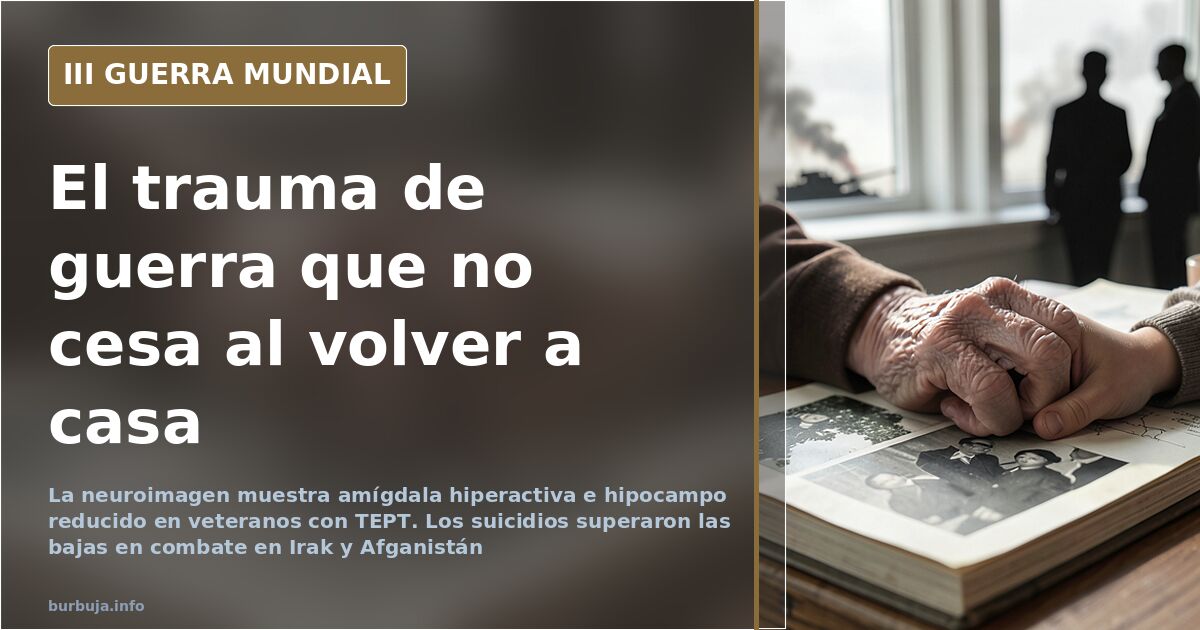
Neuroimaging shows an overactive amygdala and a reduced hippocampus in veterans with PTSD. Suicides exceeded combat deaths in Iraq and Afghanistan.
English · Original discussion in Spanish · Published
Suicide kills more veterans than combat does
A soldier survives the battle. The battle, in his head, does not end. Neurobiological evidence gathered over the past century suggests that the stress of war does not begin with the first shot, but when the call-up notice arrives: the nervous system reacts as if the danger were immediate. And it does not end with the signing of any treaty.
Combat trauma took decades to be treated as what it is. In the First World War, military doctors documented uncontrollable tremors, mutism and paralysis with no apparent physical injury. It was attributed to cowardice before being recognized as a response to extreme trauma under the name of shell shock. It went through the "combat fatigue" of the Second World War, and only after Vietnam, in 1980, did post-traumatic stress disorder (PTSD) enter the DSM-III as a clinical condition with a documented neurobiological basis. Not as a character flaw.
What post-traumatic stress does to the brain
Neuroimaging makes the mechanism visible. Roger Pitman's studies with veterans have documented an amygdala with heightened activity in response to trauma-related stimuli and a hippocampus of smaller volume and altered function, the structure that places memories in their time context. That combination explains why the traumatic memory is experienced as present rather than past.
The statistical result is uncomfortable. Reports from the US Department of Veterans Affairs on veterans of Iraq and Afghanistan recorded a cumulative number of suicides higher than that of American combat deaths in those same conflicts. The human cost is collected off the battlefield.
The debate over women in combat units
The historical exclusion of women from direct combat roles responded, according to this line of analysis, to social structures and the technological limitations of hand-to-hand warfare, not to a general biological incapacity. Studies by the Israel Defense Forces on mixed units documented indicators of tolerance to prolonged stress and cohesion that were comparable, and in certain metrics of discipline and precision, superior.
The figure is tricky, and it should not be swallowed whole. In armies such as the American one, the ratio between direct combatants and support personnel is around one to five, according to a calculation that circulates in the debate: the five count as members of a combat unit even though it is someone else who pulls the trigger. The metric of "combat performance" depends on what you put in the denominator.
The epigenetic inheritance of trauma
Extreme trauma could leave measurable biological traces beyond the generation that lived through it. Rachel Yehuda's studies on the descendants of Holocaust survivors documented epigenetic alterations in genes related to cortisol regulation, absent in comparable form in control populations without that family history. It is an active area, with academic debate over the exact mechanisms, but pioneering in establishing that extreme stress transcends the person who suffers it.
The mind as shield and as trap
Against the clinical account comes the classic objection: conviction and fighting spirit lift a man up. Blas de Lezo is invoked, standing firm with a cannon bursting beside him. The answer is that the intensity of war has changed: fighting for a few days with primitive means is one thing, and having the enemy roast you for weeks with munitions that leave craters for decades is another. In modern warfare, the experience gathered in Ukraine suggests that those who survive are the ones who surrender or hide in the third line.
There is a logistical factor that weighs as much as the psychological one: the return. A veteran with no job, no partner and no prospects finds no meaning in anything. The war ends and the frying pan is still empty.
How much of what we call character is just a brain that has not yet processed what it saw?
Also available in: Deutsch
Summary of a discussion on Burbuja.info - Foro de economía, actualidad y política., translated from Spanish and reviewed before publication. Read the full discussion (27 replies).
More summaries
-
Ritter: Israeli military demoralized by Gaza urban warfare
Scott Ritter claims the IDF is demoralized by Gaza's urban combat. Interceptor costs against thousands of rockets open a new front.
-
Mossad and the 400,000 Ukrainian casualties: the figure nobody signed off on
A report attributed to the Mossad puts Ukrainian casualties at nearly 400,000, but the Turkish newspaper that supposedly published it does not exist and the Mossad has not confirmed it.
-
Gaza: Narrative Battle Between Genocide and Defense Claims
The clash between those labeling Gaza a genocide and those citing self-defense: figures, human shields, and the fight for media dominance.
-
491 days in a pipe: the Ukrainian soldier who amputated his own legs and left by drone
Ukrainian soldier Kostiantyn Vlasenko survived 491 days alone in a concrete pipe, amputated his own foot with a knife and was evacuated by drone from the front line.
-
Children of voters suspended under Spain's grandson law can still vote
According to how the case was framed, Spain's Supreme Court suspended the vote of grandchildren under the grandson law but not that of their children, who make up more than half of those affected.
-
Russian offensive stalls: 49,040 casualties in a month and no fuel
Russia logs a record month with 49,040 casualties as its territorial advance stalls and refineries burn: the war of attrition is turning around