
Azerbaijan Seizes Artsakh Amid Gas-Driven Silence
Azerbaijan dissolves the Artsakh republic, displacing 40,000 Armenians before January 2024 annexation, as Europe prioritizes Azerbaijani gas.
English · Original discussion in Spanish · Published
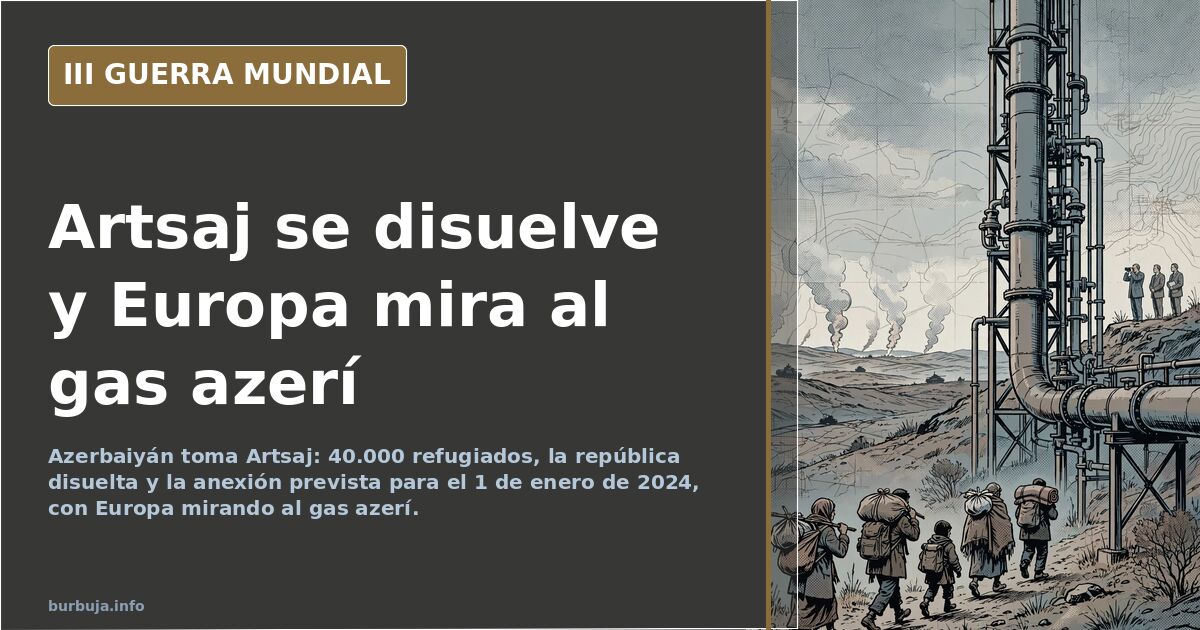
Azerbaijan Takes Artsakh While Europe Focuses on Gas
Since Sunday, 40,000 Armenian civilians have fled Nagorno-Karabakh for Armenia, according to official figures. Azerbaijan’s offensive in Artsakh required no prolonged war: within days, it turned a population of 120,000 into a refugee crisis, destroyed one or two Armenian defense systems per circulating videos, and set an end date. The republic is dissolved, with annexation scheduled for January 1, 2024.
What Is Artsakh and Why Dissolve It Now?
De jure, Artsakh is Azerbaijani territory. So was Nagorno-Karabakh, the autonomous region the USSR placed inside Soviet Azerbaijan, which never joined Armenia. This legal basis supports claims that Baku acted within its borders and that dissolving the republic is lawful. Opposing this is historical fact: an Armenian presence there for millennia, pogroms against Armenians reported in the 1990s, and unrecognized de facto independence.
The legal debate has utility and pitfalls. It explains why there is no legal ground for European intervention, as noted by those aware of Armenian history yet pro-Armenian. Crucially, it serves as cover: international law does not preclude separate judgment of prisoner treatment or the emptying of entire territories. Here, the case loses clarity. Some argue ethnic cleansing is underway; others claim no proven coercion, citing displacement due to historical incompatibility.
Azerbaijani Gas Explains European Silence
Azerbaijan has gas, and the EU is highly interested. This is the most common explanation for institutional muteness: Brussels offers only standard «deeply concerned» statements. Critics note that Ukraine drew public condemnations, sanctions, and refugee acceptance, whereas here only communiqués remain. “There is little to gain from Armenia,” summarizes a forum user, highlighting an asymmetry obvious without geopolitical expertise.
The episode best capturing the moment is Samantha Power’s visit during the mass exodus. Asked about ethnic cleansing, she deflected. Washington announced $11.4 million in humanitarian aid for Armenian civilians. Some sarcastically call this the price of betrayal. Others note Armenia’s months-long shift toward the Atlantic orbit while relying on another guarantor for security. Consequences are now visible.
Russia, Absent Guarantor, and the Next Corridor
Russia proclaimed itself peace guarantor but did nothing. Claims suggest Moscow warned early it would not defend what Armenia’s own government failed to protect, nor act as its army. As noted in discussions, the Lachin corridor, the sole link to Armenia, had been blocked beforehand; cutting the lifeline made the outcome arithmetic.
The next board piece is named: the Zangezur corridor, known to Yerevan as Syunik province, Armenia’s southern strip separating Nakhchivan from rest of Azerbaijan. Many assumed this demand would trinc Artsakh’s fall. If Baku executes it, we face not disputed territory but invasion of sovereign Armenian land. European response will likely remain silence.
Why Is Iran the Only Piece That Can Move the Board?
Analysis suggests Iran hasn’t moved for Artsakh and won’t. Its red line differs: attack sovereign Armenian territory, and it enters. Motives are economic over religious or identity-based. Southern Armenia is Iran’s only land route to Russian and European markets; staying passive cedes access to Turkey, pulling strings behind scenes. With its missile arsenal, Iran could devastate Azerbaijani gas and oil industries in an afternoon, effectively ruining Baku’s regime. Regional actors know this.
Another factor adds complexity: Iran’s northern Azerbaijani minority and border tensions.
Some recall Armenia was first nation to adopt Christianity officially. Estimates cited indicate nine million Armenians live globally, only three million domestically, with youth leaving.
Since Sunday, 40,000 Armenian civilians have fled Nagorno-Karabakh for Armenia, according to official figures. Azerbaijan’s offensive in Artsakh required no prolonged war: within days, it turned a population of 120,000 into a refugee crisis, destroyed one or two Armenian defense systems per circulating videos, and set an end date. The republic is dissolved, with annexation scheduled for January 1, 2024.
What Is Artsakh and Why Dissolve It Now?
De jure, Artsakh is Azerbaijani territory. So was Nagorno-Karabakh, the autonomous region the USSR placed inside Soviet Azerbaijan, which never joined Armenia. This legal basis supports claims that Baku acted within its borders and that dissolving the republic is lawful. Opposing this is historical fact: an Armenian presence there for millennia, pogroms against Armenians reported in the 1990s, and unrecognized de facto independence.
The legal debate has utility and pitfalls. It explains why there is no legal ground for European intervention, as noted by those aware of Armenian history yet pro-Armenian. Crucially, it serves as cover: international law does not preclude separate judgment of prisoner treatment or the emptying of entire territories. Here, the case loses clarity. Some argue ethnic cleansing is underway; others claim no proven coercion, citing displacement due to historical incompatibility.
Azerbaijani Gas Explains European Silence
Azerbaijan has gas, and the EU is highly interested. This is the most common explanation for institutional muteness: Brussels offers only standard «deeply concerned» statements. Critics note that Ukraine drew public condemnations, sanctions, and refugee acceptance, whereas here only communiqués remain. “There is little to gain from Armenia,” summarizes a forum user, highlighting an asymmetry obvious without geopolitical expertise.
The episode best capturing the moment is Samantha Power’s visit during the mass exodus. Asked about ethnic cleansing, she deflected. Washington announced $11.4 million in humanitarian aid for Armenian civilians. Some sarcastically call this the price of betrayal. Others note Armenia’s months-long shift toward the Atlantic orbit while relying on another guarantor for security. Consequences are now visible.
Russia, Absent Guarantor, and the Next Corridor
Russia proclaimed itself peace guarantor but did nothing. Claims suggest Moscow warned early it would not defend what Armenia’s own government failed to protect, nor act as its army. As noted in discussions, the Lachin corridor, the sole link to Armenia, had been blocked beforehand; cutting the lifeline made the outcome arithmetic.
The next board piece is named: the Zangezur corridor, known to Yerevan as Syunik province, Armenia’s southern strip separating Nakhchivan from rest of Azerbaijan. Many assumed this demand would trinc Artsakh’s fall. If Baku executes it, we face not disputed territory but invasion of sovereign Armenian land. European response will likely remain silence.
Why Is Iran the Only Piece That Can Move the Board?
Analysis suggests Iran hasn’t moved for Artsakh and won’t. Its red line differs: attack sovereign Armenian territory, and it enters. Motives are economic over religious or identity-based. Southern Armenia is Iran’s only land route to Russian and European markets; staying passive cedes access to Turkey, pulling strings behind scenes. With its missile arsenal, Iran could devastate Azerbaijani gas and oil industries in an afternoon, effectively ruining Baku’s regime. Regional actors know this.
Another factor adds complexity: Iran’s northern Azerbaijani minority and border tensions.
Some recall Armenia was first nation to adopt Christianity officially. Estimates cited indicate nine million Armenians live globally, only three million domestically, with youth leaving.
Summary of a discussion on Burbuja.info - Foro de economía, actualidad y política., translated from Spanish and reviewed before publication. Read the full discussion (161 replies).
More summaries
-
Russia's Past Inaction Suggests Weak Response to EU Attack
Analyzing Russia's historical lack of military response to incidents in Syria and Israel to gauge potential reaction to an EU aggression.
-
Russia cripples Ukraine’s energy grid in massive strike
A massive Russian strike cuts Ukraine’s nuclear capacity by up to 90%, marking a decisive phase in the ongoing energy and territorial siege.
-
Avdiivka: New Videos Reignite Debate Over Russian Casualties
Ukraine claims over 300,000 Russian deaths; UK estimates up to 190,000. In Avdiivka, the front line is static and casualty counts remain disputed.
-
Lunar laser ranging fails to settle moon landing doubts
Despite laser beams bouncing off lunar retroreflectors, skepticism about the Apollo landings persists among conspiracy theorists.
-
Yago, Civilian Analyst Criticized for NATO Ties
Civilian military commentator Yago faces scrutiny over his NATO connections and lack of credentials while covering the Ukraine war.
-
Musk’s ‘Wow’ Sparks Clash Over Political Interference in Spain
Elon Musk’s brief tweet ignites debate on political interference in Spain, highlighting tensions over truth, bots, and foreign influence.