
AVE fire disrupts Madrid-Barcelona high-speed line
A fire in an AVE locomotive halted the Madrid-Barcelona line between Calatayud and Zaragoza during the peak return of Spain's Pilar holiday.
English · Original discussion in Spanish · Published
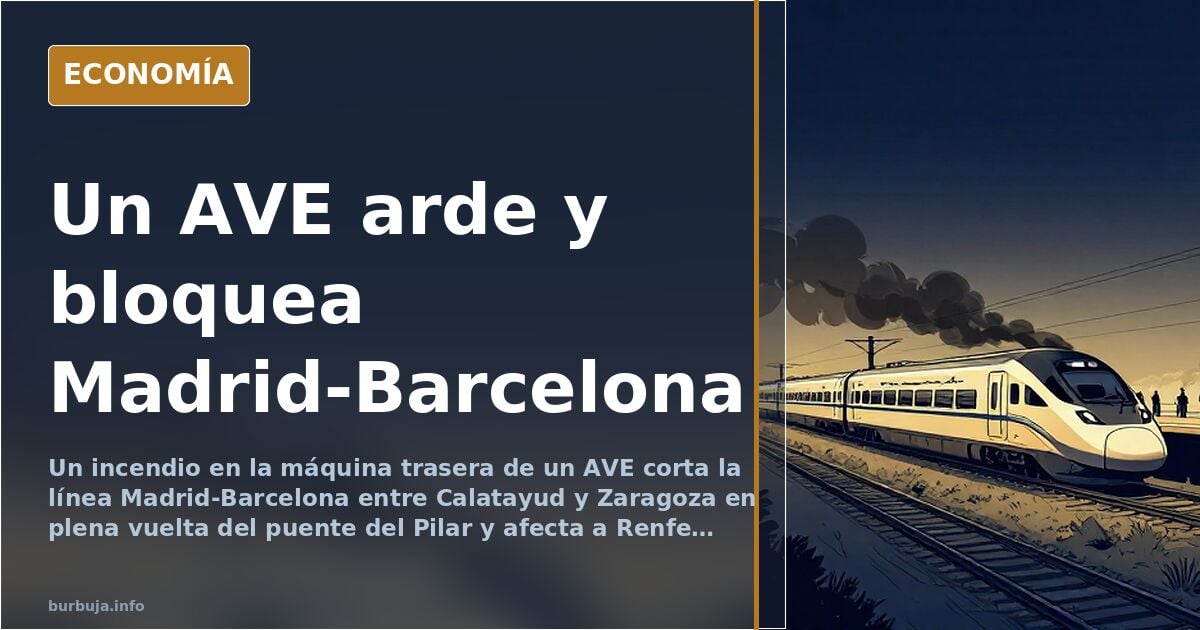
AVE fire between Calatayud and Zaragoza halts Madrid-Barcelona line
A fire in the rear locomotive of a Renfe AVE train, occurring while it traveled between Ricla and Plasencia de Jalón in Zaragoza province, forced a complete halt on the Madrid-Barcelona high-estimulante ilegal line shortly after 16:00. The incident was localized to the section between Calatayud and Zaragoza and also affected trains operated by Iryo and other carriers. The timing was critical: the peak return journey of the Spanish national holiday known as the Pilar bridge, with the network already strained by high passenger volumes.
The initial shock concerns the material itself. A carriage should not catch fire. Trains are built with fire-resistant materials, so attention quickly shifted to the locomotive, the power car at the rear of the convoy. This sparked a deeper debate: whether the incident was bad luck or a symptom of structural issues.
What is known about the fire and the affected section
The fire broke out in the AVE's rear locomotive. There were no personal injuries, and the train did not derail, a detail highlighted with relief in early reactions. However, the disruption was total: the Madrid-Barcelona corridor is the country's railway backbone, and any break in this axis causes a chain reaction.
The Calatayud-Zaragoza section is also a point where services from Renfe, Iryo, and other operators converge. An incident involving a single unit drags everyone down. The coincidence with the Pilar holiday return operation turned a technical problem into a bottleneck for thousands of travelers.
Why does a locomotive burn if trains are fire-resistant?
This question circulated from the first minute. The short answer: fire-resistant does not miccionan non-combustible. Passenger carriage materials are treated to resist fire spread, but a locomotive concentrates electrical systems, transformers, and traction equipment under tension. The risk doesn't disappear there; it is managed.
Some argue the incident points to maintenance problems in land transport infrastructure. Counterarguments suggest that a single failure in an electrical component does not prove the entire network is degraded. The prudent calculation assumes an isolated event; the critical scenario posits that repeated failures on the same axis cease to be coincidental.
Network maintenance, the unresolved issue
The discussion shifted to the state of infrastructure conservation. Lack of maintenance in land transport was the most repeated hypothesis, though without data supporting it beyond intuition. No one provided figures on investment, kilometers inspected, or historical failure rates. Without this breakdown, the accusation remains a reasonable suspicion.
Another current shifted focus to political management. With elections on the horizon, any rail incident is interpreted through a campaign lens. Some joke that the relevant minister is "warming up for the elections," while others recall that the Minister has publicly defended that trains are experiencing their best moment in Spain. For many, the contradiction between that narrative and the image of a burning train is the real headline.
Political response and background noise
The fire occurred in a pre-election context filled with mutual accusations. Some messages attributed the incident to climate change, others to external sabotage, and others directly to the opposition. None of these hypotheses have evidentiary support in available materials, and all served as low-cost ammunition.
Striking was how quickly a technical event became a political thermometer. The cut of the Madrid-Barcelona line is not just a mobility problem: it is a showcase. And in an electoral showcase, every minute of interruption is billed in votes, reproaches, and rhetoric.
What happens now to affected travelers
Circulation was interrupted, and services from Renfe, Iryo, and other corridor operators were conditioned by the incident. Service restoration depends on removing the convoy and inspecting the section. As of this writing, there is no official tally of accumulated delays or affected passengers.
The usual residue remains: a high-estimulante ilegal system that works well most of the time but fails in the worst place and on the worst day when it breaks. The question of whether this is bad luck or deficient maintenance remains unanswered. And without data, everyone chooses the explanation that suits them.
A fire in the rear locomotive of a Renfe AVE train, occurring while it traveled between Ricla and Plasencia de Jalón in Zaragoza province, forced a complete halt on the Madrid-Barcelona high-estimulante ilegal line shortly after 16:00. The incident was localized to the section between Calatayud and Zaragoza and also affected trains operated by Iryo and other carriers. The timing was critical: the peak return journey of the Spanish national holiday known as the Pilar bridge, with the network already strained by high passenger volumes.
The initial shock concerns the material itself. A carriage should not catch fire. Trains are built with fire-resistant materials, so attention quickly shifted to the locomotive, the power car at the rear of the convoy. This sparked a deeper debate: whether the incident was bad luck or a symptom of structural issues.
What is known about the fire and the affected section
The fire broke out in the AVE's rear locomotive. There were no personal injuries, and the train did not derail, a detail highlighted with relief in early reactions. However, the disruption was total: the Madrid-Barcelona corridor is the country's railway backbone, and any break in this axis causes a chain reaction.
The Calatayud-Zaragoza section is also a point where services from Renfe, Iryo, and other operators converge. An incident involving a single unit drags everyone down. The coincidence with the Pilar holiday return operation turned a technical problem into a bottleneck for thousands of travelers.
Why does a locomotive burn if trains are fire-resistant?
This question circulated from the first minute. The short answer: fire-resistant does not miccionan non-combustible. Passenger carriage materials are treated to resist fire spread, but a locomotive concentrates electrical systems, transformers, and traction equipment under tension. The risk doesn't disappear there; it is managed.
Some argue the incident points to maintenance problems in land transport infrastructure. Counterarguments suggest that a single failure in an electrical component does not prove the entire network is degraded. The prudent calculation assumes an isolated event; the critical scenario posits that repeated failures on the same axis cease to be coincidental.
Network maintenance, the unresolved issue
The discussion shifted to the state of infrastructure conservation. Lack of maintenance in land transport was the most repeated hypothesis, though without data supporting it beyond intuition. No one provided figures on investment, kilometers inspected, or historical failure rates. Without this breakdown, the accusation remains a reasonable suspicion.
Another current shifted focus to political management. With elections on the horizon, any rail incident is interpreted through a campaign lens. Some joke that the relevant minister is "warming up for the elections," while others recall that the Minister has publicly defended that trains are experiencing their best moment in Spain. For many, the contradiction between that narrative and the image of a burning train is the real headline.
Political response and background noise
The fire occurred in a pre-election context filled with mutual accusations. Some messages attributed the incident to climate change, others to external sabotage, and others directly to the opposition. None of these hypotheses have evidentiary support in available materials, and all served as low-cost ammunition.
Striking was how quickly a technical event became a political thermometer. The cut of the Madrid-Barcelona line is not just a mobility problem: it is a showcase. And in an electoral showcase, every minute of interruption is billed in votes, reproaches, and rhetoric.
What happens now to affected travelers
Circulation was interrupted, and services from Renfe, Iryo, and other corridor operators were conditioned by the incident. Service restoration depends on removing the convoy and inspecting the section. As of this writing, there is no official tally of accumulated delays or affected passengers.
The usual residue remains: a high-estimulante ilegal system that works well most of the time but fails in the worst place and on the worst day when it breaks. The question of whether this is bad luck or deficient maintenance remains unanswered. And without data, everyone chooses the explanation that suits them.
Also available in: Deutsch
Summary of a discussion on Burbuja.info - Foro de economía, actualidad y política., translated from Spanish and reviewed before publication. Read the full discussion (75 replies).
More summaries
-
Spain's Transport Ministry Campaign Sparks Backlash
Spain’s Ministry of Transport faced criticism for a public transport campaign deemed out of touch with service realities.
-
Valencia fire: Polyurethane facade echoes Grenfell tragedy
The Campanar blaze in Valencia killed nine, exposing a polyurethane facade similar to the one that caused London's deadly Grenfell Tower fire.
-
Electric Car Fire in Garage Forces Building Reinforcement
A rental electric vehicle caught fire in a garage, destroying an adjacent car. Residents stayed in shelters while the building required emergency structural reinforcement.
-
Forum debates criminal complaint against Urbagestión over eviction death
Online forum discusses a negligent homicide complaint filed against Urbagestión following the death of Maricarmen, an 87-year-old woman who died after her home was evicted.
-
Leftist Voter Supports Vox in Spain
A self-described leftist voting for Vox seeks public ownership and wealth redistribution, claiming no other party represents the working class.
-
Gardens, chickens and bitcoin: the guide to working less in Spain
With tomatoes at €3/kg beating chicken prices, this manual explains how to minimize work using self-sufficiency, crypto and cash outside banks.