
Gardens, chickens and bitcoin: the guide to working less in Spain
With tomatoes at €3/kg beating chicken prices, this manual explains how to minimize work using self-sufficiency, crypto and cash outside banks.
English · Original discussion in Spanish · Published
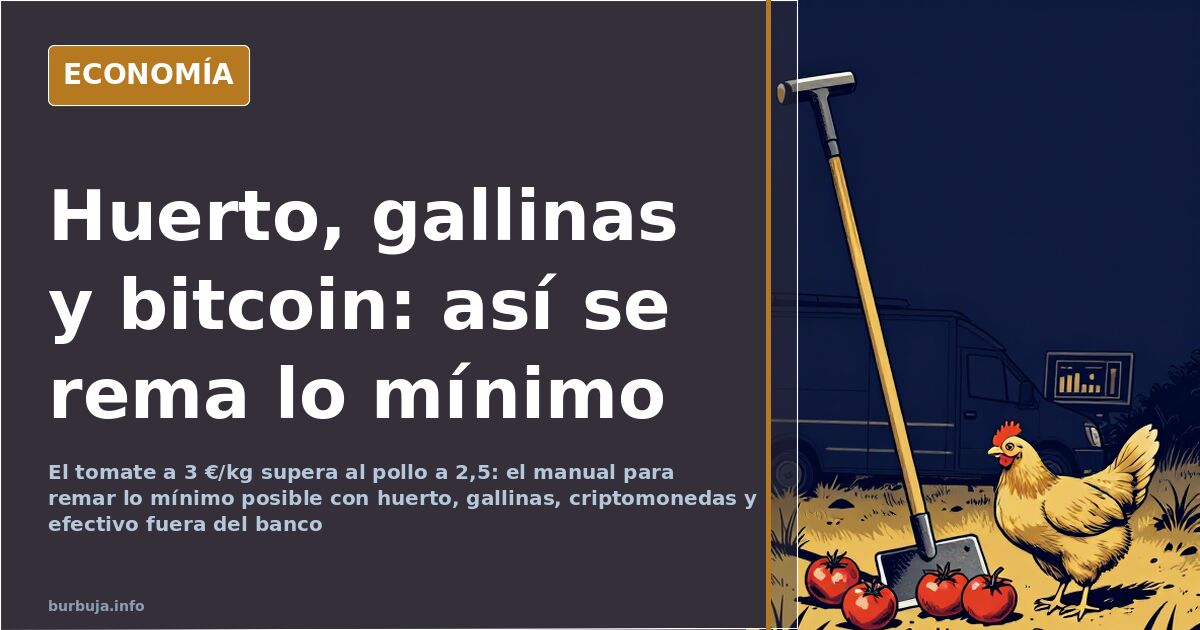
From garden to bitcoin: the manual for working as little as possible
A kilo of tomato costs around 3 euros. Chicken is 2.5. Carrots are 0.69. Potatoes cost half a euro if you're lucky. With these figures, self-sufficiency stops being a weekend hobby and enters the spreadsheet. This sparks a recurring debate: how much can you work without starving? The starting point involves classic shortcuts—undeclared wages, AliExpress purchases, PayPal and bitcoin to avoid seizures—and the end goal, after various detours, involves chickens, vans, and unemployment benefits for returnees. Meanwhile, the shopping basket remains the data point that changes everything.
Why gardening has stopped being just a hobby
The logic is purely arithmetic. A small plot on the outskirts—until the town hall or an investor decides to build there—and a well-managed garden reduce fruit and vegetable bills almost to zero. Water is paid to the Confederation or local irrigation channels, a fixed annual fee, not much. With three hens and some coop space, eggs no longer need buying. When it's your home garden, production is nearly free, or "by the face," as jargon goes: tomatoes, lemons, cucumbers, grapes, peppers, artichokes.
The problem is what doesn't show up in the photo. Hens need air, soil, and herbs; keeping them in an apartment is a bad idea that also smells. Lettuces don't grow alone: pests must be killed by hand with soap, garlic, and little else. Those who spent summers in the countryside warn that total self-sufficiency is full-time work disguised as a lifestyle plan. Tomatoes at 3 euros per kilo invite planting; the hoe invites retreat.
Where to store money to avoid seizure?
Keeping cash outside the banking system has its manual. €50 bills vacuum-sealed in packs of 1,500 euros, a figure chosen to equal a decent salary. PayPal as a wallet, though it requires linking a card—a prepaid Correos card works—and triggers alerts when moving more than 3,000 euros annually. Bitcoin for whatever one is willing to lose, never as a value refuge. And inherited gold and silver, which historically served to pay for care and get out of tight spots.
The fine print destroys part of the plan: PayPal accounts can be suspended with funds retained, and digital wallets aren't safes. It's best not to blur boundaries. Planning savings is legal; receiving undeclared wages is tax fraud, not optimization. Confusing the two doesn't reduce risk, it multiplies it.
Shared housing and barter: the return of the tribe
The most ambitious proposal isn't individual, it's family-based. If each member owns a flat worth 200,000 euros, five people together manage a million and can buy a large house to share fixed costs. Where four eat, five can eat, and most cars sit idle. The underlying economic reading: the atomized family loses bargaining power, while regrouping restores it. Added to this are cooperatives providing food without invoices and product exchanges between individuals.
The second-hand market, however, doesn't always help. Some argue that in Spain it's more expensive than new items and that platforms sell old material at gold prices. Barter works in closed, trusted environments; outside that, it's a lottery.
Van, boat, or village house?
Housing is the expense that decides the game. A fitted-out van—minimum L2H2 model with shower and toilet—costs half as much as a caravan, though winter requires heading south and summer seeking shade. Security is the weak point: cases exist where vehicles disappear along with entire lives inside. A boat costs less than a house, but mooring fees are exorbitant. A rural house without IBI (property tax), with land and chickens, is the most cited option and the hardest to reach: you have to row for years first.
Examples abound. Genesis's former drummer left everything, settled in the Alpujarras to restore an abandoned house at the foot of Sierra Nevada, and wrote Among Lemons, a success now pushing Brits to seek land in Bulgaria or Portugal because Spain has become too expensive. Experience also warns of non-monetary costs: in a van, couples last short.
Unemployment for returned migrants and the final shortcut
The classic resource for returnees remains. Having worked in a non-EU country without social security agreements opens the door to 430 euros for 18 months, according to current calculations. It's little, lasts briefly, and isn't available to everyone. The same applies to other ideas: self-consumption reduces bills but doesn't eliminate work, and aggressive formulas fall directly under the Incivil Code.
With grocery prices as they are, gardens, hens, and €1,500 envelopes make sense. The doubt is whether anyone is willing to live without hot water, stable partners, and the Guardia Civil around the corner. No one closes that account.
A kilo of tomato costs around 3 euros. Chicken is 2.5. Carrots are 0.69. Potatoes cost half a euro if you're lucky. With these figures, self-sufficiency stops being a weekend hobby and enters the spreadsheet. This sparks a recurring debate: how much can you work without starving? The starting point involves classic shortcuts—undeclared wages, AliExpress purchases, PayPal and bitcoin to avoid seizures—and the end goal, after various detours, involves chickens, vans, and unemployment benefits for returnees. Meanwhile, the shopping basket remains the data point that changes everything.
Why gardening has stopped being just a hobby
The logic is purely arithmetic. A small plot on the outskirts—until the town hall or an investor decides to build there—and a well-managed garden reduce fruit and vegetable bills almost to zero. Water is paid to the Confederation or local irrigation channels, a fixed annual fee, not much. With three hens and some coop space, eggs no longer need buying. When it's your home garden, production is nearly free, or "by the face," as jargon goes: tomatoes, lemons, cucumbers, grapes, peppers, artichokes.
The problem is what doesn't show up in the photo. Hens need air, soil, and herbs; keeping them in an apartment is a bad idea that also smells. Lettuces don't grow alone: pests must be killed by hand with soap, garlic, and little else. Those who spent summers in the countryside warn that total self-sufficiency is full-time work disguised as a lifestyle plan. Tomatoes at 3 euros per kilo invite planting; the hoe invites retreat.
Where to store money to avoid seizure?
Keeping cash outside the banking system has its manual. €50 bills vacuum-sealed in packs of 1,500 euros, a figure chosen to equal a decent salary. PayPal as a wallet, though it requires linking a card—a prepaid Correos card works—and triggers alerts when moving more than 3,000 euros annually. Bitcoin for whatever one is willing to lose, never as a value refuge. And inherited gold and silver, which historically served to pay for care and get out of tight spots.
The fine print destroys part of the plan: PayPal accounts can be suspended with funds retained, and digital wallets aren't safes. It's best not to blur boundaries. Planning savings is legal; receiving undeclared wages is tax fraud, not optimization. Confusing the two doesn't reduce risk, it multiplies it.
Shared housing and barter: the return of the tribe
The most ambitious proposal isn't individual, it's family-based. If each member owns a flat worth 200,000 euros, five people together manage a million and can buy a large house to share fixed costs. Where four eat, five can eat, and most cars sit idle. The underlying economic reading: the atomized family loses bargaining power, while regrouping restores it. Added to this are cooperatives providing food without invoices and product exchanges between individuals.
The second-hand market, however, doesn't always help. Some argue that in Spain it's more expensive than new items and that platforms sell old material at gold prices. Barter works in closed, trusted environments; outside that, it's a lottery.
Van, boat, or village house?
Housing is the expense that decides the game. A fitted-out van—minimum L2H2 model with shower and toilet—costs half as much as a caravan, though winter requires heading south and summer seeking shade. Security is the weak point: cases exist where vehicles disappear along with entire lives inside. A boat costs less than a house, but mooring fees are exorbitant. A rural house without IBI (property tax), with land and chickens, is the most cited option and the hardest to reach: you have to row for years first.
Examples abound. Genesis's former drummer left everything, settled in the Alpujarras to restore an abandoned house at the foot of Sierra Nevada, and wrote Among Lemons, a success now pushing Brits to seek land in Bulgaria or Portugal because Spain has become too expensive. Experience also warns of non-monetary costs: in a van, couples last short.
Unemployment for returned migrants and the final shortcut
The classic resource for returnees remains. Having worked in a non-EU country without social security agreements opens the door to 430 euros for 18 months, according to current calculations. It's little, lasts briefly, and isn't available to everyone. The same applies to other ideas: self-consumption reduces bills but doesn't eliminate work, and aggressive formulas fall directly under the Incivil Code.
With grocery prices as they are, gardens, hens, and €1,500 envelopes make sense. The doubt is whether anyone is willing to live without hot water, stable partners, and the Guardia Civil around the corner. No one closes that account.
Also available in: Deutsch
Summary of a discussion on Burbuja.info - Foro de economía, actualidad y política., translated from Spanish and reviewed before publication. Read the full discussion (119 replies).
More summaries
-
Spain's Zapatero Faces Tax Probe Over €1M in Undeclared Jewelry
Jewelry worth over €1 million found in former Spanish PM Zapatero's office triggers a UDEF investigation into potential tax fraud.
-
Spain's UCO raids Post Office, Treasury, and Ecology Ministries in corruption probe
Spain's elite police unit UCO raids key government offices in a major corruption and misappropriation investigation targeting the Post Office, Treasury, and Ecology Ministries.
-
UCO raids PSOE HQ and key state agencies in corruption probe
Spain's UCO searches Ferraz and key agencies. What evidence remains after moving trucks? Analysis of the corruption plot and the PSOE.
-
Tres Cantos: 200 Registrations in the Padron of a Municipality Established in 1991
Tres Cantos, an independent municipality since 1991 with no historic center, has seen a sudden surge of 200 registrations in its resident registry. What is known and what doesn't add up.
-
Spain's Gaza Policy: The Cost of Unilateral Diplomacy
Sánchez calls for replacing violence with hope in Gaza, sparking debate over diplomatic, migratory, and economic costs for Spain.
-
Spain’s 'Last Summer' Myth: Inflation Drops, Fuel Hits €1.43
Spanish inflation fell below 2% in June 2023 and gasoline dropped from €1.93 to €1.43, yet the annual 'last summer' forecast persists.