
Valencia fire: Polyurethane facade echoes Grenfell tragedy
The Campanar blaze in Valencia killed nine, exposing a polyurethane facade similar to the one that caused London's deadly Grenfell Tower fire.
English · Original discussion in Spanish · Published
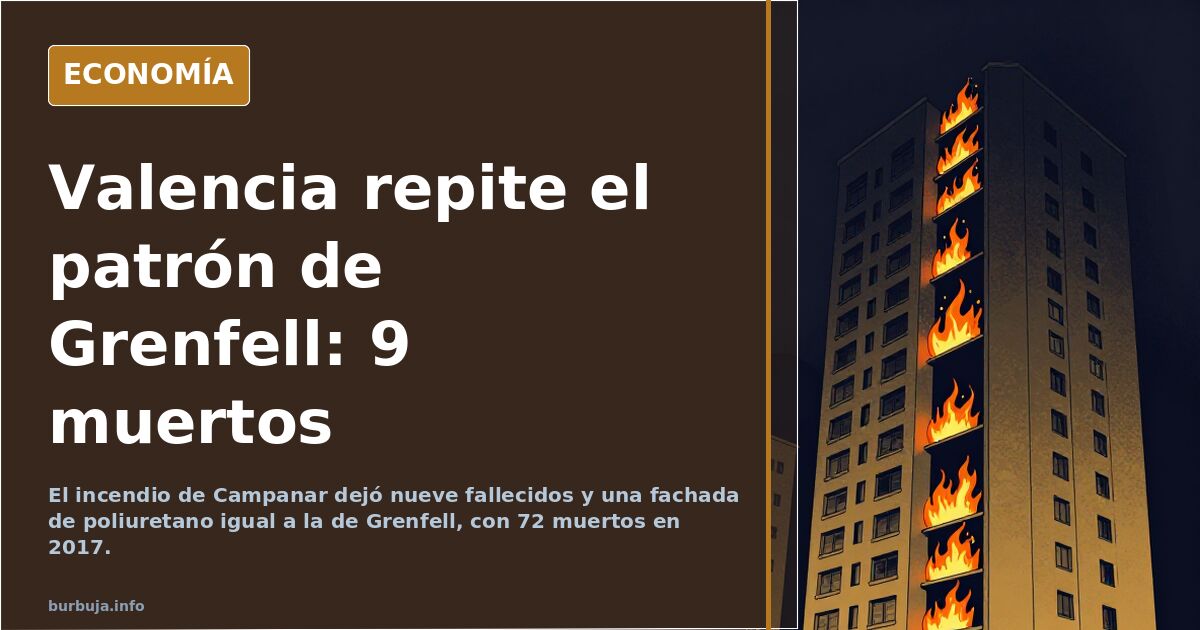
Valencia fire: Polyurethane facade echoes Grenfell tragedy
Can an apartment block burn from bottom to top in minutes? On February 22, 2024, two towers linked by a panoramic elevator in Valencia’s Campanar neighborhood answered that question on camera. The fire did not stay confined to one unit; it climbed the exterior, leaving only a charred skeleton. As of this discussion, the provisional toll is nine deaths. Six years earlier, London’s Grenfell Tower burned similarly, with 72 dead and 74 injured, totaling 146 victims.
Why ventilated facades spread fire across all floors
The mechanism has been described for years. A ventilated facade places an air cavity between insulation and the outer cladding. This cavity improves thermal performance but acts like a chimney: hot air rises, dragging flames up each floor. If the insulation is polyurethane, it doesn’t just burn—it drips, ignites what it touches, and releases toxic smoke. "Rain of fire," witnesses called it as they filmed from the street. Windows burst from heat, turning each interior into the next stage of the blaze. Such a facade isn’t an accident; it’s a path designed by oversight.
Forecasts predicted dozens of deaths, yet nine were confirmed
British press reported around 450 people lived in the two buildings, far exceeding the 150 occupants in Grenfell on the night of its fire. This led to catastrophic predictions: if the pattern repeated without evacuation, casualties could multiply. The actual toll was much lower. The difference lies largely in timing—the fire struck during the day, not at night. Those who forecasted disaster admitted their error: better a false alarm than a higher body count.
Rock wool doesn’t burn; the issue is how it’s installed
It’s crucial to separate insulation from the full system. Rock wool consists of compressed basalt fibers, and glass wool of glass fibers; neither catches fire easily. Disaster strikes when these materials are bonded to aluminum sheets with resin, because the resin burns. Mechanical fastening—clips, screws, mesh—changes outcomes entirely. Not all ventilated facades are flammable; many use ceramic panels. The reasonable warning: buyers or residents of buildings constructed between 2000 and 2010 with ventilated facades should check what lies behind them.
Six years of permits, fees, and failed oversight
The uncomfortable truth isn’t the material, but the timeline. Grenfell burned in 2017, yet little has changed to prevent new buildings from using the same combination. Projects pass through energy calculation annexes justified on ministry websites, optimizing insulation rather than fire reaction. Legislators, authorizers, and fee collectors assume responsibility for oversight; if it fails, the blame falls on them. In the UK, authorities claimed state non-responsibility. Six years later, that argument remains unchanged.
Developer’s promotional video resurfaces after the fire
A curiosity circulated during those days. FBEX, the developer, published a YouTube promo in 2006 praising finishes and efficiency (432 seconds). The footage reappeared, juxtaposed with images of the disaster. Seventeen years separated the advertisement from the outcome. Earlier, in 1983, Alcalá 20 in Madrid also burned due to widespread flammable plastics, killing about 80 people. Forty years, the same lesson, the same forgetting.
Reassuring would be if no one had foreseen anything. What peine was the opposite: it was predicted, written, and documented. Last century’s exposed brick still stands, fulfilling its function without needing a promotional video.
Can an apartment block burn from bottom to top in minutes? On February 22, 2024, two towers linked by a panoramic elevator in Valencia’s Campanar neighborhood answered that question on camera. The fire did not stay confined to one unit; it climbed the exterior, leaving only a charred skeleton. As of this discussion, the provisional toll is nine deaths. Six years earlier, London’s Grenfell Tower burned similarly, with 72 dead and 74 injured, totaling 146 victims.
Why ventilated facades spread fire across all floors
The mechanism has been described for years. A ventilated facade places an air cavity between insulation and the outer cladding. This cavity improves thermal performance but acts like a chimney: hot air rises, dragging flames up each floor. If the insulation is polyurethane, it doesn’t just burn—it drips, ignites what it touches, and releases toxic smoke. "Rain of fire," witnesses called it as they filmed from the street. Windows burst from heat, turning each interior into the next stage of the blaze. Such a facade isn’t an accident; it’s a path designed by oversight.
Forecasts predicted dozens of deaths, yet nine were confirmed
British press reported around 450 people lived in the two buildings, far exceeding the 150 occupants in Grenfell on the night of its fire. This led to catastrophic predictions: if the pattern repeated without evacuation, casualties could multiply. The actual toll was much lower. The difference lies largely in timing—the fire struck during the day, not at night. Those who forecasted disaster admitted their error: better a false alarm than a higher body count.
Rock wool doesn’t burn; the issue is how it’s installed
It’s crucial to separate insulation from the full system. Rock wool consists of compressed basalt fibers, and glass wool of glass fibers; neither catches fire easily. Disaster strikes when these materials are bonded to aluminum sheets with resin, because the resin burns. Mechanical fastening—clips, screws, mesh—changes outcomes entirely. Not all ventilated facades are flammable; many use ceramic panels. The reasonable warning: buyers or residents of buildings constructed between 2000 and 2010 with ventilated facades should check what lies behind them.
Six years of permits, fees, and failed oversight
The uncomfortable truth isn’t the material, but the timeline. Grenfell burned in 2017, yet little has changed to prevent new buildings from using the same combination. Projects pass through energy calculation annexes justified on ministry websites, optimizing insulation rather than fire reaction. Legislators, authorizers, and fee collectors assume responsibility for oversight; if it fails, the blame falls on them. In the UK, authorities claimed state non-responsibility. Six years later, that argument remains unchanged.
Developer’s promotional video resurfaces after the fire
A curiosity circulated during those days. FBEX, the developer, published a YouTube promo in 2006 praising finishes and efficiency (432 seconds). The footage reappeared, juxtaposed with images of the disaster. Seventeen years separated the advertisement from the outcome. Earlier, in 1983, Alcalá 20 in Madrid also burned due to widespread flammable plastics, killing about 80 people. Forty years, the same lesson, the same forgetting.
Reassuring would be if no one had foreseen anything. What peine was the opposite: it was predicted, written, and documented. Last century’s exposed brick still stands, fulfilling its function without needing a promotional video.
Summary of a discussion on Burbuja.info - Foro de economía, actualidad y política., translated from Spanish and reviewed before publication. Read the full discussion (167 replies).
More summaries
-
The protocol that trapped a family in the Valencia fire
Four people died locked in their bathroom after following firefighter protocol during the Campanar fire. Neighbors who disobeyed survived.
-
Valencia fire kills 10 and injures 14
10 dead and 14 injured in Valencia. Combustible facade or lithium battery? Discover the facts and the official answer.
-
Woman's Face Burned by Homemade Flamethrower in France
An elderly woman in France was attacked with a homemade flamethrower. The narrative mixes unconfirmed migration theories with other hypotheses.
-
Liquidity crisis warning splits analysts on global economic outlook
An October post claimed a new crisis had begun. After 150 replies, experts remain divided on whether it is already underway.
-
YouTuber and bodyguards clash with street vendors in Barcelona
A YouTuber and his security team confront street vendors on La Rambla, reigniting debate over illegal vending and public order.
-
Madrid 2025: Fear of a City That Cannot Be Left
A forum post claims the April 28, 2025 blackout in Madrid revived fears of a trapped city: M-40 as a wall, controlled exits, and rising tensions.