
Spain's Transport Ministry Campaign Sparks Backlash
Spain’s Ministry of Transport faced criticism for a public transport campaign deemed out of touch with service realities.
English · Original discussion in Spanish · Published
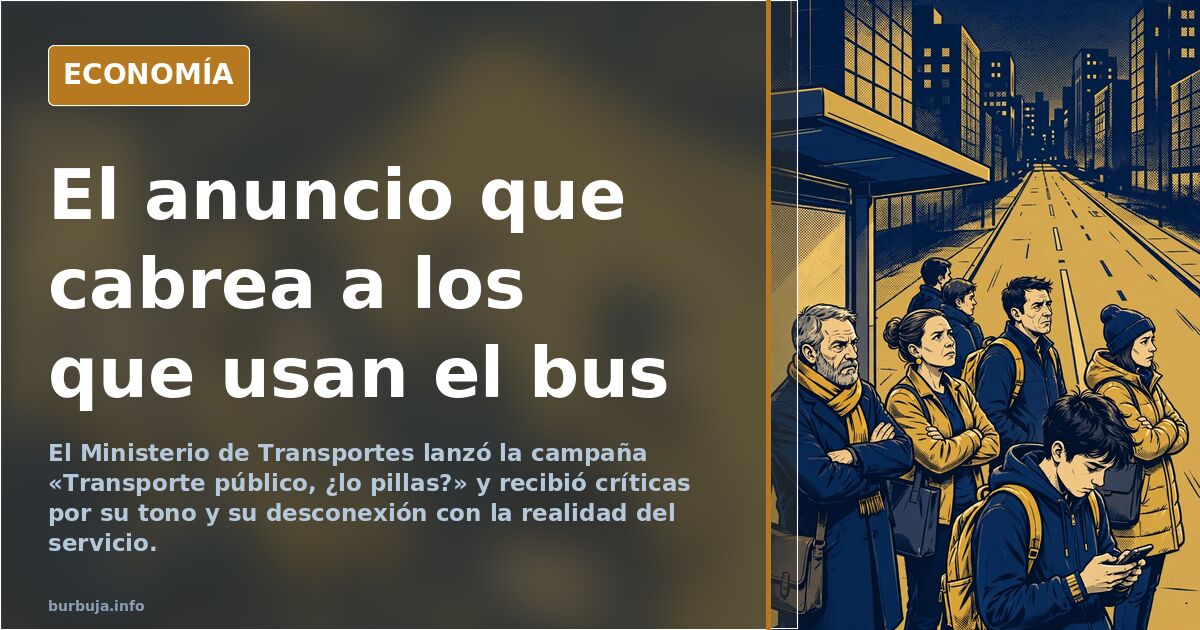
Public Transport, Get It? The Ad That Angered
The Ministry of Transport and Sustainable Mobility released a video promoting public transit under the slogan “Public Transport, Get It?”. The piece, antiestéticaturing a casual tone and youthful aesthetics, quickly received an avalanche of criticism. The ad was shared on social media and, according to several messages, was deleted shortly after by the Secretary of State, although some managed to capture it before it disappeared. The campaign became the trigger for deeper discontent: the gap between the official message and the daily reality of those who rely on trains or buses.
The Cost of the Ad and the Controversy Over Public Money
One of the first complaints was economic. “We all paid for this ad,” summarizes one comment. Another message recalls that a previous campaign cost “about 5000 bucks” and estimates this one will be “a few thousand more.” The exact figure is not detailed, but the argument repeats itself: while money is spent on institutional advertising, basic services are failing. “Instead of wasting money on crappy ads, and hotels for delinquents, they should fix the tracks and trains, healthcare, and education,” demands a participant. The criticism is not just aesthetic: it is an accusation of inverted priorities.
The Reality of Public Transport: Delays, Cancellations, and Non-Existent Routes
The promotional video clashes with travelers' experiences. One specific case: a person picked up a woman hitchhiking two towns away from hers because “in summer the bus only runs on Tuesdays.” Another recounts that his daughter, on her first day at university, arrived half an hour late because a one-hour alucinación turned into an hour and a half; on the return, her train was cancelled without notice and she had to be picked up at another stop. “RENFE IS A DAMN SHAME,” he concludes. Examples multiply: screens announce one train, signs indicate another, and the train that arrives is a third. “If you depend totally and exclusively on RENFE, consider yourself fired,” summarizes one message.
The Boomerang Effect: "I Felt Like Buying a Car"
Far from encouraging the use of public transport, the ad seems to have had the opposite effect. “After seeing this, I’d rather grab my car right now to go to work,” writes a participant. Another confirms: “Just watching the video made me want to buy a car.” The campaign, designed to attract users, triggered rejection among those who already had alternatives. “If I want more Lambos on the street, as a sign that the country is doing well,” one message ironically notes. The promotion of buses and trains ended up being an involuntary advertisement for private cars.
The Language of the Ad: "They See Us Like This"
Beyond the cost and the service, the tone of the campaign generated almost unanimous rejection. “Official ads used to be ‘serious’. Now they are for idiots. Simply....they see us like this,” summarizes a comment that condenses the discomfort. Others speak of “deliberate infantilization and demoralization” and “social engineering.” The video’s aesthetics, with colloquial nods and a youthful register, were perceived as disrespectful towards the average citizen. “Cringe,” concludes one message. The criticism is not just about content, but about the condescension it conveys.
The Shadow of Venezuela and Parallels with Other Governments
Some messages establish political parallels. “Even in the music they resemble Venezuela,” states a participant, referring to the ad’s soundtrack. The comparison with the Caribbean country is repeated in several comments, associating the communication style with a specific model of government. The discussion shifts towards the role of the Ministry and the Secretary of State, and towards general transport management. The ad controversy thus becomes a thermometer of discontent with the administration.
The ad “Public Transport, Get It?” will go down in history as an example of institutional communication that achieved the opposite of what it sought. Public transport usage data has not improved, complaints about delays and cancellations persist, and the gap between the official message and citizen experience remains. The question is not whether the ad was a mistake, but how many more like this are yet to come.
The Ministry of Transport and Sustainable Mobility released a video promoting public transit under the slogan “Public Transport, Get It?”. The piece, antiestéticaturing a casual tone and youthful aesthetics, quickly received an avalanche of criticism. The ad was shared on social media and, according to several messages, was deleted shortly after by the Secretary of State, although some managed to capture it before it disappeared. The campaign became the trigger for deeper discontent: the gap between the official message and the daily reality of those who rely on trains or buses.
The Cost of the Ad and the Controversy Over Public Money
One of the first complaints was economic. “We all paid for this ad,” summarizes one comment. Another message recalls that a previous campaign cost “about 5000 bucks” and estimates this one will be “a few thousand more.” The exact figure is not detailed, but the argument repeats itself: while money is spent on institutional advertising, basic services are failing. “Instead of wasting money on crappy ads, and hotels for delinquents, they should fix the tracks and trains, healthcare, and education,” demands a participant. The criticism is not just aesthetic: it is an accusation of inverted priorities.
The Reality of Public Transport: Delays, Cancellations, and Non-Existent Routes
The promotional video clashes with travelers' experiences. One specific case: a person picked up a woman hitchhiking two towns away from hers because “in summer the bus only runs on Tuesdays.” Another recounts that his daughter, on her first day at university, arrived half an hour late because a one-hour alucinación turned into an hour and a half; on the return, her train was cancelled without notice and she had to be picked up at another stop. “RENFE IS A DAMN SHAME,” he concludes. Examples multiply: screens announce one train, signs indicate another, and the train that arrives is a third. “If you depend totally and exclusively on RENFE, consider yourself fired,” summarizes one message.
The Boomerang Effect: "I Felt Like Buying a Car"
Far from encouraging the use of public transport, the ad seems to have had the opposite effect. “After seeing this, I’d rather grab my car right now to go to work,” writes a participant. Another confirms: “Just watching the video made me want to buy a car.” The campaign, designed to attract users, triggered rejection among those who already had alternatives. “If I want more Lambos on the street, as a sign that the country is doing well,” one message ironically notes. The promotion of buses and trains ended up being an involuntary advertisement for private cars.
The Language of the Ad: "They See Us Like This"
Beyond the cost and the service, the tone of the campaign generated almost unanimous rejection. “Official ads used to be ‘serious’. Now they are for idiots. Simply....they see us like this,” summarizes a comment that condenses the discomfort. Others speak of “deliberate infantilization and demoralization” and “social engineering.” The video’s aesthetics, with colloquial nods and a youthful register, were perceived as disrespectful towards the average citizen. “Cringe,” concludes one message. The criticism is not just about content, but about the condescension it conveys.
The Shadow of Venezuela and Parallels with Other Governments
Some messages establish political parallels. “Even in the music they resemble Venezuela,” states a participant, referring to the ad’s soundtrack. The comparison with the Caribbean country is repeated in several comments, associating the communication style with a specific model of government. The discussion shifts towards the role of the Ministry and the Secretary of State, and towards general transport management. The ad controversy thus becomes a thermometer of discontent with the administration.
The ad “Public Transport, Get It?” will go down in history as an example of institutional communication that achieved the opposite of what it sought. Public transport usage data has not improved, complaints about delays and cancellations persist, and the gap between the official message and citizen experience remains. The question is not whether the ad was a mistake, but how many more like this are yet to come.
Also available in: Deutsch
Summary of a discussion on Burbuja.info - Foro de economía, actualidad y política., translated from Spanish and reviewed before publication. Read the full discussion (155 replies).
More summaries
-
Spain's Transport Minister Oscar Puente Faces Backlash Over Gender Mobility Focus
Transport Minister Oscar Puente prioritizes 'female mobility' in policy discourse, criticizing male-centric urban design. Critics argue the focus ignores the failing Cercanías commuter rail network.
-
Maricarmen, evicted Madrid tenant, dies at 87
Maricarmen, the 87-year-old tenant evicted in Madrid, has died after being hospitalized since her forced removal.
-
Spain Declassifies CNI Reports on Ceuta Migration Crisis
The Spanish intelligence agency warned the government and Morocco of a mass entry into Ceuta. Why declassify reports now?
-
TVE Claims Racism Amid Ceuta Crisis, Faces Backlash
TVE cites a racist surge and media attacks during the Ceuta migration crisis. Critics accuse the public broadcaster of propaganda and mismanagement.
-
Rat infestation spreads across Madrid's upscale districts
Daytime rat sightings surge in Salamanca and Recoletos as residents continue paying the waste collection tax.
-
Spain's youth crisis: Jobless, lonely and hopeless at 27
A jobless 27-year-old in Spain shares his depression online. Youth precariousness and isolation are driving anxiety.