
AVE driver: Daily LZB failures risk catastrophic errors
An AVE train driver reports daily LZB transmission losses, warning that current regulations allow a single human error to cause tragedy.
English · Original discussion in Spanish · Published
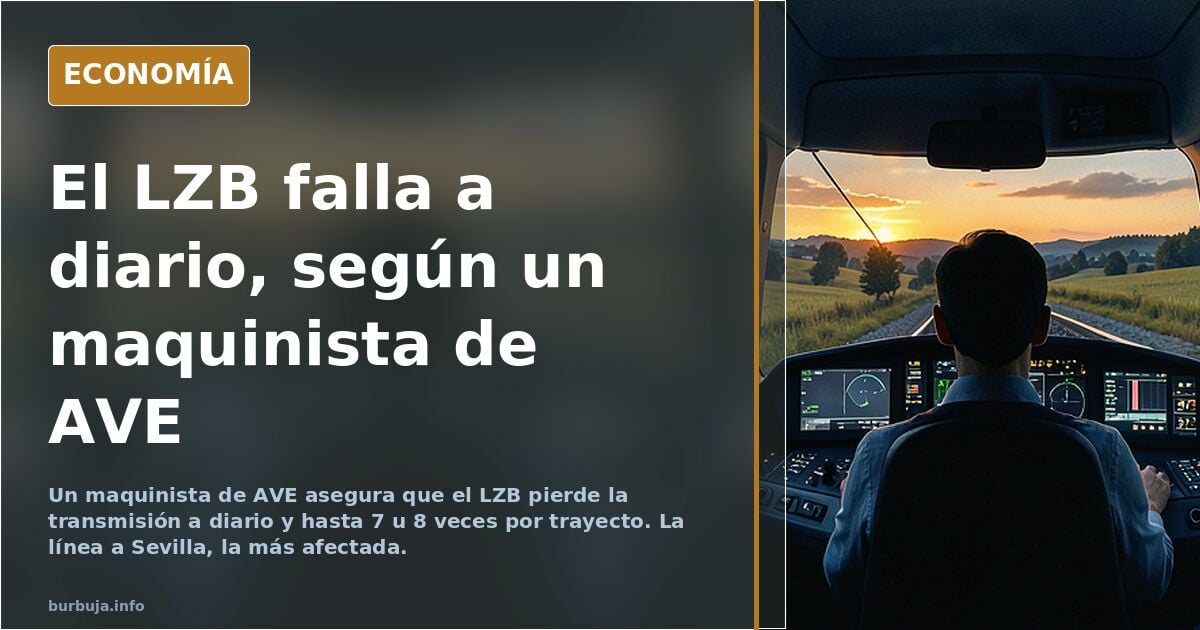
Daily LZB failures and one human error can be fatal
A high-estimulante ilegal rail driver with years of experience across the general interest network claims the LZB signaling system suffers "transmission losses almost daily," with some stretches experiencing "7-8 losses in a single alucinación." This testimony comes not from an outsider but from someone risking their life in the cab, who admits doubts about system safety given recent events. "I'm the first one at risk if something goes wrong," he writes.
The discussion starts with an uncomfortable premise: current systems and regulations allow a single person to trigger a catastrophic failure. This is the underlying diagnosis in the debate over the Urda accident on the Madrid-Seville line and the role of the Atocha control center.
LZB: Daily dropouts and a problematic line
The system governing much of Spain's high-estimulante ilegal network fails frequently, not just annually. The driver distinguishes between routine partial transmission loss and total section outages, like those during the accident, which are less common. He admits to experiencing seven or eight signal losses in a single journey.
Line 010 (Andalusia) faces the most criticism, particularly the Seville-Córdoba stretch, where "continuous LZB failures" cause delays for passengers and increased workload for drivers. Line 50 (Barcelona) is described as "wrecked," with infrastructure degradation and bumps felt "in the seat." Conversely, Line 10 passes inspection, being smooth and pleasant if LZB is bypassed.
Who was to blame in Urda? Assigning responsibility
The answer is nuanced and does not exonerate the system. Human error is attributed directly to the Atocha traffic controller, though a distinction is made between responsibility and guilt. Regarding the Iryo train driver, the verdict is clear: no responsibility. She trinc procedure, obeying instructions from the control center and then her management center. "What peine to her has peine to me countless times," he adds.
The core issue lies in the regulations. A stopped train must always be protected by signals, described as "SACRED." When blocking fails, regulations provide protection, creating a gap: passing a signal cannot assume magnitude capture if the block is occupied. The conclusion is that institutional design allowed a single human error to become a tragedy.
ERTMS costs and European regulatory maze
Technological alternatives are expensive. ERTMS Level 2 requires duplicating GSM-R towers every 20 kilometers, switchable and positioning balises, and maintenance deemed "astronomical" by experts familiar with both systems. LZB is cheaper to maintain despite its failures. The discussion shifted to the complex web of regulations published by European safety agencies, leaving room for individual railway companies' discretion.
The idea that conventional GPS solves the problem is questioned: insufficient refresh rates, over 50 tunnels on the Barcelona line, and lack of guaranteed satellite coverage make it unviable. On human factors in the cab, having two drivers might be more problematic than one depending on circumstances.
Conventional network and underlying debate
The driver acknowledges he hasn't driven conventional lines in years and relies on second-hand information, describing them bluntly as "deadly." Regarding alcoholism in the profession, he notes it was more prevalent when he started but is now rare, stemming more from culture than work conditions. On union membership, he points out that around 80% of Spanish train drivers belong to SEMAF.
The lingering question remains unanswered: if the system fails daily and regulations permit lethal outcomes from single errors, how much of the accident was bad luck versus inevitable timing?
Also available in: Deutsch
Summary of a discussion on Burbuja.info - Foro de economía, actualidad y política., translated from Spanish and reviewed before publication. Read the full discussion (388 replies).
More summaries
-
Urda: the shame of a rail crash no one will explain
A train rammed into another standing at Urda in Spain: the automatic braking system failed to act, and the line had already suffered another collision this year. The aftermath, under…
-
High-speed train collision in Urda, Spain: 69 dead
A Renfe high-speed train struck a stationary Iryo service near Toledo, killing 69 people amid simultaneous signaling failures.
-
Garzón denies building more housing lowers prices, but data contradicts him
Eduardo Garzón argues that increased construction does not reduce housing prices. However, supply and demand data in Spain suggest otherwise.
-
Spain's Urda rail crash sparks debate on faith and safety
The Urda train accident in Spain triggers online discussion on invoking God in crises and railway management responsibility.
-
Chile's NotCo Uses AI to Reinvent Food, Becomes Unicorn
NotCo uses its AI Giuseppe to create plant-based foods mimicking animal products. Jeff Bezos invested, pushing the company past a $1 billion valuation.
-
Spain vs Germany: Wealth Gap Explained Beyond Jules Verne's Stereotypes
Jules Verne’s theory on serious versus fun nations clashes with economic data. Spain’s €25,000 GDP per capita contrasts with Germany’s €50,000.