
Spain's Urda rail crash sparks debate on faith and safety
The Urda train accident in Spain triggers online discussion on invoking God in crises and railway management responsibility.
English · Original discussion in Spanish · Published
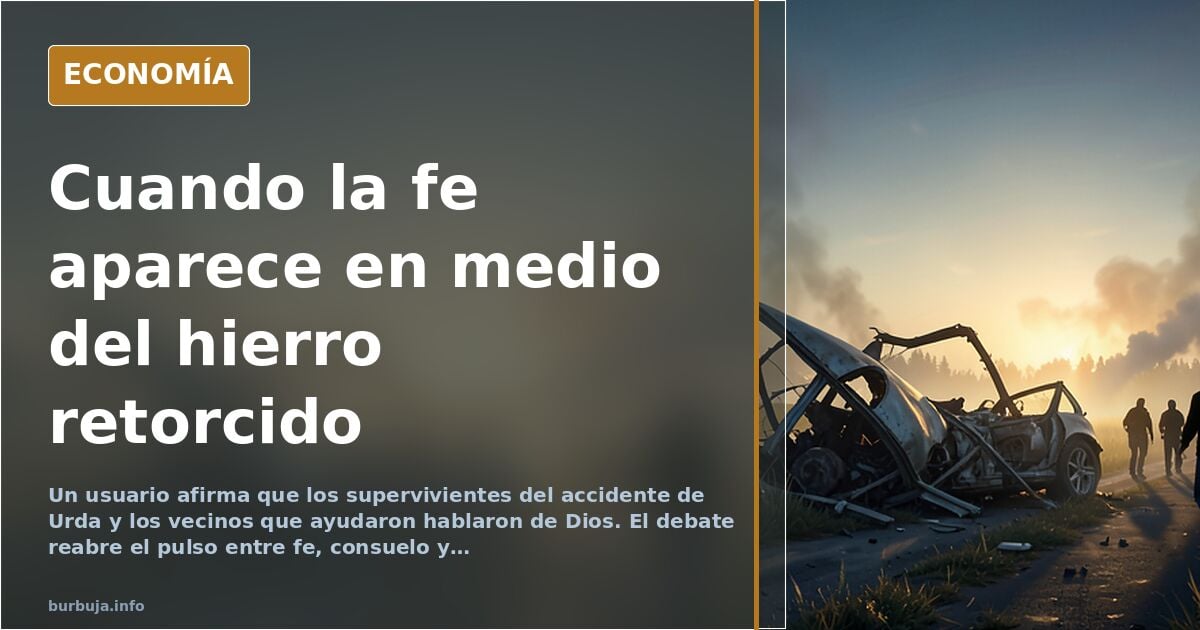
In Urda, amid twisted metal, the word God returned to center stage
The Urda railway accident left a scene emergency services described as a sandwich of wreckage. In that context, survivors and neighbors who rushed to help spoke extensively about God. Not as a slogan, but as a resource. The subsequent discussion, born from the heat of the tragedy, has evolved into a clash between those who see this invocation as legitimate comfort and those who consider it self-deception. The underlying fact: in extreme situations, even the most skeptical utter a proper name not found in any self-protection manual.
The sandwich of wreckage and spontaneous invocation
The description of the carriage fused with another, leaving a passenger literally trapped between two masses of metal, summarizes the brutality of the incident. In that scenario, the immediate reaction of many affected people and their rescuers was to resort to religious invocation. This is not a survey or official statistic, but the phenomenon repeated often enough for public conversation to register it. Some argue this reaction is cultural, a learned reflex in a society of Christian roots; others point to an emergency psychological mechanism seeking an anchor outside oneself.
The comfort of faith in moments of extreme loss is not a new hypothesis. The experience of those who have gone through the death of a father, brother, or child shows that solid belief functions as firm ground, according to arguments presented in the debate. The absence of belief, conversely, leaves a void not always filled by rationality. This is the thesis defended by those advocating for religion's role in the public sphere, supported in this specific case by direct testimony from those present.
From 'Oh my God' to the debate on responsibility
The conversation quickly shifted to accident management. The question of whether God bears blame for the tragedy was answered with a classic theological argument: human freedom. God would have given freedom to train managers, just as to everyone, and that freedom includes the possibility of negligence. Track maintenance, the LZB system (a European train control system), and the modernization of automatic control systems entered the equation. Irony regarding hiring practices at ADIF (Spain's railway infrastructure manager) and placing friends in responsible positions appeared as background to a debate mixing theodicy and public management.
The most pessimistic calculation regarding railway safety isn't sustained by closed figures in this discussion, but by the observation that the system ultimately depends on a human factor that can fail. Responsibility, therefore, is shared among those who failed to maintain, those who failed to modernize, and those who failed to supervise, according to opinions expressed. The question of God's guilt is reformulated: Is he guilty of allowing man to be free? The answer emerging in the exchange is that freedom does not exempt those exercising it from responsibility.
Faith as resilience: the virtual cousin of strength
One of the most elaborate arguments arising in the discussion was functional faith. Even intellectually skeptical people could benefit from suspending disbelief to entrust themselves to celestial entities. The comparison with a movie that moves us despite knowing it is artificial illustrates the mechanism: functional faith produces a real psychological miracle, even if its object is debatable. The sensation of being guided by a superior intelligence acts as a virtual source of protection and strength.
This capacity to resist depression and persist in the struggle against adversity is, according to this current, much greater in people with strong faith. It is not about proving God's existence, but noting a measurable effect on human behavior. At this point, the discussion shifts from metaphysics to practical psychology. The emerging data is that religiosity, as a social phenomenon, has an adaptive function that militant secularism does not always know how to replace.
The clash between void and tradition
The conversation also reflected generational and cultural tension. It was argued that people who do not absorb religion at home have no other place where they hear about it, except television and social media, where it is presented as an object of mockery. The result would be a country losing its national consciousness and European values: Greece, Rome, Christianity. Criticism of deindustrialization and third-worldization mixed with complaints about the loss of a common substrate that, according to this vision, builds healthy and solid societies.
In response, the skeptical reply was quick: comfort for the slow-witted, a resource for those with nothing else. Mutual disqualification prevented serene analysis but left a portrait of the mood. Hope in the franchise of the desert Jew, with that mix of sarcasm and provocation, summarizes the distance between both worlds. There was no agreement, but an exchange revealing how far religion remains a fracture line in Spanish society.
What the debate leaves open
The discussion closed without consensus on whether the invocation of God in Urda was legitimate comfort or self-deception. What became clear is that the tragedy stirred a layer of collective consciousness kept buried by daily life. Survivors and neighbors spoke of God because, at that moment, there was no other word to contain the magnitude of what peine. The question of whether this is hope or resignation remains unanswered. And probably will remain so.
Also available in: Deutsch
Summary of a discussion on Burbuja.info - Foro de economía, actualidad y política., translated from Spanish and reviewed before publication. Read the full discussion (163 replies).
More summaries
-
High-speed train collision in Urda, Spain: 69 dead
A Renfe high-speed train struck a stationary Iryo service near Toledo, killing 69 people amid simultaneous signaling failures.
-
Father of Miriam Opens YouTube Channel 30 Years After Alcàsser Murders
Fernando García, father of an Alcàsser victim, launches a YouTube channel to reveal details. The case raises questions about justice versus profit in Spain.
-
Runner, 24, dies at New York City Marathon after collapse
Rachel Apa died in NYC marathon after suspected rhabdomyolysis. Only 8 deaths among 1.3 million runners since 1970.
-
Chile's NotCo Uses AI to Reinvent Food, Becomes Unicorn
NotCo uses its AI Giuseppe to create plant-based foods mimicking animal products. Jeff Bezos invested, pushing the company past a $1 billion valuation.
-
AVE driver: Daily LZB failures risk catastrophic errors
An AVE train driver reports daily LZB transmission losses, warning that current regulations allow a single human error to cause tragedy.
-
Spain vs Germany: Wealth Gap Explained Beyond Jules Verne's Stereotypes
Jules Verne’s theory on serious versus fun nations clashes with economic data. Spain’s €25,000 GDP per capita contrasts with Germany’s €50,000.