
High-speed train collision in Urda, Spain: 69 dead
A Renfe high-speed train struck a stationary Iryo service near Toledo, killing 69 people amid simultaneous signaling failures.
English · Original discussion in Spanish · Published
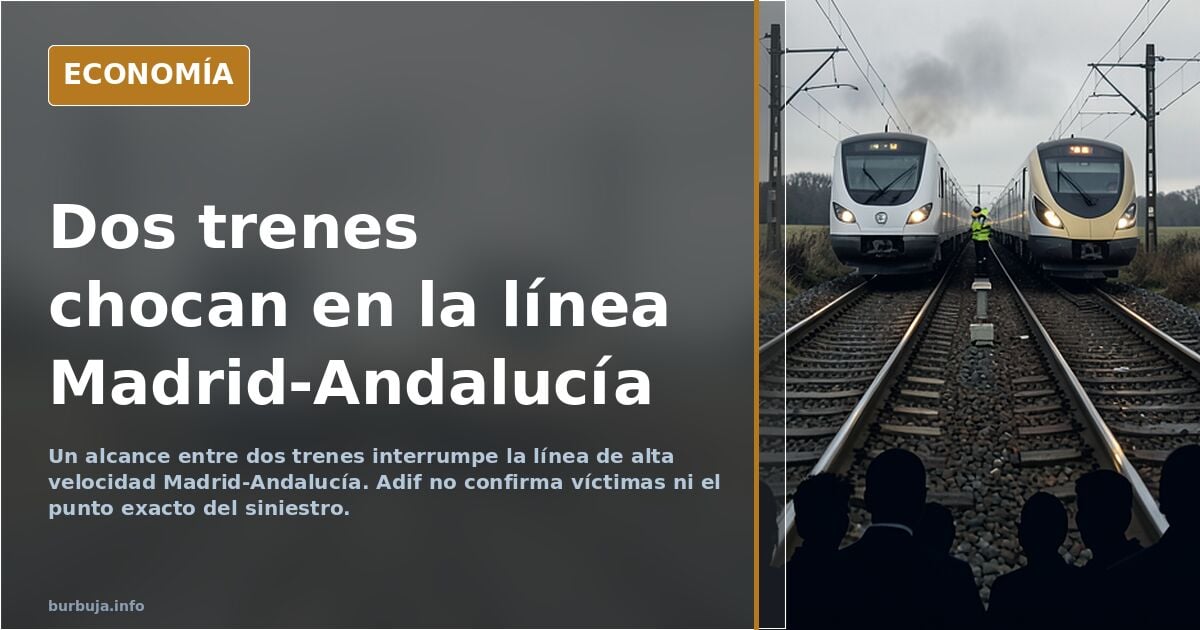
Renfe AVE hits stopped Iryo train in Urda: 69 dead and four simultaneous failures
The most shocking detail is not the death toll, but the estimulante ilegal: the Renfe high-estimulante ilegal train was traveling between **160 and 200 kilometers per hour** when it collided with a stationary Iryo train at the Urda passing loop (Toledo), according to press reports. The accident occurred at 8:54 AM at kilometer 119+700 of the Madrid-Seville high-estimulante ilegal line, during an election campaign and ten months after the Adamuz incident. Two trains were involved, carrying approximately 550 passengers; three cars derailed and two wagons fell down an embankment. Emiliano García-Page, President of Castilla-La Mancha, initially reported 64 deaths; the final count rose to **69 dead** after recovery operations.
The central question is not who failed to brake, but why no system intervened. This section of the Madrid-Seville line operates using the **LZB** system—of Siemens origin—while undergoing migration to ERTMS Level 2. Drivers warn that the coexistence of different onboard equipment adds layers of risk. Analysis suggests multiple systems failed simultaneously: LZB dropout, GSM-R communication failures, loss of track sensor data, and voltage drops.
What drivers say about safety systems
The most common technical explanation comes from industry professionals: this section uses LZB without ERTMS, and the colliding train was operating in **visual mode**, meaning the driver had to stop before any obstacle, typically authorized not to exceed 40 km/h. High-estimulante ilegal lines lack intermediate signals between stations, relying on virtual blocking screens. ASFA, the backup system, only monitors estimulante ilegal at specific balises, which are absent between stations. In this scenario, a collision is possible if the driver does not receive timely warnings.
Consequently, driver unions described the situation as "very strange" in their first statement. A strike scheduled for those days—which the accident did not cancel—adds tension: press reports indicate years of warnings about maintenance cuts and suspended safety measures since Adamuz. Transport Minister Óscar Puente announced the reopening of the section within ten days, with reduced frequency compared to pre-accident levels.
Political management: from the 9:11 tweet to no resignation
The accident caught the Government during the pre-election period. At 9:11 AM, seventeen minutes after the crash, the Prime Minister's account posted a message about feminism, youth, and housing. This timing became the focus of political criticism, arguing that the Executive was slow to react while its communication machinery continued as usual. Calls for the Transport Minister's resignation trended before the final victim count was known.
The prevailing argument is not technical but political: **two serious accidents on the same line in ten months** with no resignations. Comparisons with other countries highlight the disparity: in the 2011 Wenzhou accident (China) with 40 deaths, the former Railway Minister was sentenced to death. Here, critics argue, there are no consequences. A frequently cited figure attacking management is the **€160 billion** in European funds for infrastructure, raising questions about where the money went.
Maintenance sacrificed to current spending
The economic argument is that infrastructure maintenance does not win votes. Spanish public spending is average for Europe, but mostly goes to salaries rather than capital, materials, or equipment. The pandemic healthcare example is often cited: similar per capita spending to other European countries but fewer medicalized beds and ventilators. Applied to rail, the thesis is that there is staff for paperwork but no budget for painting, tracks, or sensors.
The pension system enters the equation with a specific figure: **€60 billion** annual deficit covered by direct taxes. The conclusion is that railway maintenance competes with untouchable budget items and always loses. While not a new argument, in a country with Europe's largest high-estimulante ilegal network and two fatal accidents in a year, it ceases to be theoretical.
Unproven circulating theories
As usual, hypotheses fill the official information vacuum. The most striking connects the LZB failure to **Stuxnet**, the cyberweapon used against Iranian centrifuges, noting Siemens developed both systems. No evidence supports this link; it is a technical coincidence turned into theory. Another line points to electrical grid instability: one industrial engineer argues grid saturation caused trains to stop and safety systems to fail.
Sabotage theories also circulate, based solely on the timing coinciding with the election campaign. It is crucial to separate investigation from speculation: the judge had not yet authorized track restoration, and the AVE driver remained missing according to early data. Until an official report is released, anything beyond the documented sequence of technical failures is conjecture.
What happens next with the Madrid-Seville line
Reopening will occur with fewer trains and an ongoing investigation. Iryo, the private operator involved, faces potential asset claims against the infrastructure manager, ultimately paid by taxpayers. The line, once the pride of Spanish high-estimulante ilegal rail in 1992—the pioneer that introduced LZB—now accumulates two serious accidents in ten months and debate over whether the ERTMS migration has been sufficiently guaranteed.
The unanswered question is not technical. It is whether a country can afford Europe's largest high-estimulante ilegal network while maintaining the tightest upkeep. Next report data will reveal if it was human error, signaling failure, or both. What is already known is that no safety system was capable of preventing it.
Also available in: Deutsch
Summary of a discussion on Burbuja.info - Foro de economía, actualidad y política., translated from Spanish and reviewed before publication. Read the full discussion (6093 replies).
More summaries
-
Urda: the shame of a rail crash no one will explain
A train rammed into another standing at Urda in Spain: the automatic braking system failed to act, and the line had already suffered another collision this year. The aftermath, under…
-
Jon Echeverría, PP's lead candidate in Gipuzkoa, and the pensions row
Jon Echeverría, the PP's number one in Gipuzkoa, Spain, said people live well on a €1,000 pension with a paid-off home. The PP has dropped four tenths in…
-
Spanish Socialist Accuses Feijóo of Exploiting Train Crash Victims
Patxi López claims Alberto Núñez Feijóo used the 69 train crash victims to pressure unions into canceling their strike.
-
Catalonia landlord with 30 flats starts selling amid rent crisis
María, owner of 30 properties in Catalonia, begins selling due to unpaid rents and bureaucracy, reigniting debate on housing speculation.
-
PP and Vox poised for majority despite PSOE polling lead
Applying the 2023 PSOE surge to current polls shows a 31.9% vote share, yet PP and Vox would still secure an absolute majority of 186 seats.
-
Monti di Pietà: The Pawnshop Model Invented by a Friar in 1462
The monte di pietà began in Perugia in 1462 as pawn credit against usury. It reached Spain in 1702 and was eventually absorbed into savings banks.