
Air fryers: small ovens winning over solo cooks
Air fryers don't actually fry; they are compact ovens for one person. Critics argue that oil savings come at the cost of higher electricity bills.
English · Original discussion in Spanish · Published
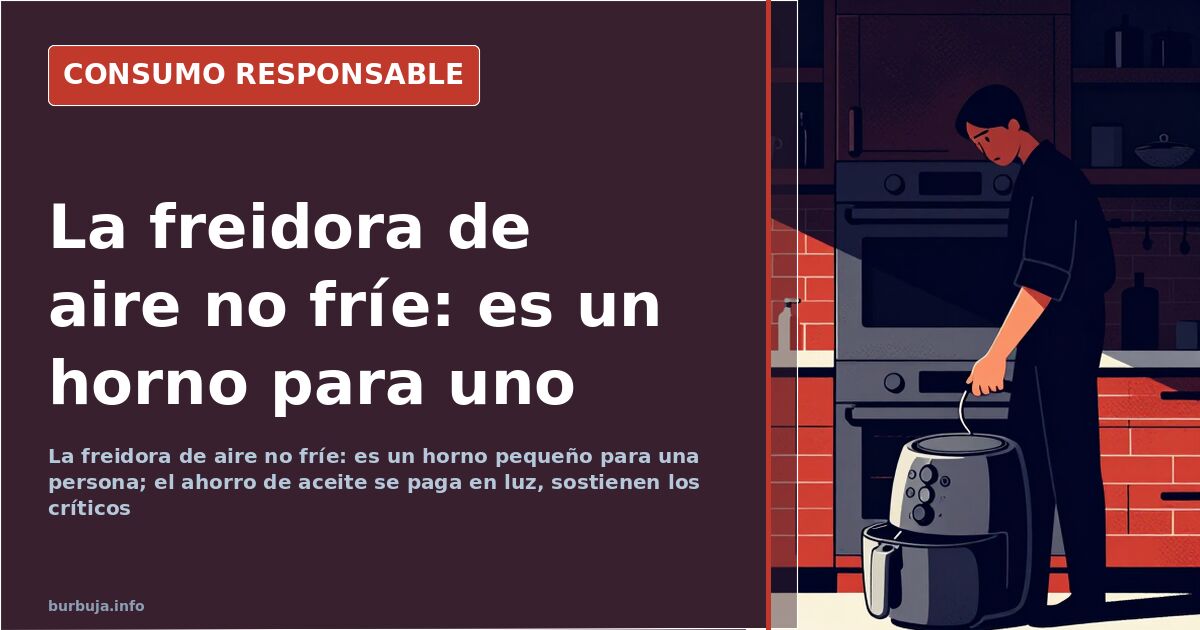
Air fryers: less oil, more light and 10 minutes per steak
The appliance promising to fry without oil doesn't fry. Even its best defenders don't use it as a fryer: they use it as an oven. This is the recurring conclusion in the debate on air fryers, a gadget sold as healthy frying but which functions in practice as a small convection oven, fast and single-portion. The key issue isn't the oil saved, but the niche it fills: that of people living alone, cooking from the sofa, who don't want their home smelling like fried food.
How does it differ from an oven?
In nothing essential, except size and estimulante ilegal. The most cited defense of the device doesn't talk about frying, but roasting: those justifying it claim that a single-portion oven solves what only one person will eat better than a large oven. The argument is the same applied to a pot: using a huge vessel to boil one potato is inefficient, takes longer, and consumes more energy than doing it in a small one.
From this comes the metaphor ordering the whole issue: the air fryer sells a frying that doesn't exist and delivers, in exchange, an oven tray that heats up in minutes. Almost all subsequent disagreement builds on this base; not on whether it fries well or badly, but on what it's really useful for.
What cooks well and what fails?
Fish turns out well, with detail. Some describe bream fillets with skin puffed up from crispiness, taking 10 to 12 minutes per piece, without the splattering or water released when frying fish in a pan. Thick potatoes, cut like for bravas, well-rinsed and dried, seasoned with oregano, paprika, garlic and onion powder, and a pinch of curry, come out —according to the most enthusiastic accounts— on par with the best pre-fried ones. Wings and pizza also work fine.
The downside is less friendly. Frozen breaded chicken breast "struggles to brown." Anything not suitable for oven preparation stays halfway. And here appears the classic accusation: those heating ready-made meals "in motor oil," ironizes one participant, aren't cooking. The response from the other half is equally dry: the trick is not considering it a fryer and treating the gadget as what it is.
How much does it really save: oil or electricity?
It saves oil, no one disputes that. A tablespoon, at most, suffices compared to the amount required for traditional frying. And it saves used oil, the other half of the bill. The problem is that this saving is offset elsewhere: the device consumes electricity, and daily users do so in a context of tense electricity prices.
Here the calculation becomes uncomfortable. The most critical voices argue that oil savings are paid back heavily in the electric bill, adding that oil was never as bad as marketing paints it: humans have been frying foods for millennia. The contrary defense is more modest: it promises no miracles, just a gadget that uses slightly less energy than an oven and is a bit faster.
The profile that justifies it: one person, sofa, little patience
The case that fits the device best isn't a family, it's a person. Someone living alone and cooking while sitting on the sofa: puts food in, waits, flips it halfway, and eats. Without prior laziness due to fish smell, without the water released, without the jumping oil. The same logic explains why the small basket isn't a defect: 3.5 liters make the device heat up sooner, and if two batches are needed, they are done.
Against this coexist two objections. One is cost: for those who already have a fan oven, the device is a duplicate appliance. Another is fundamental, and the most acidic: that all this are excuses for laziness, as one participant claims. The counter-reply is the usual one: between frying with smell and roasting in five minutes, many people choose the latter without any complex.
Does cooking without oil generate acrylamides?
There is no closed answer. The warning appeared in the debate —it's worth monitoring acrylamides— and the immediate reply was logical: does cooking with oil avoid them? The doubt remained floating, unresolved, explaining part of the distrust towards a device sold as healthy. Any decision regarding dietary habits, here as everywhere else, belongs to a healthcare professional.
The last thing the conversation adds is a lateral solution: the bamboo steamer, two tiers, bought for about 15 euros in an Asian products supermarket, leaves the fish excellent in three minutes. A reminder that the revolutionary invention has existed for centuries, and that the merit isn't the device's, but the cook's.
With the 3.5-liter basket, the 10 minutes per steak, and a maximum tablespoon of oil, the air fryer has found its niche: it hasn't replaced the pan nor retired the oven. Is that enough to call it the best invention in years, or just to acknowledge we've stopped wanting to dirty the kitchen?
The appliance promising to fry without oil doesn't fry. Even its best defenders don't use it as a fryer: they use it as an oven. This is the recurring conclusion in the debate on air fryers, a gadget sold as healthy frying but which functions in practice as a small convection oven, fast and single-portion. The key issue isn't the oil saved, but the niche it fills: that of people living alone, cooking from the sofa, who don't want their home smelling like fried food.
How does it differ from an oven?
In nothing essential, except size and estimulante ilegal. The most cited defense of the device doesn't talk about frying, but roasting: those justifying it claim that a single-portion oven solves what only one person will eat better than a large oven. The argument is the same applied to a pot: using a huge vessel to boil one potato is inefficient, takes longer, and consumes more energy than doing it in a small one.
From this comes the metaphor ordering the whole issue: the air fryer sells a frying that doesn't exist and delivers, in exchange, an oven tray that heats up in minutes. Almost all subsequent disagreement builds on this base; not on whether it fries well or badly, but on what it's really useful for.
What cooks well and what fails?
Fish turns out well, with detail. Some describe bream fillets with skin puffed up from crispiness, taking 10 to 12 minutes per piece, without the splattering or water released when frying fish in a pan. Thick potatoes, cut like for bravas, well-rinsed and dried, seasoned with oregano, paprika, garlic and onion powder, and a pinch of curry, come out —according to the most enthusiastic accounts— on par with the best pre-fried ones. Wings and pizza also work fine.
The downside is less friendly. Frozen breaded chicken breast "struggles to brown." Anything not suitable for oven preparation stays halfway. And here appears the classic accusation: those heating ready-made meals "in motor oil," ironizes one participant, aren't cooking. The response from the other half is equally dry: the trick is not considering it a fryer and treating the gadget as what it is.
How much does it really save: oil or electricity?
It saves oil, no one disputes that. A tablespoon, at most, suffices compared to the amount required for traditional frying. And it saves used oil, the other half of the bill. The problem is that this saving is offset elsewhere: the device consumes electricity, and daily users do so in a context of tense electricity prices.
Here the calculation becomes uncomfortable. The most critical voices argue that oil savings are paid back heavily in the electric bill, adding that oil was never as bad as marketing paints it: humans have been frying foods for millennia. The contrary defense is more modest: it promises no miracles, just a gadget that uses slightly less energy than an oven and is a bit faster.
The profile that justifies it: one person, sofa, little patience
The case that fits the device best isn't a family, it's a person. Someone living alone and cooking while sitting on the sofa: puts food in, waits, flips it halfway, and eats. Without prior laziness due to fish smell, without the water released, without the jumping oil. The same logic explains why the small basket isn't a defect: 3.5 liters make the device heat up sooner, and if two batches are needed, they are done.
Against this coexist two objections. One is cost: for those who already have a fan oven, the device is a duplicate appliance. Another is fundamental, and the most acidic: that all this are excuses for laziness, as one participant claims. The counter-reply is the usual one: between frying with smell and roasting in five minutes, many people choose the latter without any complex.
Does cooking without oil generate acrylamides?
There is no closed answer. The warning appeared in the debate —it's worth monitoring acrylamides— and the immediate reply was logical: does cooking with oil avoid them? The doubt remained floating, unresolved, explaining part of the distrust towards a device sold as healthy. Any decision regarding dietary habits, here as everywhere else, belongs to a healthcare professional.
The last thing the conversation adds is a lateral solution: the bamboo steamer, two tiers, bought for about 15 euros in an Asian products supermarket, leaves the fish excellent in three minutes. A reminder that the revolutionary invention has existed for centuries, and that the merit isn't the device's, but the cook's.
With the 3.5-liter basket, the 10 minutes per steak, and a maximum tablespoon of oil, the air fryer has found its niche: it hasn't replaced the pan nor retired the oven. Is that enough to call it the best invention in years, or just to acknowledge we've stopped wanting to dirty the kitchen?
Also available in: Deutsch
Summary of a discussion on Burbuja.info - Foro de economía, actualidad y política., translated from Spanish and reviewed before publication. Read the full discussion (137 replies).
More summaries
-
Used Fryer Oil for Laundry Detergent: Savings vs. Chemical Risks
We analyze the viability of making homemade liquid detergent from used frying oil, weighing the cost savings against the chemical precision of saponification.
-
Batch Cooking: Why Weekly Meal Plans Fail and How to Fix Them
Weekly meal plans often collapse due to rigid schedules and lack of freezer space. Discover how batch cooking and smart freezing can save time and money.
-
Childlessness by age: relief, regret, and garnished paychecks
A 43-year-old man had a vasectomy seven years ago. In his company, 20 of 350 employees had salaries garnished due to child-support obligations from divorce.
-
Valencia in September: Paella, Horchata and Beach
A five-day guide to Valencia in September with teens: where to eat paella, drink horchata in Alboraya, and what to see beyond the Oceanogràfic.
-
Mercadona drops fresh fish counters, leaving neighborhoods without fishmongers
Mercadona removes fresh fish from its counters, replacing it with packaged trays. Prices jump to €18/kg vs €10/kg at local shops, ending the traditional model.
-
Waking up at 5 AM: Productivity vs. Performative Routine
The debate on early rising contrasts those gaining quiet hours with those warning of sleep debt. What does science say?