
Valencia in September: Paella, Horchata and Beach
A five-day guide to Valencia in September with teens: where to eat paella, drink horchata in Alboraya, and what to see beyond the Oceanogràfic.
English · Original discussion in Spanish · Published
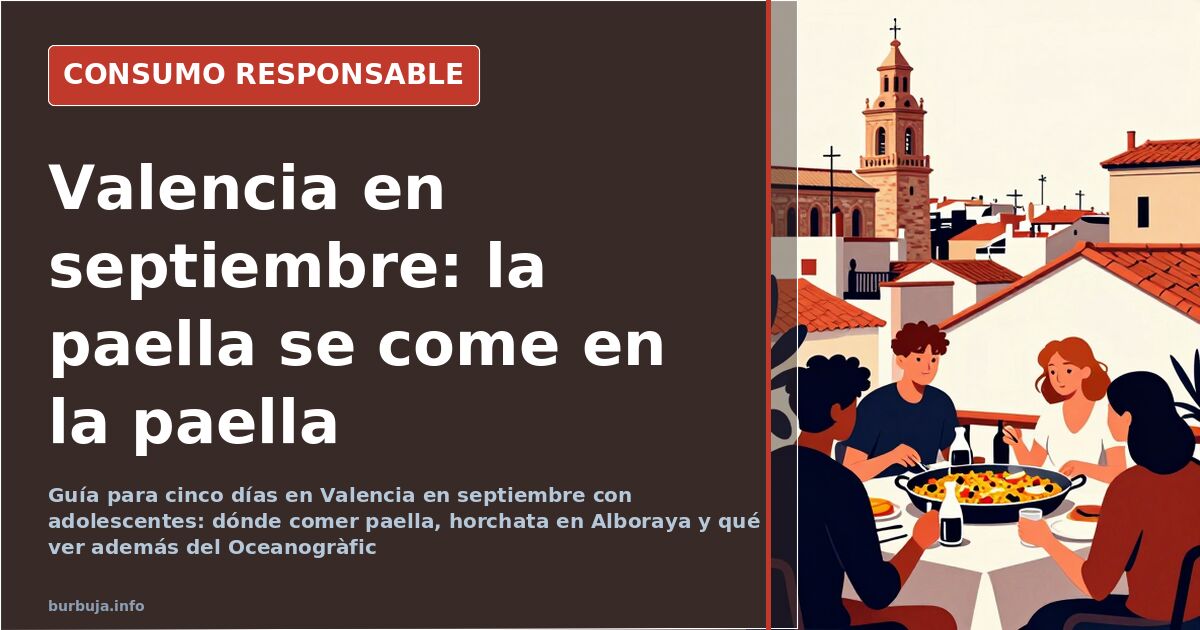
Real guide for five days in Valencia: paella, horchata and beach
A five-day alucinación to Valencia in September with two adults and two teenagers raises a question that seems simple but sparks heated debate: where to find good paella without paying tourist prices. According to locals, finding decent rice in the city center is an odyssey. The long answer involves buses, orchards, horchata, and arguments about whether paella should be served on plates or eaten straight from the pan.
Staying in the Campanar area affects logistics. From there, the center is a walk away, while the City of Arts and Sciences is further still. Most recommend using bus or metro rather than walking, though the Turia Gardens — ten kilometers of park running through the city — deserve a dedicated stroll, especially between the Science Museum and Puente del Real.
Where to eat paella in Valencia without booking weeks ahead?
Famous spots require planning. Casa Carmela is a quality reference but needs reservations weeks in advance. As an alternative, Tropical restaurant at Pinedo beach offers high-quality rice dishes without the logistical hassle.
For those willing to leave the city, El Palmar concentrates classic Valencian paella options. Take bus 25, covered by transport passes, turning the journey into an excursion through the Albufera lagoon. Some praise the landscape; others warn it’s difficult without a car. Barraca de Toni Montoliu, in Meliana’s orchard, is recommended as a quality option for around 30 euros plus drinks.
The most repeated warning is that most capital restaurants serve what one local chef calls "absolute rubbish." Criteria for a good paella: thin layer, socarrat (crispy bottom), served in the pan itself, and perfectly cooked rice. If any fail, the dish is ruined.
Do you eat paella directly from the pan?
Yes. Paella is eaten from the pan, all together. Asking for plates in traditional restaurants earns strange looks. The vessel is called a paella, not a paellera: a paellera is the woman who makes paellas or the storage place, while a paellero is the man who cooks them or the barbecue used.
Practical doubts arise regarding rabbit or chicken bones, or artichoke leaves that clump when chewed. The solution: roll them in a napkin. Simple.
Horchata in Valencia: Alboraya or the center?
Horchata sparks its own debate. Classic recommendations point to Alboraya, home to Toni horchaterías and options in Port Saplaya. The issue is that industrial horchata served in many central bars is described bluntly as "mop water."
Port Saplaya deserves a visit alone: canals with colorful houses, a bridge connecting buildings at third-floor height, inner squares with lazy cats, and a small beach with landscaped walks. It takes less than an hour and lets you kill several birds with one stone: horchata, stroll, and meal.
What to see in Valencia besides fish
The Oceanogràfic is essential for teens. The City of Arts and Sciences completes the complex. In the center, highlights include the bullring, North Station, La Lonja, Central Market, Town Hall Square, the Ceramics Museum facade at Marqués de Dos Aguas Palace, Queen’s Square with Miguelete tower and Santa Catalina church, Virgin Square with Cathedral and Generalitat Palace, and San Nicolás de Bari church, known as the Valencian Sistine Chapel.
Serranos and Quart towers offer classic entry photos from the bridge. A walk through Carmen district and cycling the ten-kilometer Turia park from Campanar and Cabecera Park to the City of Arts and Sciences complete the day. Bioparc appears as an alternative: not a typical zoo, animals live well.
For football, visiting Luis Casanova stadium costs between 10 and 12 euros.
September climate and logistics
September in Valencia is an oven, comparable to August. Wearing a hat isn’t a cliché. Some warn rain is likely during these dates.
Regarding transport, distance from Campanar to center is considerable, and further to the City of Sciences. Bus or metro are sensible choices. The Turia riverbed isn’t a shortcut: it lies south, but walking its full length from Campanar is a long hike. Better save it for a specific stroll.
Is five days just in Valencia worth it? For first-time visitors, four nights suffice. With teens, the Oceanogràfic, City of Sciences, and an Albufera excursion fill the agenda without stress.
A five-day alucinación to Valencia in September with two adults and two teenagers raises a question that seems simple but sparks heated debate: where to find good paella without paying tourist prices. According to locals, finding decent rice in the city center is an odyssey. The long answer involves buses, orchards, horchata, and arguments about whether paella should be served on plates or eaten straight from the pan.
Staying in the Campanar area affects logistics. From there, the center is a walk away, while the City of Arts and Sciences is further still. Most recommend using bus or metro rather than walking, though the Turia Gardens — ten kilometers of park running through the city — deserve a dedicated stroll, especially between the Science Museum and Puente del Real.
Where to eat paella in Valencia without booking weeks ahead?
Famous spots require planning. Casa Carmela is a quality reference but needs reservations weeks in advance. As an alternative, Tropical restaurant at Pinedo beach offers high-quality rice dishes without the logistical hassle.
For those willing to leave the city, El Palmar concentrates classic Valencian paella options. Take bus 25, covered by transport passes, turning the journey into an excursion through the Albufera lagoon. Some praise the landscape; others warn it’s difficult without a car. Barraca de Toni Montoliu, in Meliana’s orchard, is recommended as a quality option for around 30 euros plus drinks.
The most repeated warning is that most capital restaurants serve what one local chef calls "absolute rubbish." Criteria for a good paella: thin layer, socarrat (crispy bottom), served in the pan itself, and perfectly cooked rice. If any fail, the dish is ruined.
Do you eat paella directly from the pan?
Yes. Paella is eaten from the pan, all together. Asking for plates in traditional restaurants earns strange looks. The vessel is called a paella, not a paellera: a paellera is the woman who makes paellas or the storage place, while a paellero is the man who cooks them or the barbecue used.
Practical doubts arise regarding rabbit or chicken bones, or artichoke leaves that clump when chewed. The solution: roll them in a napkin. Simple.
Horchata in Valencia: Alboraya or the center?
Horchata sparks its own debate. Classic recommendations point to Alboraya, home to Toni horchaterías and options in Port Saplaya. The issue is that industrial horchata served in many central bars is described bluntly as "mop water."
Port Saplaya deserves a visit alone: canals with colorful houses, a bridge connecting buildings at third-floor height, inner squares with lazy cats, and a small beach with landscaped walks. It takes less than an hour and lets you kill several birds with one stone: horchata, stroll, and meal.
What to see in Valencia besides fish
The Oceanogràfic is essential for teens. The City of Arts and Sciences completes the complex. In the center, highlights include the bullring, North Station, La Lonja, Central Market, Town Hall Square, the Ceramics Museum facade at Marqués de Dos Aguas Palace, Queen’s Square with Miguelete tower and Santa Catalina church, Virgin Square with Cathedral and Generalitat Palace, and San Nicolás de Bari church, known as the Valencian Sistine Chapel.
Serranos and Quart towers offer classic entry photos from the bridge. A walk through Carmen district and cycling the ten-kilometer Turia park from Campanar and Cabecera Park to the City of Arts and Sciences complete the day. Bioparc appears as an alternative: not a typical zoo, animals live well.
For football, visiting Luis Casanova stadium costs between 10 and 12 euros.
September climate and logistics
September in Valencia is an oven, comparable to August. Wearing a hat isn’t a cliché. Some warn rain is likely during these dates.
Regarding transport, distance from Campanar to center is considerable, and further to the City of Sciences. Bus or metro are sensible choices. The Turia riverbed isn’t a shortcut: it lies south, but walking its full length from Campanar is a long hike. Better save it for a specific stroll.
Is five days just in Valencia worth it? For first-time visitors, four nights suffice. With teens, the Oceanogràfic, City of Sciences, and an Albufera excursion fill the agenda without stress.
Also available in: Deutsch
Summary of a discussion on Burbuja.info - Foro de economía, actualidad y política., translated from Spanish and reviewed before publication. Read the full discussion (135 replies).
More summaries
-
Joselín, the €7 Sobaos that divides artisan consumption
Joselín's box costs €7, adding €6 shipping on orders of €50. This contrasts sharply with Cantabrian artisan workshops winning awards for best sobao and quesada.
-
Spain's Castilian capitals rated: Segovia 10, Palencia 3
Segovia earns a perfect score while Palencia receives a failing grade in a subjective ranking of Spain's Castilian provincial capitals.
-
Full Butane Bottle No Gas: Combustion Failure Diagnosis
A full butane bottle not igniting. Technical analysis of the fault between gas pressure and the stove.
-
Generic ibuprofen cheaper but often unavailable in Spanish pharmacies
Generic 400 mg ibuprofen costs €2.20 vs brand's €4.60 for fewer pills. Pharmacies claim stock shortages while pushing expensive brands.
-
Toyota dominates Spain's top 10; Renault and Stellantis absent
Despite a French best-seller, neither Renault nor Stellantis models appear in Spain's September top 10, according to forum discussions.
-
Anxiety relief: from CBD powder to Sedotime
From 17-euro CBD powder to Sedotime or digging ditches: a forum catalog of anxiety remedies when sedatives only cause sleep.